
Global financial markets are experiencing heightened volatility amid escalating geopolitical tensions between allies, particularly between the United States and the European Union, over the issue of “Greenland.” U.S. President Donald Trump has insisted on annexing the island to the United States on the grounds of “national security,” a move that has been firmly rejected by the European Union. In this context, Trump announced the imposition of 10% tariffs on imports from eight European countries—including Sweden, Denmark, Norway, Finland, Germany, France, the United Kingdom, and the Netherlands—effective from February 1, with plans to raise them to 25% in June. In addition, a 200% tariff was imposed on French alcohol imports, further intensifying trade tensions between the two sides.
At the same time, Japanese Prime Minister Sanae Takaishi called for early parliamentary elections, which could take place in the first week of February, based on opinion polls suggesting she could secure a parliamentary majority. This move is widely seen as paving the way for reinforcing an expansionary fiscal policy through tax cuts across several sectors—particularly consumption—and increased government spending to support the Japanese economy. Such policies could widen the fiscal deficit and further increase public debt, which has already exceeded 230% of GDP.
These developments collectively weighed on global financial assets. Major global equity indices declined, particularly in the United States, Europe, China, and Japan. The VIX volatility and fear index rose to 20.99 points yesterday, marking its highest level since November 25, 2025, reflecting heightened market anxiety and increased investor outflows from U.S. equities. Global bond markets also came under selling pressure, especially U.S., European, and Japanese bonds, as yields rose sharply across various maturities amid expectations of significant fiscal stimulus from the Japanese government.
Cryptocurrencies, led by Bitcoin and Ethereum, also retreated, alongside a decline in the U.S. Dollar Index, which measures the dollar’s performance against a basket of six major currencies.
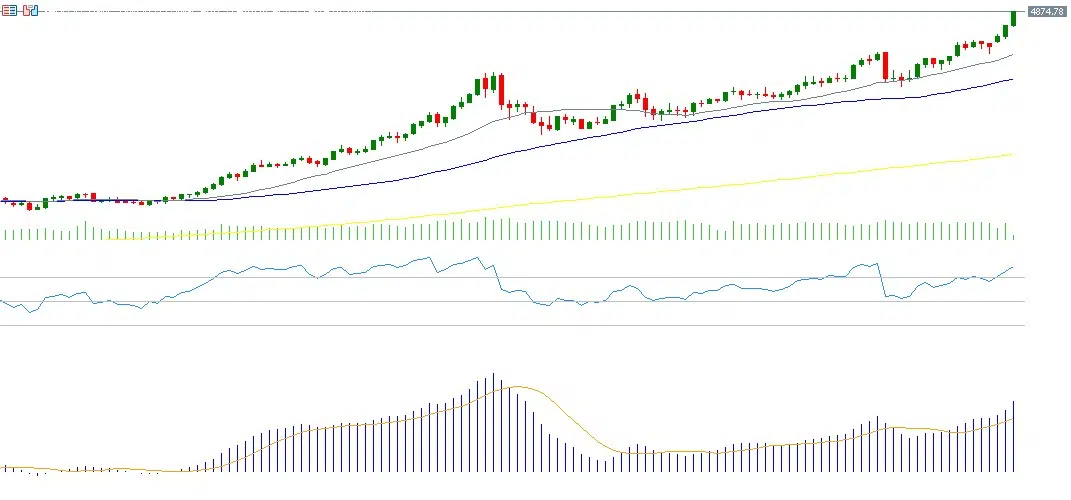
In contrast, precious metals emerged as the biggest winners during this period, led by gold and silver, which continued to post new record highs. Gold prices reached $4,751, while silver climbed to $95.89, marking gains of approximately 13% and 32%, respectively, from the beginning of the year, outperforming most other financial assets. Outlooks suggest that the upward trend in both metals is likely to continue in the coming period, supported by several technical indicators. These include the alignment and upward slope of the 20-, 50-, and 200-day moving averages, with the 20-day average above the 50-day, and the 50-day above the 200-day. The Relative Strength Index (RSI) has entered overbought territory above 70, indicating strong positive momentum. In addition, the MACD indicator shows the MACD line (blue) above the signal line (orange), reinforcing the positive outlook for the continuation of the bullish trend in gold and silver.
Please note that this analysis is provided for informational purposes only and should not be considered as investment advice. All trading involves risk.