All major US equity indices closed higher yesterday, including the S&P 500, Nasdaq 100, Dow Jones, and Russell 2000. Meanwhile, the VIX volatility index declined for the second consecutive session by nearly 25%, falling from around 21 points on Tuesday to approximately 15.63 points yesterday, signaling improved investor sentiment and increased risk appetite toward US equities.
The standout performer was the Russell 2000 index, which tracks small- and mid-cap stocks, outperforming other indices and reaching record levels. The Russell 2000 has also outperformed all major indices since the beginning of the year, rising by nearly 10%, indicating ongoing portfolio rotation by investors in an environment of US interest rate cuts.
As is well known, small- and mid-cap companies tend to benefit the most from lower interest rates due to their relatively limited liquidity and greater reliance on borrowing. As borrowing costs decline, their access to financing improves, positively impacting their financial performance and results.
Outlook points to continued positive momentum in US equities in the coming period, despite elevated valuations, supported by several key factors, including:
• Easing tensions between the United States and the European Union over the Greenland issue.
• Strong US economic performance, with third-quarter GDP growth reaching 4.4%, exceeding expectations of 4.3% and the previous reading of 3.8%, driven by higher consumer spending, export growth, and accelerating government expenditure. Core personal consumption expenditure rose by 2.9% in the third quarter, in line with expectations but higher than the previous 2.6%. Initial jobless claims came in at 200,000, below expectations of 209,000.
• Solid earnings results from most US companies that have reported so far for the final quarter of last year, particularly in the banking sector, with markets awaiting earnings releases from the so-called “Magnificent Seven” starting next week.
• Continued positive momentum in large-cap technology stocks linked to artificial intelligence, with the Magnificent Seven index rising by 2% yesterday. The Philadelphia Semiconductor Index also gained nearly 1%, reaching a new record high and posting gains of around 14% year to date, reflecting strong demand for AI-related products and substantial investment flows into sector infrastructure.
• The banking sector has also posted solid performance, with the KBW Bank Index up about 2% year to date.
• The industrial sector has risen by around 7% since the beginning of the year, as reflected by gains in the XLI industrial ETF.
• The healthcare sector has increased by approximately 2% year to date, supported by gains in the XLV healthcare ETF.
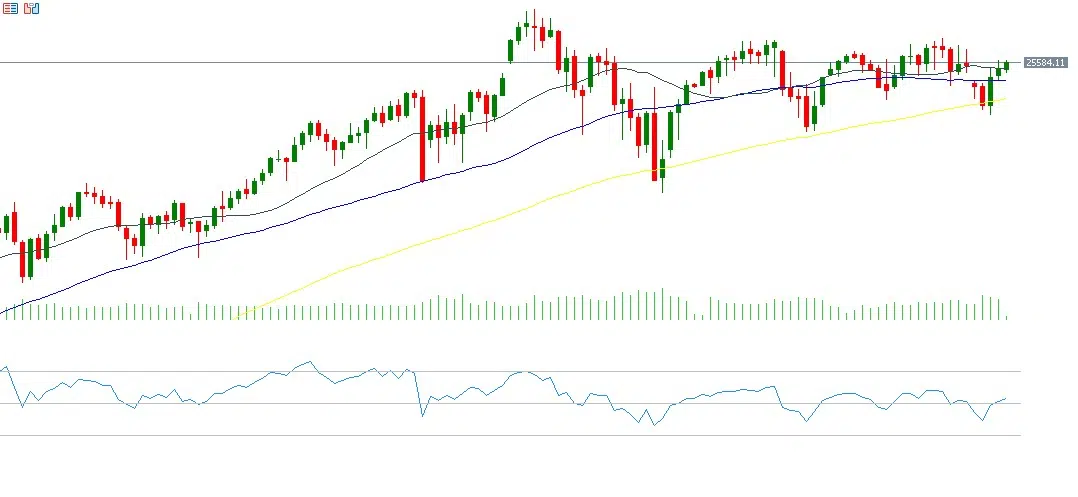
From a technical perspective, indicators continue to point to an ongoing uptrend in the Nasdaq 100. The positive alignment of the 20-, 50-, and 200-day moving averages remains intact, with the 20-day average above the 50-day, which in turn is above the 200-day average, reflecting a constructive technical setup. The next key challenge lies in whether the Nasdaq 100 can retest its record high of 26,182 points set on October 29, 2025. The Relative Strength Index has also moved above the 50 level, currently around 52, confirming the continuation of positive momentum.
Please note that this analysis is provided for informational purposes only and should not be considered as investment advice. All trading involves risk.