Precious metals are currently experiencing heightened volatility, with gold outperforming its peers, rising by around 17% since the beginning of the year to date, compared with silver (15%), platinum (5%), and palladium (8%).
Despite this strong volatility, underlying fundamentals remain solid and supportive, particularly for gold. Recently, growing caution from China toward US debt holdings has been evident, as China’s holdings of US Treasuries fell to their lowest level since 2008. This has weighed on the US dollar, with the Dollar Index currently at 96.57 points, its lowest level since January 30, providing positive momentum for the yellow metal.
In addition, US retail sales data released yesterday showed zero month-on-month growth, below both expectations and the previous reading, signaling weaker US consumer spending. This could increase expectations of interest rate cuts by the Federal Reserve in the coming period, which would further support gold prices.
Political pressure has also emerged from US President Donald Trump on incoming Federal Reserve Chair Kevin Warsh ahead of his assumption of office, amid expectations of a more accommodative monetary policy to support the economy ahead of the midterm elections. This has once again raised questions about the independence of the Federal Reserve, adding further support for gold.
Moreover, traditional supportive factors for gold remain in place, including continued purchases by global central banks and declining investor confidence in public finances, particularly in advanced economies. Investors are increasingly reducing exposure to long-term government bonds and turning to gold as a traditional safe haven, amid ongoing trade and geopolitical tensions and persistent inflationary risks.
Turning to upcoming US labor market data and its potential impact on markets, the nonfarm payrolls report, unemployment rate, and average hourly earnings are due to be released today at 17:30 UAE time. Expectations point to the US economy adding around 70,000 jobs in January 2026, compared with 37,000 jobs added in December 2025. The unemployment rate is expected to remain steady at 4.4%, while average hourly earnings are forecast to grow by 3.6% year on year, down from the previous reading of 3.8%.
However, caution is warranted, as any readings stronger than expected for employment and wage growth, or a lower-than-expected unemployment rate, could weigh on precious metal prices—particularly gold—while boosting the US dollar, which would be the main beneficiary in such a scenario.
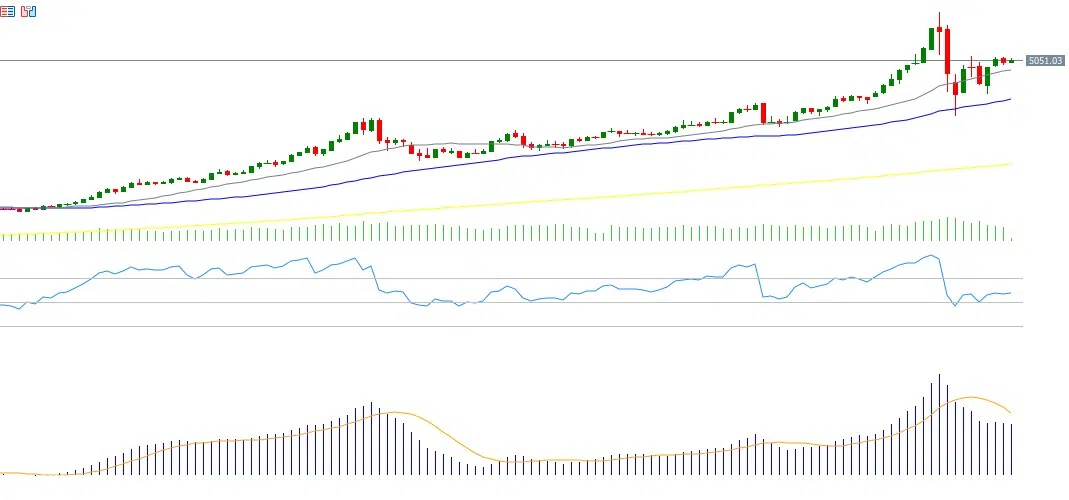
From a technical perspective, gold continues to show positive alignment in its 20-day, 50-day, and 200-day moving averages, all trending higher, with the 20-day moving average above the 50-day and the 50-day above the 200-day. The Relative Strength Index currently stands at 58, indicating positive momentum, while the MACD is trading below its signal line, suggesting that short-term bearish momentum remains in place.
Please note that this analysis is provided for informational purposes only and should not be considered as investment advice. All trading involves risk.