US equity indices closed mixed in the previous session, with the S&P 500 ending flat, while the Dow Jones declined by 0.23% and the Russell 2000 fell by 0.50%. In contrast, the Nasdaq 100 rose by around 0.29%. Since the beginning of the year, the Dow Jones has gained approximately 4%, indicating an outperformance of value stocks overgrowth stocks during this phase. Meanwhile, the S&P 500 is up about 1%, while the Nasdaq 100 has declined by roughly 0.20%.
Notably, the Russell 2000, which represents small- and mid-cap stocks, continues to outperform in relative terms and has reached record levels compared with other indices. The index has risen by around 8% year to date, outperforming its peers and signaling ongoing portfolio rotation by investors, particularly in an environment of declining US interest rates. In addition, the S&P 500 Equal Weight Index has gained about 5%, compared with roughly 1% for the traditional market cap-weighted S&P 500, highlighting broader participation in the rally and strong internal market momentum.
Looking ahead, expectations point to a continuation of positive momentum in US equities in the coming period, despite elevated valuations, supported by several key factors. US economic data remains solid, with non-farm payrolls showing an increase of 130,000 jobs, exceeding expectations of 66,000 and the previous reading of 48,000. The unemployment rate declined to 4.3%, below both forecasts and the prior reading of 4.4%. Average hourly earnings rose by 3.7% year on year, slightly above expectations of 3.6% and in line with the previous reading, underscoring the resilience of the US labor market.
Corporate earnings have also been supportive, with most US companies reporting strong results for the final quarter of last year so far. In addition, easing geopolitical tensions between the United States and Iran have improved overall market sentiment.
The semiconductor sector continues to show strong positive momentum, with the Philadelphia Semiconductor Index up around 17% year to date, reflecting robust demand for AI-related products and significant investment flows into the sector’s infrastructure. The banking sector is also performing well, with the KBW Bank Index up about 4% year to date, while the regional banks index has gained roughly 12%. Meanwhile, the industrial sector has risen by around 13% since the beginning of the year, with the XLI industrial ETF reaching a new record high in the previous session.
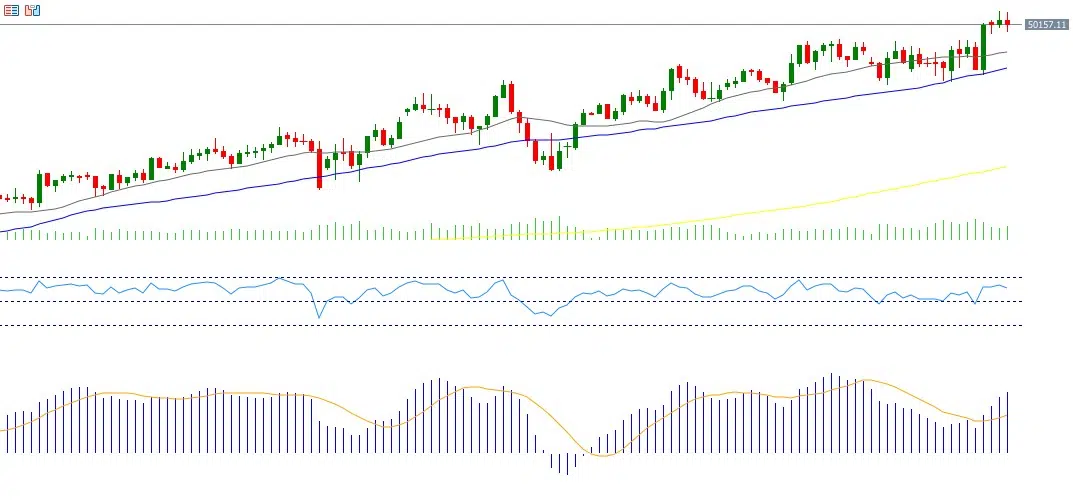
From a technical perspective, indicators continue to point to a sustained upward trend in Dow Jones. The 20-, 50-, and 200-day moving averages remain positively aligned, with the 20-day average above the 50-day, and the 50-day above the 200-day, confirming a supportive technical structure. The Relative Strength Index currently stands at 62, indicating positive momentum, while a bullish crossover between the MACD line and the signal line further confirms the continuation of upward momentum.
Finally, US President Donald Trump recently stated that the Dow Jones could reach 100,000 points during his term, describing the rally as evidence of the success of the US tariff policies that have been implemented.
Please note that this analysis is provided for informational purposes only and should not be considered as investment advice. All trading involves risk.