
Imagine a currency pair falling toward a support level that has held for weeks. Price breaks below it, traders jump in expecting a further decline, and then buyers quickly push the market back above the level, leaving sellers trapped on the wrong side of the move.
This false breakdown is known as a bear trap. A bear trap trading strategy helps Forex traders identify these failed moves, wait for confirmation, and position for a potential reversal instead of chasing a misleading signal.
In this guide, we will cover how bear traps form, how to identify them, entry and exit strategies, useful confirmation indicators, common mistakes, and how they compare with similar chart patterns.
What Is a Bear Trap in Trading?
A bear trap is a false bearish breakdown where price moves below a key support level, which makes traders believe a downtrend will continue before quickly reversing higher. Forex traders who sell the breakdown can become trapped as price recovers, forcing them to close positions and adding further buying pressure.

In Forex trading, this pattern works because many traders treat a support break as a sell signal. When buyers reclaim the level, the failed breakdown can trigger a sharp reversal that catches short sellers on the wrong side of the market.
Bear traps are especially common around high-impact news releases, where a sudden data surprise can push price through support momentarily before the market quickly recovers. This is one reason traders who apply Forex news trading strategies pay close attention to the speed and volume of a breakdown rather than the break itself.
How Does a Bear Trap Trading Pattern Form?
Most bear trap trading patterns form around liquidity. Support levels are common areas where stop-loss orders and short-entry orders cluster. When price breaks below support, it can trigger those orders and create the impression that a deeper bearish move is starting.
In some cases, this move is described as a stop hunt or liquidity grab. However, it is not always deliberate manipulation. Thin liquidity, a news spike, or a sudden shift in market sentiment can create the same pattern.
What matters is the structure itself: price breaks below support, selling pressure fails to continue, buyers step back in and price quickly reclaims the broken level. The market then starts to look stronger than the original breakdown suggested.
How to Identify a Bear Trap Before Entering a Trade
Spotting a bear trap requires looking for multiple signs rather than assuming every support break will lead to further downside. Before entering a trade, traders usually look for these confirmations:
- A false break below support: A bear trap often starts with price moving below a clear support zone before quickly reversing. If the breakdown lacks strong selling momentum, it may signal that sellers are losing control.
- Weak selling volume followed by stronger buying pressure: A breakdown on low volume followed by a strong rebound can suggest that the move lower lacks conviction and buyers are stepping back into the market. This is also where a divergence trading strategy can become useful. If RSI or MACD forms a higher low while price makes a lower low during the breakdown, that bullish divergence may warn that bearish momentum is weakening.
- A reclaim of the broken support level: Price returning above the previous support zone is one of the strongest signs that the breakdown may have failed. Many traders wait for a candle close above the level before considering an entry.
- Confirmation from higher timeframes: Checking 4-hour or daily charts can help filter out false signals caused by short-term market noise. Traders may also watch Fibonacci retracement levels, such as 61.8% and 78.6%, where bear traps can sometimes form during larger pullbacks.
- A rapid gap fill: Gaps below support that fill quickly can be another clue. Traders familiar with price gap trading strategies know that a gap that closes rapidly often signals a failed move rather than a genuine directional break.
Bear Trap Trading Strategy: How to Trade a False Breakout
Once a bear trap is identified, the goal is not to predict the reversal but to wait for evidence that sellers have lost control. A structured approach focuses on confirmation, entry timing, Forex risk management, and realistic profit targets.
1. Wait for Confirmation Before Entering
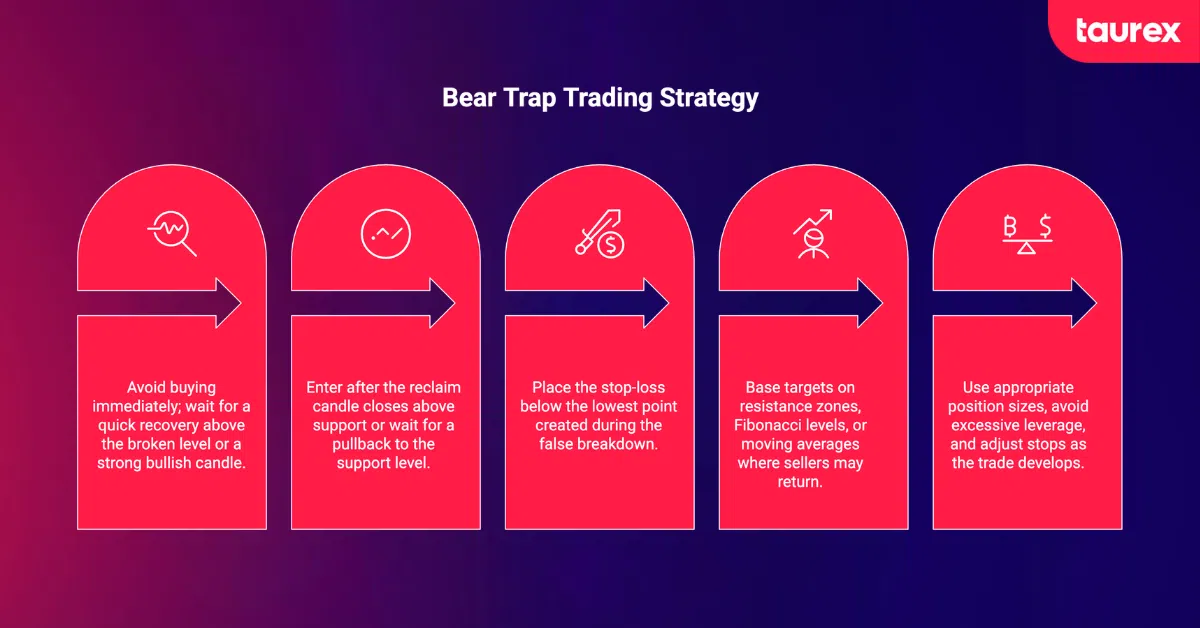
The first step is avoiding the temptation to buy immediately after price drops below support. A genuine bear trap needs evidence that sellers have lost control, such as a quick recovery above the broken level, a strong bullish candle, or signs that selling pressure is weakening.
Entering too early can turn a potential bear trap into a losing trade if price continues lower. Waiting for confirmation reduces the chance of buying into a real breakdown rather than a false one. Traders who use an opening range breakout framework will recognise this logic. Both approaches wait for price to clearly establish itself outside a defined level before committing to a direction, and bear trap confirmation requires the same patience before acting on the reclaim.
2. Find the Best Entry Point
Once price reclaims the support level, traders usually look for the safest place to enter. One approach is entering after the reclaim candle closes above support, confirming that buyers have taken control. Another approach is waiting for a pullback to the same level, now acting as support, before opening a position.
The second method can offer a better risk-to-reward ratio because the trader is not chasing the first reversal move. This retest entry is essentially a pullback trading strategy applied to the reclaimed support level. Price returns to the false breakdown zone, confirms the level holds, and provides a lower-risk entry in the direction of the reversal. Bullish candlestick patterns, such as an engulfing candle, hammer, or pin bar, can provide additional confirmation during the retest.
3. Place Your Stop-Loss Correctly
The stop-loss should be placed where the original bear trap idea becomes invalid. For many traders, this means placing it below the lowest point created during the false breakdown, also known as the trap low.
This placement gives the trade room to breathe while keeping potential losses controlled. A stop that is too close may be triggered by normal volatility, while one that is too wide can create unnecessary risk. Understanding the different types of Forex orders helps you place these levels precisely.
4. Set Profit Targets
Profit targets should be based on areas where price may face resistance rather than arbitrary numbers. Common targets include previous resistance zones, Fibonacci retracement levels, moving averages, or other technical areas where sellers may return.
Some traders manage the position by taking partial profits at the first target and keeping the remaining position open if bullish momentum continues. This approach allows them to secure gains while still benefiting from a larger reversal.
5. Manage Risk During Bear Trap Trades
A bear trap can produce a strong reversal, but not every failed breakdown leads to a lasting move higher. Traders should control risk by using appropriate position sizes, avoiding excessive leverage, and adjusting stops as the trade develops.
Trailing stops can help protect profits during extended moves, while a clear risk-to-reward plan prevents emotions from taking over after entering the trade. It is also worth monitoring your overall Forex drawdown across bear trap setups. Because these trades involve buying into a recent breakdown, a string of failed signals can erode capital quickly, and tracking drawdown helps you recognise when conditions are not favouring the setup.
Which Technical Indicators Confirm a Bear Trap Trading Pattern?
No single indicator can confirm a bear trap on its own. However, combining momentum, volume, and trend-based tools can help traders decide whether a breakdown is losing strength or turning into a genuine reversal.
Solid Forex technical analysis usually stacks several of these signals.
- Relative Strength Index (RSI): RSI is often used to spot bullish divergence, which happens when price makes a lower low while RSI forms a higher low. This suggests that bearish momentum is weakening and can be an early warning that the breakdown may fail.
- MACD: MACD can provide similar divergence signals. If price creates a new low but the MACD line or histogram shows improving momentum, it may indicate that sellers are losing control and a reversal is becoming more likely.
- Volume indicators: Volume can help separate a strong breakdown from a weak one. A move below support on declining volume, followed by stronger buying volume during the recovery, may suggest that the bearish move lacks conviction.
- Moving averages: Moving averages can help confirm whether buyers are regaining control after a bear trap. A price move back above a key moving average or a bullish crossover can provide additional support for a long entry.
Bear Trap Trading Strategy vs Other False Breakout Setups
Bear traps can look similar to other breakout and reversal setups, especially when price moves quickly around support or resistance. Comparing them side by side helps traders understand whether they are looking at a failed bearish breakdown, a continuation pattern, or a different type of reversal structure.
| Setup | What Happens | Key Difference |
| Bear Trap | Price breaks below support, then reverses higher | A failed bearish breakdown that traps sellers |
| Bull Flag | Price consolidates after a strong upward move | A continuation setup, not a false breakdown |
| Falling Wedge Breakout | Price narrows between descending trendlines before breaking out | A longer-forming pattern with a defined wedge structure |
| Island Reversal | Price is separated by gaps before reversing | Depends on gap formation |
| Bump and Run Reversal | Price accelerates in one direction, then reverses | Usually develops over a longer period |
Common Mistakes Traders Make When Trading Bear Traps
Bear traps can create strong reversal opportunities, but they also punish traders who act too quickly. Avoiding these common mistakes can help you separate genuine setups from false signals.
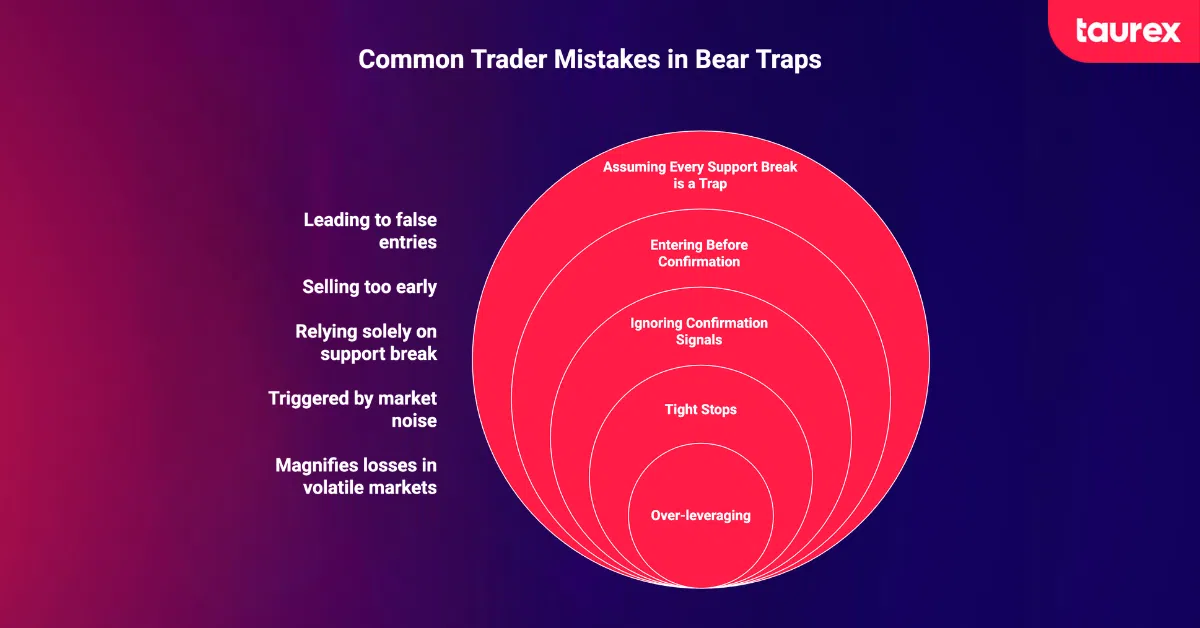
- Entering before confirmation: Selling as soon as price breaks support can leave you caught in a reversal. Waiting for a reclaim of the level, volume confirmation, or a bullish signal can reduce the risk of entering too early.
- Ignoring confirmation signals: Relying only on the support break can lead to poor decisions. Tools such as RSI divergence, volume analysis, and candlestick patterns can provide additional evidence that the breakdown is failing.
- Using stops that are too tight: Bear traps often involve sharp price swings, and stops placed too close to the entry can be triggered by normal market noise before the reversal develops.
- Over-leveraging the trade: High leverage can magnify losses if the setup fails. Keeping position sizes reasonable helps protect your account during volatile market conditions.
- Assuming every support break is a bear trap: Not every breakdown reverses. Treating every support failure as a trap can lead to repeated false entries.
Best Practices for Trading Bear Traps Successfully
A disciplined approach matters more than simply recognising the pattern. These habits can help traders improve their decision-making when looking for bear trap setups.
- Combine multiple confirmations: Look for a combination of price action, momentum indicators, volume clues, and key levels instead of relying on a single signal.
- Use proper risk management: Set position sizes based on your risk tolerance and avoid putting too much capital into one setup.
- Wait for clear signals: Sharp market moves can trigger emotional decisions. Taking time to reassess the setup can prevent impulsive entries.
- Consider higher timeframes: Daily and 4-hour charts often provide clearer signals than lower timeframes, where market noise can create more false breaks.
- Review your trades: Keeping a trading journal helps identify patterns in your entries, exits, and mistakes so you can improve over time.
When approached with discipline, bear traps can become a useful part of a broader trading strategy. A regulated platform like Taurex provides charting tools and a structured environment where traders can practise analysing setups and refining their approach.
A regulated platform like Taurex, with advanced charting tools and multi-jurisdictional oversight, gives you the environment to practise and apply this approach with confidence.
Final Thoughts
Bear traps can be challenging to trade, but they can also become a useful setup for traders who understand how to identify false breakdowns and wait for confirmation. The main lesson is simple: patience and preparation matter more than reacting quickly when price breaks a key level.
Before committing real capital, try identifying these setups on a demo account and focus on improving your chart reading, entry timing, and risk management. With Taurex, you can access demo trading tools that let you test your bear trap trading strategy in a simulated environment before applying it to live markets.
Remember that trading involves significant risk, and past price patterns do not guarantee future results. A disciplined approach and proper risk management are essential when applying any trading strategy.
Open a demo account today and start practising your Forex strategies in a risk-free environment before trading with real funds.
FAQ
What is a bear trap in Forex?
A bear trap is a false bearish breakdown where price falls below support, convincing traders that a downtrend will continue before reversing higher. The reversal forces short sellers to close their positions, which can add further buying pressure.
How do you identify a bear trap?
Look for a break below support that lacks strong selling momentum, weak volume during the breakdown, and a strong recovery back above the broken level. Bullish divergence on indicators like RSI or MACD can provide additional confirmation.
What is a bear trap trading strategy?
A bear trap trading strategy involves waiting for a false breakdown to fail before entering a long position. Traders typically wait for price to reclaim support, enter on the recovery or retest, place a stop below the trap low, and target nearby resistance levels.
What causes a bear trap?
Bear traps often form when traders sell after a support break without waiting for confirmation. High leverage, market uncertainty, and sudden news events can increase volatility and create conditions where short sellers become trapped.
Is a bear trap bullish or bearish?
A bear trap is generally considered a bullish setup because the failed breakdown often leads to an upward reversal. The bearish move is the trap, while the recovery creates the potential trading opportunity.
Which indicators work best for confirming a bear trap?
RSI and MACD divergence, volume analysis, and moving averages are commonly used to confirm bear traps. Combining multiple signals usually provides stronger confirmation than relying on a single indicator.
What is the difference between a bear trap and a bull trap?
A bear trap tricks sellers into short positions before price moves higher, while a bull trap tricks buyers into entering before price reverses lower. They are opposite types of false breakout setups.
Can beginners trade bear traps successfully?
Beginners can learn to trade bear traps, but they should first focus on confirmation-based entries and risk management. Practising on a demo account can help build experience before using real capital.
Which timeframe is best for spotting bear traps?
Higher timeframes, such as 4-hour and daily charts, often provide clearer bear trap signals because they filter out short-term market noise. Traders commonly use higher timeframes for analysis and lower timeframes for precise entries.
How Can Traders Avoid False Bearish Breakouts?
Wait for price to reclaim the broken level, confirm with volume and momentum indicators, avoid shorting directly into support, and use disciplined position sizing. Checking the setup against Forex market hours also helps, since volatility around major sessions can distort breakouts.