
How to Start Forex Trading: Step-by-Step Guide for Beginners
Forex trading means buying one currency while selling another. It takes place in the foreign exchange market, where banks, institutions, businesses and individual traders exchange currencies.
For beginners, forex trading can seem complex at first because prices move constantly and every trade involves two currencies. However, the basic idea is simple: traders try to understand if one currency may strengthen or weaken against another.
According to the Bank for International Settlements, trading in OTC forex markets reached $9.6 trillion per day in April 2025, making forex one of the largest financial markets in the world. This size creates many trading opportunities, but it also means beginners need a clear plan, strong risk management and enough practice before trading with real money.
This guide explains forex trading for beginners, how currency pairs work, key terms to know, how to trade forex for beginners step by step and how to practise with a demo account before opening a live trading account.
Key Takeaways
- Forex trading means buying one currency and selling another through currency pairs such as EUR/USD, GBP/USD and USD/JPY.
- Beginners should learn key terms such as pips, spreads, leverage, margin, stop-losses and lot sizes before trading live.
- A demo account can help beginners practise forex trading with virtual funds before using real money.
- Risk management is essential because forex prices can move quickly and leverage can increase losses.
- Beginners should start with a clear plan, small position sizes and simple strategies before moving to more advanced setups.
What Is Forex Trading?
Forex trading is the act of exchanging one currency for another. Currencies are traded in pairs, such as EUR/USD, GBP/USD or USD/JPY. The first currency in the pair is called the base currency, while the second is called the quote currency.
For example, if AUD/USD is trading at 0.6600, it means 1 Australian dollar is worth 0.6600 US dollars. If the price rises, the Australian dollar has strengthened against the US dollar. If the price falls, the Australian dollar has weakened against the US dollar.
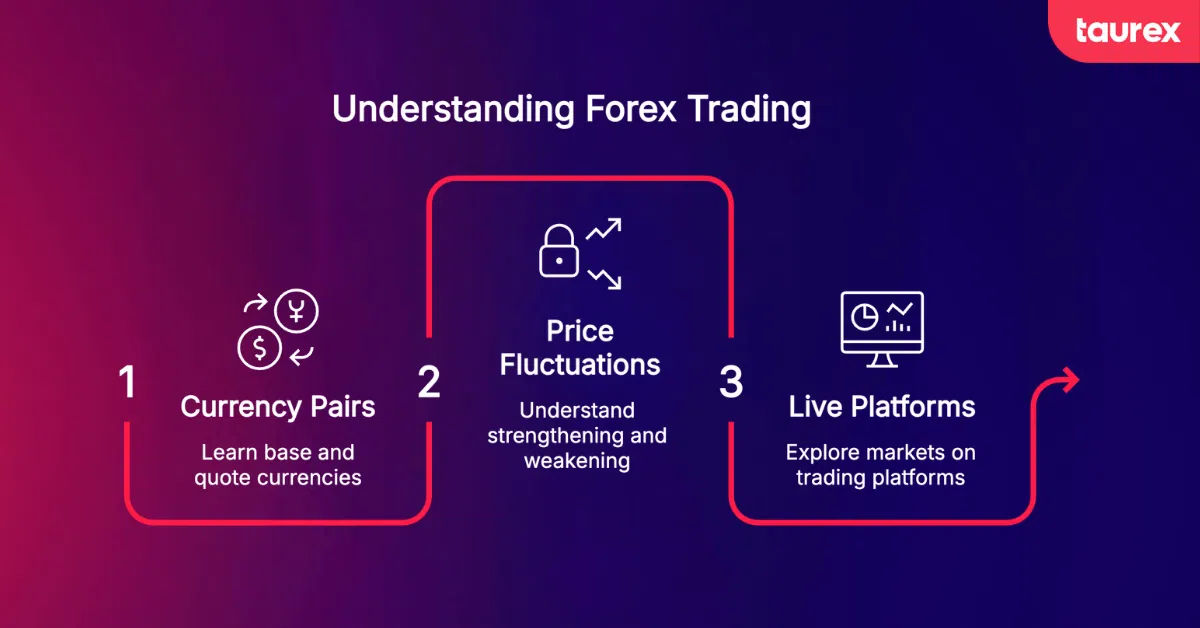
Beginners can explore available currency markets through forex trading platforms, where prices are shown as live bid and ask quotes.
How Does Forex Trading Work?
Forex trading works by speculating on changes in currency pair prices. A trader may buy a pair if they think the base currency will rise against the quote currency. They may sell the pair if they think the base currency will fall.
| Market view | Possible action | Example |
| The euro may rise against the US dollar | Buy EUR/USD | Trader expects EUR/USD to move higher |
| The euro may fall against the US dollar | Sell EUR/USD | Trader expects EUR/USD to move lower |
| The British pound may rise against the US dollar | Buy GBP/USD | Trader expects GBP/USD to move higher |
| The US dollar may rise against the Japanese yen | Buy USD/JPY | Trader expects USD/JPY to move higher |
Forex prices are affected by many factors, including interest rates, inflation, employment data, economic growth, political events, central bank decisions and market sentiment.
Because forex prices can move quickly, beginners should focus on learning how the market works before using real money.
Example of a Forex Trade
A simple example can make forex trading easier to understand.
Imagine USD/CAD is trading at 1.3500. A beginner thinks the US dollar may strengthen against the Canadian dollar, so they buy USD/CAD. If the price rises to 1.3550, the pair has moved 50 pips higher. If the trader closes the position at that level, the trade may result in a profit, depending on trade size, spread and any other costs.
If USD/CAD falls from 1.3500 to 1.3450 instead, the trade has moved 50 pips against the trader. This may result in a loss if the position is closed or if a stop-loss is triggered.
This example shows why beginners need a clear entry, a stop-loss, a take-profit target and a defined risk level before placing a trade.
Key Terms about Forex Trading that Beginners Should Know
Before placing trades, beginners should understand the basic language of forex trading.
| Term | Meaning |
| Currency pair | Two currencies traded against each other, such as EUR/USD. Learn more about how to read forex quotes. |
| Base currency | The first currency in the pair |
| Quote currency | The second currency in the pair |
| Pip | A small unit of price movement in forex. This is one of the basic forex trading terms beginners should know. |
| Spread | The difference between the buy and sell price, also known as the forex spread. |
| Lot size | The trade size used to open a position. Beginners can learn how to calculate lot size in forex before placing trades. |
| Leverage | A tool that allows traders to control a larger position with a smaller deposit. It should be used carefully as part of forex risk management. |
| Margin | The amount required to open or maintain a leveraged trade. Some brokers may also apply dynamic margin rules. |
| Stop-loss | An order used to close a trade at a set loss level. Stop-losses are one of the main forex order types beginners should understand. |
| Take-profit | An order used to close a trade at a set profit level. |
Beginners should learn these terms before moving on to strategies. Understanding spreads, margin and order types can help reduce basic mistakes when opening and managing trades.
What Are the Main Types of Forex Markets?
Forex trading can take place through different market types. Beginners do not need to trade every type, but understanding the difference can help them learn how the wider forex market works.
| Market type | Meaning | Beginner note |
| Spot forex market | Currencies are exchanged at the current market price | Commonly used for short-term currency trading |
| Forward forex market | A contract is agreed to exchange currencies at a future date and price | Often used by businesses and institutions |
| Futures forex market | Standardised currency contracts traded on exchanges | More structured but may be less common for retail beginners |
| Options forex market | Contracts that give the right, but not the obligation, to exchange currencies | More advanced and not usually the first step for beginners |
Most beginners start by learning spot forex because it is the simplest to understand. The trader is focused on the current price of a currency pair and how that price may move.
How to Start Forex Trading Step-by-Step
Learning how to start forex trading is easier when the process is broken into clear steps.
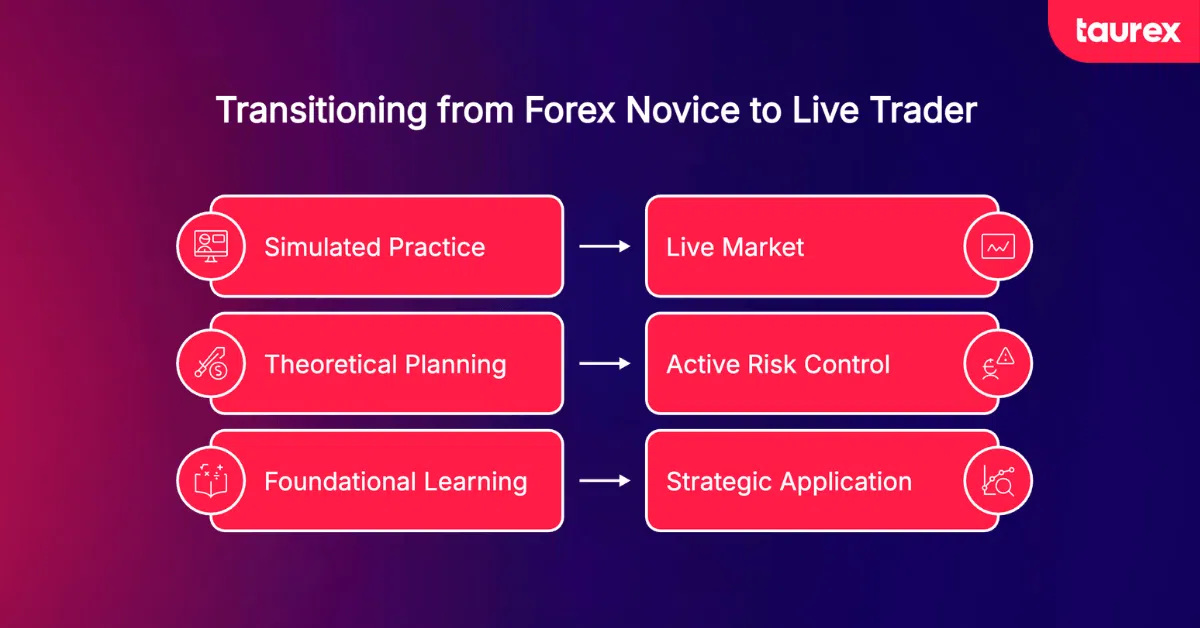
Step 1: Learn the Basics
Start with the core concepts: currency pairs, pips, spreads, leverage, margin, chart reading and risk management. Beginners should understand how trades are opened and closed before placing any live trades.
It is also useful to learn how market sessions work. Different forex market hours can affect liquidity, spreads and volatility.
Step 2: Choose a Forex Broker
A broker gives traders access to the forex market through a trading platform. Beginners should compare regulation, costs, available currency pairs, platform options, deposit and withdrawal conditions and customer support.
A useful starting point is a guide on how to choose a forex broker before opening an account.
Step 3: Open a Demo Account
A demo account lets beginners practise forex trading with virtual funds. This helps traders learn the platform, place orders, test strategies and build confidence without risking real capital.
Traders can open a demo account to practise in a simulated trading environment before moving to live trading. Taurex also states that its trading app can be used with a demo account before trading with real money.
Step 4: Choose a Trading Platform
A trading platform is where traders analyse charts, place orders and manage positions. Taurex provides access to MetaTrader 4, MetaTrader 5 and the Taurex trading app.
Beginners should choose a platform that feels clear, stable and practical for their trading goals.
Step 5: Learn to Read Forex Charts
Charts show how a currency pair has moved over time. Beginners can use charts to identify trends, support and resistance, price patterns and market behaviour.
A beginner-friendly guide on how to read forex charts can help traders understand price movement before they start building strategies.
Step 6: Build a Risk Management Plan
Risk management should come before strategy. Beginners should decide how much they are willing to risk per trade, where to place stop-losses and when to stop trading for the day.
A strong forex risk management plan can help traders protect their account from oversized losses.
Step 7: Start Small When Moving to Live Trading
After practising on a demo account, beginners may choose to open a live account. This should be done gradually because real money creates more emotional pressure than demo trading.
Traders should start with small position sizes, use stop-losses and avoid increasing risk too quickly.
How Much Money Do You Need to Start Forex Trading?
The amount needed to start forex trading depends on the broker, account type, trading platform and the trader’s own risk plan. Beginners should not focus only on the minimum deposit. They should also consider how much they can afford to risk, how they will size positions and how they will manage losing trades.
A small account can help beginners learn live trading gradually, but it may also limit flexibility. A larger account does not guarantee better results and can increase emotional pressure if risk is not controlled.
Before trading live, beginners should ask:
- Can I afford to lose this money?
- Do I understand how leverage and margin work?
- Have I practised with a demo account?
- Do I have a risk limit per trade?
- Do I know when to stop trading for the day?
Beginners should practise with virtual funds first and move to live trading only when they understand the platform, order types, position size and risk limits.
What Currency Pairs Can Beginners Trade?
Forex pairs are usually grouped into major, minor and exotic pairs.
| Pair type | Description | Examples |
| Major pairs | Include the US dollar and another major currency | EUR/USD, GBP/USD, USD/JPY |
| Minor pairs | Include major currencies but not the US dollar | EUR/GBP, EUR/AUD, GBP/JPY |
| Exotic pairs | Include one major currency and one less-traded currency | USD/TRY, EUR/ZAR, GBP/MXN |
Many beginners start with major pairs because they are usually more liquid and often have tighter spreads than less-traded pairs. This does not make them risk-free, but it can make them easier to observe and study.
Beginners may start by watching pairs such as EUR/USD or GBP/USD and learning how they react during different market sessions.
How to Read Forex Charts as a Beginner
Forex charts show price movement over time. The most common chart types are line charts, bar charts and candlestick charts.
Line charts show the general direction of price. Bar charts provide more detail by showing the open, high, low and close. Candlestick charts are popular because they show price movement visually and can help traders understand buying and selling pressure.
Beginners should focus on three basic questions when reading a forex chart:
| Question | What to look for |
| Is price moving up, down or sideways? | Identify the trend |
| Where has price reacted before? | Mark support and resistance |
| Is price moving strongly or weakly? | Check candle size, momentum and volatility |
Technical indicators can help confirm chart analysis, but they should not replace price reading. Beginners can start with simple tools such as moving averages, RSI and support and resistance before adding more complex indicators.
Forex Trading Strategies for Beginners
A forex trading strategy is a set of rules for entering, managing and exiting trades. Beginners should keep trading strategies simple and focus on consistency.
Trend-Following Strategy
A trend-following strategy looks for trades in the direction of the current market trend. If price is making higher highs and higher lows, traders may look for buying opportunities. If price is making lower highs and lower lows, traders may look for selling opportunities.
Moving averages can help beginners identify the direction of the trend. Traders can also learn how a trend line trading strategy helps identify trend direction, breakouts and continuation setups.
Support and Resistance Strategy
Support is a price area where buyers have previously stepped in. Resistance is a price area where sellers have previously appeared.
Beginners may watch how price reacts around these areas. A bounce from support or rejection from resistance can help traders plan entries, exits and stop-loss placement.
Breakout Strategy
A breakout happens when price moves beyond a key support or resistance level. Traders may use breakout strategies when price leaves a range or breaks through an important level.
Beginners should be careful with false breakouts. One structured example is the opening range breakout strategy, which waits for price to break a defined session range before entering.
News Trading Awareness
Economic news can cause sharp price movement in forex markets. Beginners do not need to trade news events immediately, but they should know when high-impact events are scheduled.
Checking an economic calendar can help traders avoid entering trades during major announcements if they are not prepared for volatility. Beginners can also study forex news trading strategies to understand how events such as NFP, CPI and rate decisions can affect currency pairs.
Forex Risk Management for Beginners
Risk management is one of the most important parts of forex trading for beginners. A trader can have a strong setup and still lose money if risk is not controlled.
Beginners should consider these rules:
| Rule | Why it matters |
| Use stop-losses | Helps limit losses if price moves against the trade |
| Control position size | Prevents one trade from risking too much of the account |
| Set a daily loss limit | Helps stop emotional trading after losses |
| Avoid overusing leverage | Reduces the risk of large losses |
| Do not chase trades | Helps avoid impulsive entries |
| Keep a trading journal | Makes it easier to review mistakes and improve |
Forex trading involves losses. The goal is not to avoid every loss, but to keep losses controlled and avoid emotional decisions.
Why Is Forex Trading Risky for Beginners?
Forex trading is risky because prices can move quickly and losses can happen even when the analysis looks reasonable. Beginners may also underestimate the effect of leverage, volatility and emotional decision-making.
Main risks include:
| Risk | What it means |
| Leverage risk | Leverage can increase both profits and losses |
| Volatility risk | Currency prices can move sharply during news or market stress |
| Execution risk | Price may change between order placement and execution |
| Spread risk | Trading costs may increase during volatile or low-liquidity periods |
| Emotional risk | Fear, greed or frustration may lead to poor decisions |
| Strategy risk | A setup that worked before may fail in different market conditions |
Beginners should not treat forex trading as a quick way to make money. It requires education, practice, discipline and strict risk control.
Pros and Cons of Forex Trading for Beginners
The advantages of Forex trading also come with disadvantages. Beginners should understand both before opening a live account..
| Pros | Cons |
| Large and active global market | Prices can move quickly |
| Many currency pairs to study | Leverage can increase losses |
| Ability to practise with demo accounts | Beginners may overtrade |
| Platforms offer charts, tools and order types | Trading costs can affect results |
| Market access across different sessions | Emotional pressure can be high |
| Educational resources are widely available | No strategy works all the time |
The goal is not to avoid forex because it has risks. The goal is to understand those risks before trading live.
Common Forex Trading Mistakes Beginners Should Avoid
Beginners often make mistakes because they focus too much on potential profit and not enough on process.
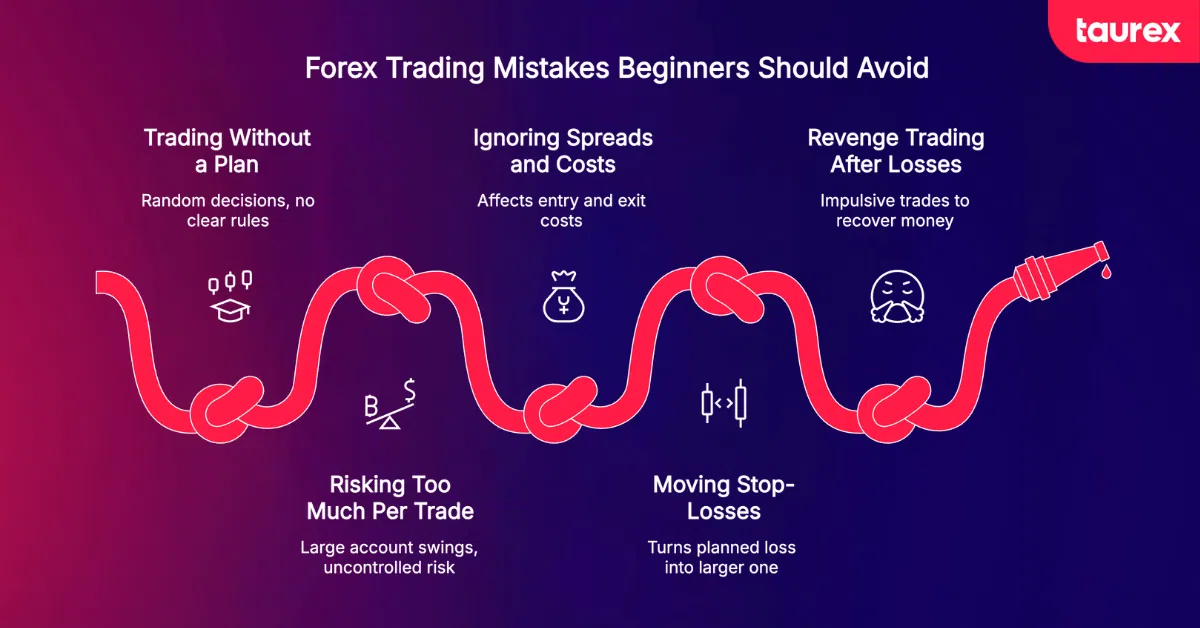
Trading Without a Plan
Opening trades without clear rules can lead to random decisions. A trading plan should define the market, setup, entry, stop-loss, target and risk per trade.
Risking Too Much Per Trade
Beginners may increase trade size too quickly after a win or loss. This can lead to large account swings. Risk should stay controlled, especially during the learning stage.
Ignoring Spreads and Costs
Spreads affect the cost of entering and exiting trades. Beginners should understand forex spreads before trading short-term setups.
Moving Stop-Losses
A stop-loss is designed to limit risk. Moving it further away because a trade is losing can turn a planned loss into a larger one.
Revenge Trading After Losses
Revenge trading happens when a trader places impulsive trades after a loss to recover money quickly. This can lead to overtrading and larger drawdowns.
Learning how to avoid revenge trading can help beginners build better discipline.
Can You Learn Forex Trading Yourself?
Yes, beginners can learn forex trading themselves, but they need structure. Reading guides, watching platform tutorials, using a demo account and keeping a trading journal can help beginners build knowledge gradually.
Self-learning should include:
- basic forex terminology
- chart reading
- order types
- risk management
- trading psychology
- platform practice
- regular review of trades
Beginners should avoid expecting fast results. Forex trading takes time to understand, and live trading introduces emotional pressure that demo trading does not fully recreate.
Practise With a Forex Demo Account
A forex demo account allows beginners to practise trading with virtual funds before using real money. This is useful for learning how the platform works, testing strategies and building a routine.
A demo account can help beginners practise:
- opening and closing trades
- setting stop-loss and take-profit levels
- reading charts
- checking spreads
- testing simple strategies
- reviewing trade results
- following a trading plan
Demo trading should be treated seriously. Traders should use realistic position sizes, set risk limits and keep a journal. This makes demo practice more useful when moving to live trading.
Beginners can start with a Taurex demo account to practise forex trading in a simulated environment.
How to Choose a Forex Broker as a Beginner
Choosing a forex broker is an important decision for beginners. A broker should provide a clear trading environment, transparent costs, suitable platforms and access to helpful educational resources.
Beginners should compare:
| Factor | What to check |
| Regulation | Which entity provides the account and how it is regulated |
| Trading costs | Spreads, commissions and overnight charges |
| Platforms | MT4, MT5, web, desktop or mobile access |
| Demo account | Ability to practise before trading live |
| Currency pairs | Available major, minor and exotic pairs |
| Support | Help with account, platform or technical questions |
| Education | Guides, tools and resources for learning |
A beginner should not choose a broker only because of high leverage or promotional claims. The focus should be safety funds, clarity, platform usability and risk control.
Final Thoughts
Forex for beginners starts with understanding how currency pairs move, how trades are placed and how risk is managed. A structured approach to forex trading for beginners can make the learning process easier and more practical. The forex market offers many opportunities, but beginners should not rush into live trading without preparation.
The best starting point is to learn the key terms, practise reading charts, use a demo account, build a trading plan and focus on risk management before using real money.
Taurex provides access to forex trading, demo account practice, MT4, MT5 and the Taurex trading app, giving beginners a way to learn the platform and practise before moving to live trading!
FAQs
What is forex trading for beginners?
Forex trading for beginners means learning how currencies are bought and sold in pairs. Beginners should understand currency pairs, pips, spreads, leverage, margin, order types, charts and risk management before trading with real money.
How do I start forex trading as a beginner?
To start forex trading, learn the basics, choose a forex broker, open a demo account, practise on a trading platform, build a risk management plan and move to live trading gradually when ready.
How does forex trading work?
Forex trading works by buying one currency and selling another. Traders speculate on price changes in currency pairs, such as EUR/USD or GBP/USD. If the price moves in the expected direction, the trade may make a profit. If it moves against the trade, it may result in a loss.
Can I learn forex trading by myself?
Yes, beginners can learn forex trading themselves through guides, demo practice, platform tutorials and trade review. However, self-learning requires patience, structure and strong risk management.
What is the best forex pair for beginners?
Many beginners start with major currency pairs such as EUR/USD, GBP/USD or USD/JPY because they are widely traded and often easier to follow. No pair is risk-free, so beginners should practise on a demo account first.
How much money do I need to start forex trading?
The amount needed depends on the broker, account type and trading plan. Beginners should avoid starting with money they cannot afford to lose and should practise with a demo account before trading live.
Is forex trading risky for beginners?
Yes. Forex trading is risky because prices can move quickly and leverage can increase losses. Beginners should use stop-losses, control position size and avoid trading without a plan.
Should beginners use a forex demo account?
Yes. A forex demo account helps beginners practise without risking real money. It can be used to learn the platform, test strategies, read charts and build risk management habits before opening a live account.
What is the easiest forex strategy for beginners?
Simple strategies based on trends, support and resistance or breakouts are often easier for beginners to understand. The strategy should include clear entry rules, stop-loss placement, take-profit targets and risk limits.
Can I trade forex on mobile?
Yes. Many brokers provide mobile trading platforms. Taurex offers a trading app that can be used to monitor markets, analyse charts and manage trades from a mobile device.