
Recent German economic data continue to indicate persistent weakness in the German economy. Industrial production declined on a monthly basis, recording a contraction of 0.5%, a figure that came below expectations (1.0%) but higher than the previous reading (-1.0%). Factory orders also fell on a monthly basis, registering a sharp contraction of 11.1%, which was significantly worse than expectations (-4.2%) and the previous reading (6.4%). In addition, German retail sales declined on a monthly basis by 0.9%, a figure that came below expectations (0.0%) and the previous reading (1.2%).
It is also worth noting that Germany’s consumer price index on a yearly basis slowed to 1.9%, coming in below expectations (2.0%) and the previous reading (2.1%).
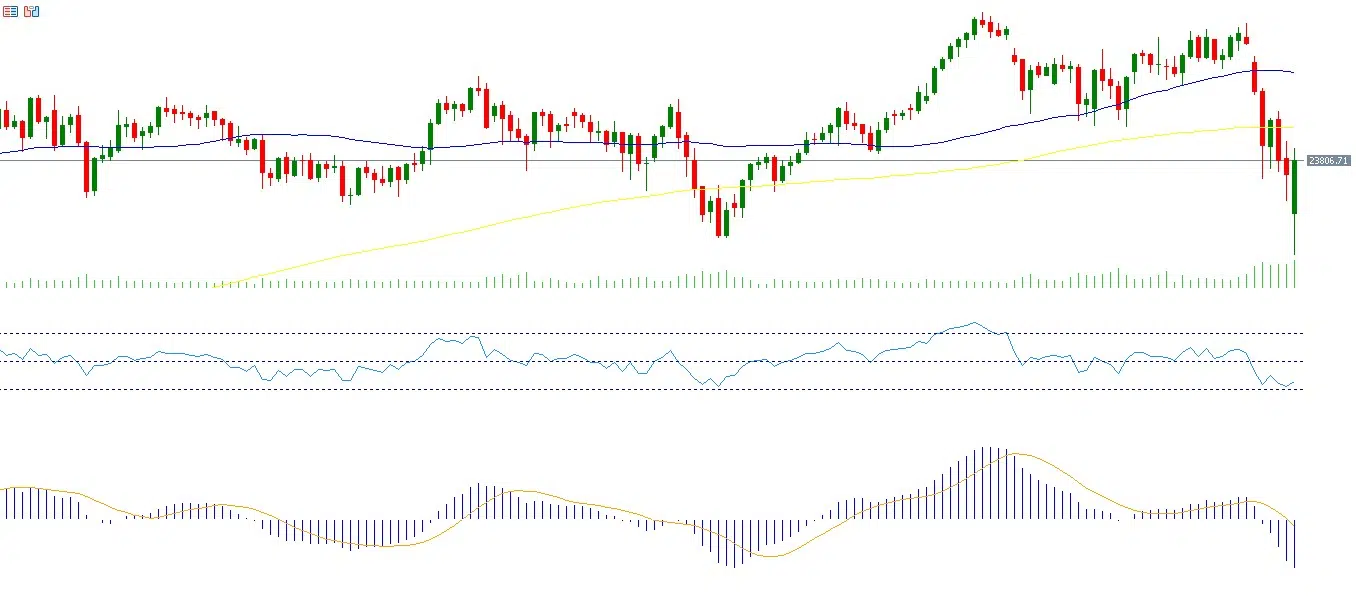
Meanwhile, the German DAX index continues its downward trajectory, closing yesterday at 22,928 points, the lowest level since May 6, 2025. The index has declined by about 10% from its peak recorded on January 13, 2026, at 25,508 points to yesterday’s low of 22,928 points. The index has also erased all of its gains for the year and is now down roughly 5% since the beginning of the year. Most other European equity indices also declined, including the French CAC 40 (-4%) and the European Stoxx 600 index (-0.25%). However, despite its recent pullback, the FTSE 100 remains up by around 3% since the beginning of the year.
The primary reason behind these declines in European equities is the ongoing geopolitical tensions, particularly the war involving the United States and Israel against Iran. Rising concerns about a potential widening of the conflict, along with uncertainty regarding its duration and outcome, are weighing on risk-sensitive assets, especially equities. Additionally, the surge in energy prices, including oil and natural gas, is creating inflationary pressure on the European economy, which could lead to a resurgence in inflation and potentially push the European Central Bank to raise interest rates in the coming period.
In this context, we are witnessing broad increases in European government bond yields, particularly in Germany, France, and the United Kingdom. For instance, the yield on the two-year German government bond rose to 2.48% yesterday, the highest level since August 1, 2024. Similarly, the yield on the two-year French government bond climbed to 2.58%, the highest level since September 6, 2024. The yield on the two-year UK government bond also increased to 4.24%, the highest level since March 28, 2025. These moves indicate selling pressure on government bonds amid expectations of rising European inflation due to persistently higher energy prices.
From a technical perspective, indicators appear to support the continuation of the downward trend in the DAX index in the coming period. The index has recently experienced a bearish crossover between the 20-day moving average and the 50-day moving average, which is considered a negative technical signal suggesting the potential for further declines. The Relative Strength Index is currently hovering around 31 points, close to the oversold territory, reflecting the strong negative momentum in the index. In addition, a bearish crossover between the MACD line and the signal line has emerged, further reinforcing the likelihood of continued negative momentum in the index.
Please note that this analysis is provided for informational purposes only and should not be considered as investment advice. All trading involves risk.