
Recent Chinese economic data have shown a clear divergence in performance. Retail sales declined on a year-on-year basis in December, recording growth of just 0.9%, below market expectations of 1.1% and the previous reading of 1.3%. Fixed asset investment also weakened, contracting by 3.8% year-on-year, worse than expectations of -3.1% and the prior reading of -2.6%. In addition, house prices continued to fall, with the annual house price index declining by 2.7%, compared with a 2.4% contraction in the previous reading.
In contrast, industrial production posted a solid performance, rising by 5.2% year-on-year in December, slightly above expectations of 5.1% and higher than the previous reading of 4.8%. More importantly, China’s gross domestic product grew by 5% in 2025 for the third consecutive year, while the trade surplus reached a record $1.2 trillion in 2025, supported by strong export growth.
Overall, these figures suggest that the Chinese economy remains heavily reliant on industrial output and exports, while facing pronounced weakness in domestic consumption and fixed investment. This imbalance is further exacerbated by ongoing stress in the property sector, which has been struggling for the fifth consecutive year, underscoring the need for additional policy stimulus from Chinese authorities to support domestic demand.
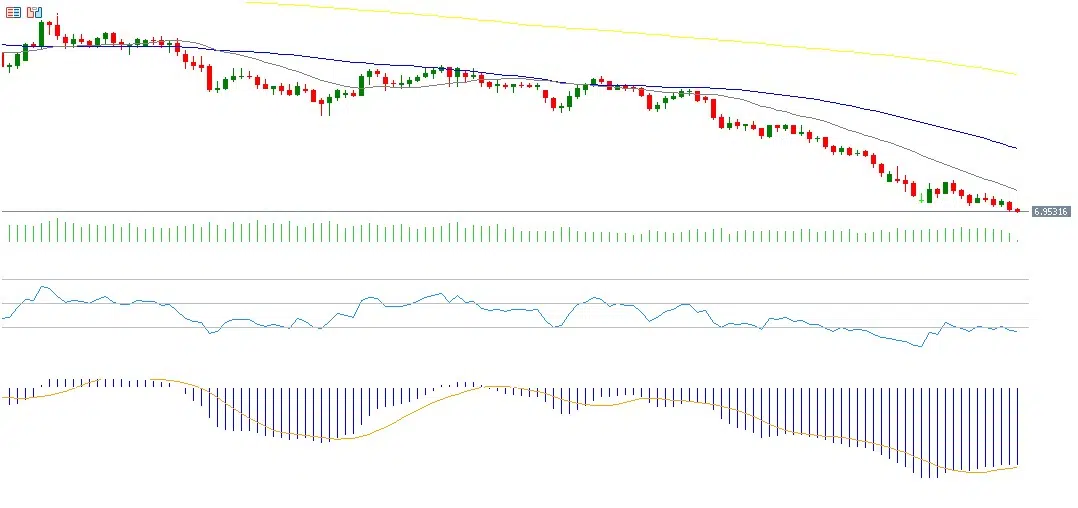
As for the USD/CNH exchange rate, it continues to trade within a downward trend, with the pair falling to 6.9518 yesterday, its lowest level since May 16, 2023, and down around 0.30% year-to-date. This decline comes amid broad selling pressure on the U.S. dollar against most major currencies, particularly as markets increasingly expect two U.S. interest rate cuts during the current year.
From a technical perspective, indicators point to the likelihood of further downside in USD/CNH in the period ahead. A bearish crossover remains in place between the 20-day and 50-day moving averages, signaling persistent negative momentum. The Relative Strength Index currently stands near 26, placing the pair in oversold territory and confirming bearish conditions. In addition, the MACD indicator shows a bearish crossover between the MACD line and the signal line, reinforcing expectations of continued downside pressure on the pair.
Please note that this analysis is provided for informational purposes only and should not be considered as investment advice. All trading involves risk.