
The Reserve Bank of New Zealand decided on Wednesday, February 18, to keep interest rates unchanged at 2.25%, in line with expectations. Recent New Zealand economic data point to a degree of resilience in economic performance, with the annual Consumer Price Index rising by 3.1%, exceeding both expectations and the previous reading of 3.0%. Employment change also increased by 0.5%, above expectations (0.3%) and the prior reading (0.0%). In the same context, core retail sales rose on a quarterly basis by 1.5%, surpassing expectations (0.4%) and the previous reading (1.2%).
The New Zealand dollar reached a level of 0.6093 against the US dollar on Thursday, January 29, 2026, its highest level since July 3, 2025. The pair has also gained around 4% since the start of the year and is currently trading near the 0.6000 level.
The New Zealand dollar continues to deliver a strong performance, ranking third among G10 currencies against the US dollar, after the Australian dollar and the Norwegian krone, and ahead of the Swiss franc in fourth place, followed by the Swedish krona, Japanese yen, euro, British pound, and Canadian dollar.
Meanwhile, the US dollar is facing selling pressure against most foreign currencies, with the US Dollar Index down about 1% from the beginning of the year. This weakness follows a US Supreme Court decision to overturn tariffs imposed by President Donald Trump on most countries by a 6–3 majority, with potential compensation costs reaching up to USD 170 billion. Following the ruling, Trump announced an increase in global tariffs from 10% to 15% on all countries, invoking the Trade Act of 1974 to bypass the Supreme Court decision, with the measures entering into force immediately. Around 1,500 companies have also filed lawsuits to recover dues after the ruling, increasing uncertainty surrounding the trade file, which is expected to persist throughout Trump’s term.
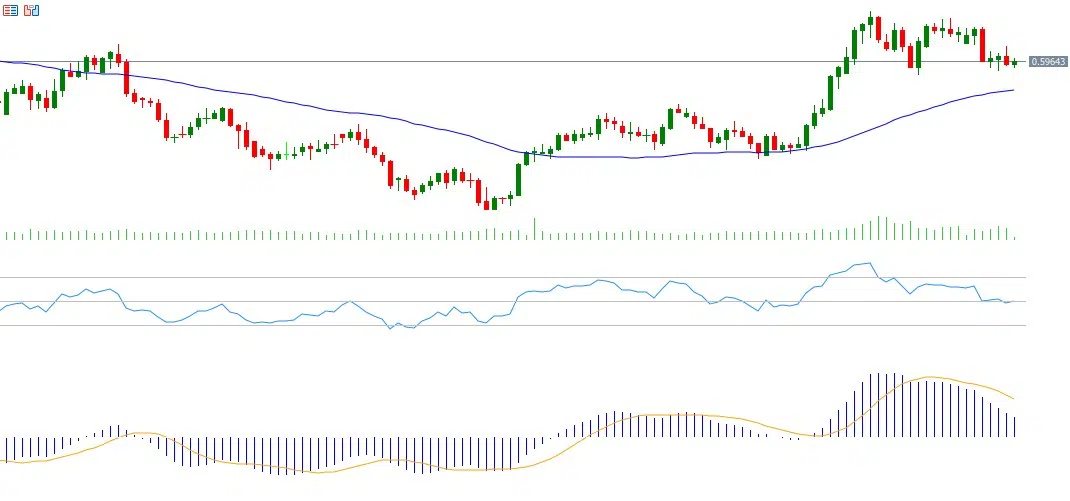
From a technical perspective, a break below the pivot level at 0.5971 could open the way for a test of support levels at 0.5938, 0.5918, and 0.5885. On the upside, a break above the pivot could see the pair target resistance levels at 0.5991, 0.6024, and 0.6044.
The Relative Strength Index (RSI) is currently around 51 points, indicating a moderately positive momentum for the New Zealand dollar against the US dollar.
Please note that this analysis is provided for informational purposes only and should not be considered as investment advice. All trading involves risk.