The VIX volatility and fear index fell to 13.38 points on Wednesday, its lowest level since December 13, 2024, signaling a state of comfort and growing investor appetite for U.S. equities.
At this stage, U.S. equity indices are experiencing positive momentum, supported by technology stocks linked to artificial intelligence. The index composed of the “Magnificent Seven” (MAGS) has risen by around 25% since the beginning of the year. Likewise, the Philadelphia Semiconductor Index (SOX) has gained approximately 45% year to date, reflecting continued strong demand for AI-related products, along with substantial investment inflows into the sector’s infrastructure.
What stands out, however, is the outperformance of the Russell 2000 index, which includes small- and mid-cap stocks, as it approaches its record levels compared with other indices. The Russell 2000 has also outperformed other indices during November and December so far, indicating a rotation in investment portfolios by investors, particularly in an environment of U.S. interest rate cuts.
Despite elevated valuations, expectations point to the continuation of positive momentum in U.S. equities in the coming period, supported by several factors. Most notably, the financial results of the majority of U.S. companies came in better than analysts’ expectations in the third quarter of this year, with markets now awaiting fourth-quarter earnings.
This momentum is also supported by a U.S. interest rate-cut environment, even though the Federal Reserve’s dot plot indicates only one rate cut of 25 basis points next year, while markets are pricing in two cuts. Nevertheless, the pace of easing could be faster, with the possibility of three to four rate cuts next year, especially with President Trump appointing a new Federal Reserve chair, regardless of the individual, as a more accommodative stance is expected starting in May. With five Fed meetings scheduled between June and December, a 25-basis-point cut at each meeting could bring interest rates down to a range of 2.25%–2.50%. This would imply entering a negative real interest rate environment amid persistent inflation, which could face additional upside pressures due to tariffs, thereby supporting U.S. equities, particularly small- and mid-cap stocks and value stocks.
The banking sector is also showing strong performance, as the KBW Bank Index recorded a new all-time high on Wednesday, posting gains of nearly 32% since the beginning of the year. The industrial sector has also performed well, with XLI ETF, which tracks industrial stocks, rising by more than 20% year to date. Meanwhile, the healthcare sector has delivered solid performance as well, with XLV ETF, which tracks healthcare stocks, up more than 13% since the start of the year.
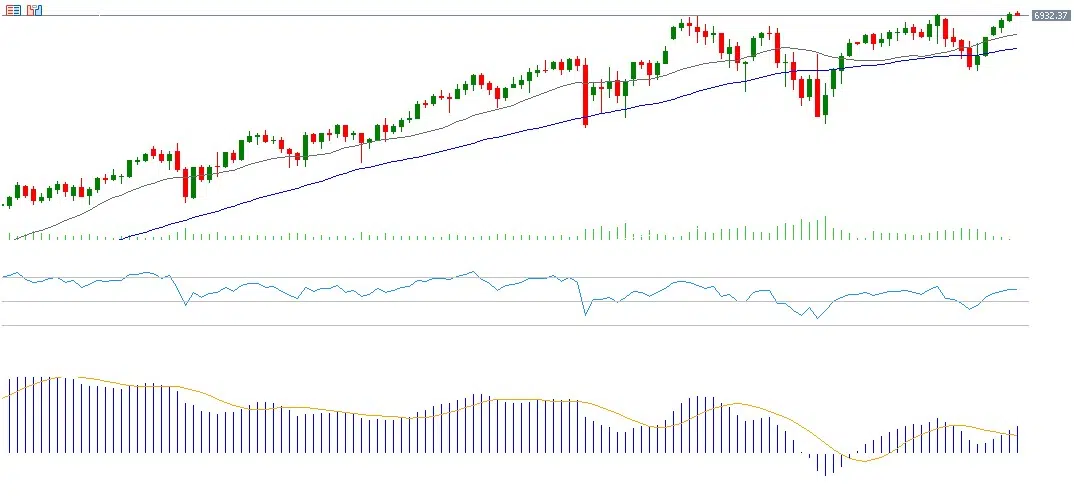
From a technical perspective, indicators point to the continuation of the upward trend in the S&P 500 index, which recorded a new all-time high on Wednesday at 6,937 points, up around 18% since the beginning of the year to date. In addition, the alignment of the 20-, 50-, and 200-day moving averages remains positive, with the 20-day average above the 50-day average, which in turn is above the 200-day average, reflecting a constructive technical setup. The Relative Strength Index (RSI) stands at 61 points, indicating positive momentum. A bullish crossover is also visible between the MACD line and the signal line, further confirming the continuation of positive momentum.
Please note that this analysis is provided for informational purposes only and should not be considered as investment advice. All trading involves risk.