
Few data releases carry as much weight on the economic calendar as the Consumer Price Index, or CPI.
On release day, major currency pairs can jump within seconds. Moves of 50 to 100 pips are common when the result is very different from what traders expected. The reason for this is simple. CPI shows how inflation is changing, and this directly affects interest rate expectations. Interest rates are one of the main drivers of currency value.
For Forex traders traders, CPI is an important indicator for monitoring economic news, monetary policy expectations and market volatility.
The guide explains what CPI is in Forex, how CPI is calculated, why CPI news in Forex affects currency markets and how traders approach CPI releases while managing the associated risks.
What Is CPI in Forex Trading?
The Consumer Price Index measures the average change over time in the prices consumers pay for a basket of goods and services.
The U.S. Bureau of Labor Statistics states that the CPI measures inflation as experienced by consumers in their everyday expenses. It covers more than 200 categories. These are grouped into eight major areas: food and beverages, housing, apparel, transportation, medical care, recreation, education and communication, and other goods and services.
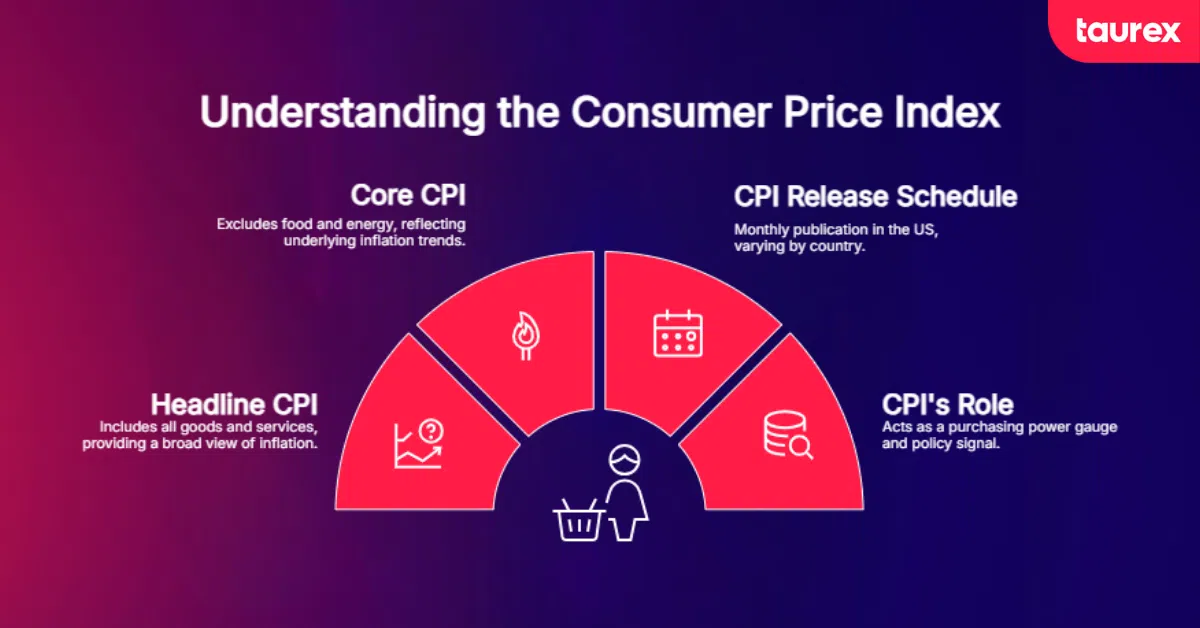
To understand how CPI impacts trading, you should know that the index comes in two main forms, and the difference between them matters for how markets respond:
- Headline CPI includes everything in the basket, including volatile food and energy prices. It gives the broadest picture of price changes but can be influenced by temporary supply shocks in oil or agricultural commodities.
- Core CPI removes food and energy from the calculation. The Core CPI vs Headline CPI distinction is one of the most important separations in CPI Forex analysis: the Core reading tends to be the one central banks and professional traders watch more closely, because it better reflects the underlying inflation trend that monetary policy can actually influence.
In the United States, the Bureau of Labor Statistics (BLS) publishes CPI monthly, typically at 8:30 AM EST on the second Tuesday of the month. The timing differs by country, but CPI remains an important inflation indicator for Forex traders because it can influence interest rate expectations and currency movements.
CPI Release Dates
Knowing the exact release dates in advance lets traders prepare positions, set alerts, and avoid being caught off guard by volatility. The table below shows the next six scheduled U.S. CPI releases, alongside the equivalent dates for the UK and Eurozone. All times are local to each region.
| Data For (Month) | U.S. CPI Release Date | U.S. Release Time | UK CPI Release Date | UK Release Time | Eurozone HICP Flash Estimate | Eurozone Full Release |
| April 2026 | 12 May 2026 | 8:30 AM ET | 20 May 2026 | 7:00 AM BST | 30 April 2026 | 20 May 2026 |
| May 2026 | 10 June 2026 | 8:30 AM ET | 17 June 2026 | 7:00 AM BST | 2 June 2026 | 17 June 2026 |
| June 2026 | 14 July 2026 | 8:30 AM ET | 22 July 2026 | 7:00 AM BST | 1 July 2026 | 17 July 2026 |
| July 2026 | 12 August 2026 | 8:30 AM ET | 19 August 2026 | 7:00 AM BST | 31 July 2026 | 19 August 2026 |
| August 2026 | 11 September 2026 | 8:30 AM ET | 16 September 2026 | 7:00 AM BST | 1 September 2026 | 17 September 2026 |
| September 2026 | 14 October 2026 | 8:30 AM ET | 21 October 2026 | 7:00 AM BST | 2 October 2026 | 16 October 2026 |
| October 2026 | 10 November 2026 | 8:30 AM ET | 18 November 2026 | 7:00 AM GMT | 4 November 2026 | 18 November 2026 |
| November 2026 | 10 December 2026 | 8:30 AM ET | 16 December 2026 | 7:00 AM GMT | 1 December 2026 | 17 December 2026 |
| December 2026 | Not yet published | 8:30 AM ET | 20 January 2027 | 7:00 AM GMT | 6 January 2027 | 19 January 2027 |
How Is the Consumer Price Index Calculated?
Behind every CPI number is a large data collection process. In the U.S., the Bureau of Labor Statistics tracks around 80,000 prices across many products and locations.
These items are grouped into categories like housing, transport, and food. Each category is given a weight based on how much people spend on it. For example, housing has the biggest weight, so changes in housing prices have a larger impact on CPI than smaller categories like clothing.
The formula itself is straightforward:
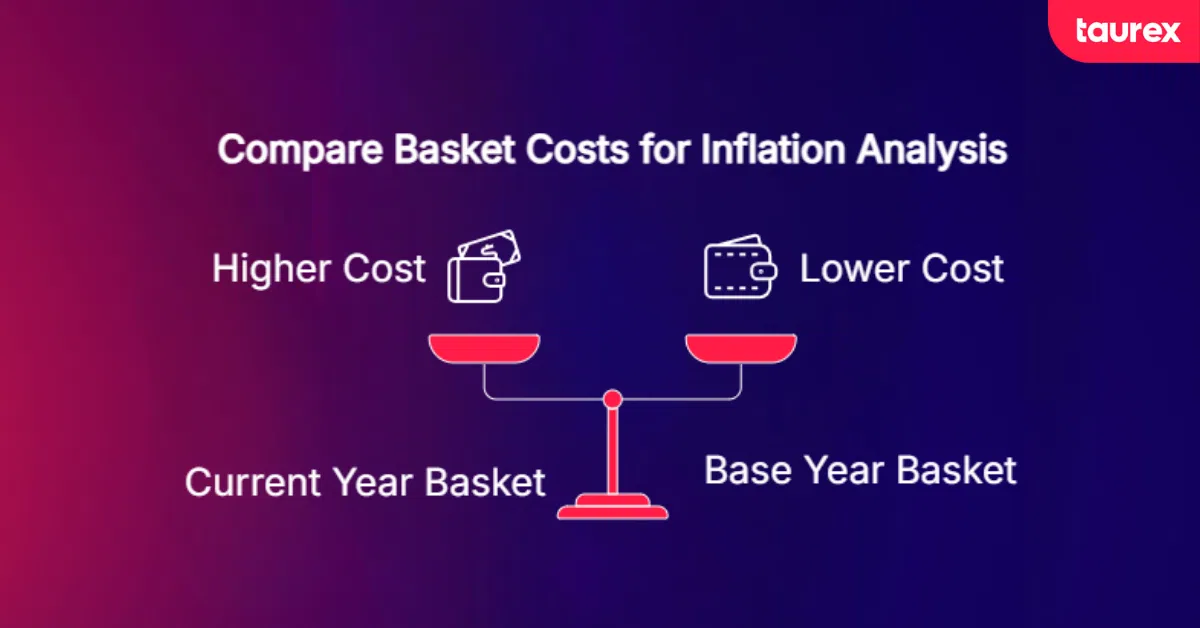
CPI = (Cost of Basket in Current Year / Cost of Basket in Base Year) x 100
The base year is set at 100. If the number is above 100, it means prices have gone up. For example, if a basket of goods costs 500 in the base year and 550 today, the CPI would be 110. This shows that prices have increased by 10%.
The calculation also adjusts for small changes in consumer behavior. If prices rise for certain items, people may switch to cheaper alternatives. CPI takes this into account to give a more realistic view of inflation.
How To Calculate the Inflation Rate From CPI
Once you have two CPI readings, calculating the inflation rate is straightforward:
Inflation Rate = [(CPI New Period – CPI Previous Period) / CPI Previous Period] x 100
As a real-world example, if CPI stood at 44.4 in 1973 and rose to 49.3 in 1974, the inflation rate for that year was approximately 11%.
Forex traders tend to focus on both year-over-year (YoY) and month-over-month (MoM) comparisons. YoY shows the broader trend, while MoM offers a more current signal on whether inflation is accelerating or cooling.
It was precisely this kind of inflation rate calculation that underpinned the Fed’s aggressive rate hike cycle, which saw rates climb from 0.1% to 5.25% between December 2021 and August 2023. Following three rate cuts in the second half of 2025, the Fed has since eased to a target range of 3.50%–3.75%, where it has held steady through early 2026 as inflation remains above its 2% goal.
Why Is CPI Important in Forex Trading?
CPI in Forex trading is a direct input into central bank monetary policy decisions, making it one of the most closely monitored indicators on the market.
The mechanism works like this: higher CPI readings build expectations for interest rate hikes, which tend to strengthen the relevant currency as capital moves toward higher-yielding assets. Lower CPI readings have the opposite effect, supporting rate cut expectations and weakening the currency.
Since the USD is the world’s most traded currency and sits on one side of the majority of Forex pairs, U.S. CPI data carries the broadest global reach, directly affecting pairs like EUR/USD, USD/JPY, and GBP/USD.
What really moves the market is not just the CPI number, but how it compares to expectations. If CPI is higher than expected, the dollar can rise quickly. If it is lower, the dollar may fall.
Central banks also pay close attention to Core CPI, which removes food and energy prices. This gives a clearer view of long-term inflation and is important for traders to watch.
CPI is not only important for trading. It is also used to adjust wages, taxes, and government payments. This is why the release can affect both the economy and the markets at the same time.
How to Trade CPI in Forex: Strategies for CPI Releases
Preparation begins well before the data is published. Check your economic calendar ahead of the release: CPI is classified as a high-impact event. Monitor analyst consensus forecasts carefully, because the market reaction is tied largely to the gap between what was expected and what actually comes in.
A deviation of 0.2% or more from consensus may create enough momentum for a sustained directional move, while a 0.1% deviation more often results in a whipsaw, where price spikes and then quickly reverses. Identifying key support and resistance levels on your charts ahead of time gives you reference points for where the market may stall or accelerate.
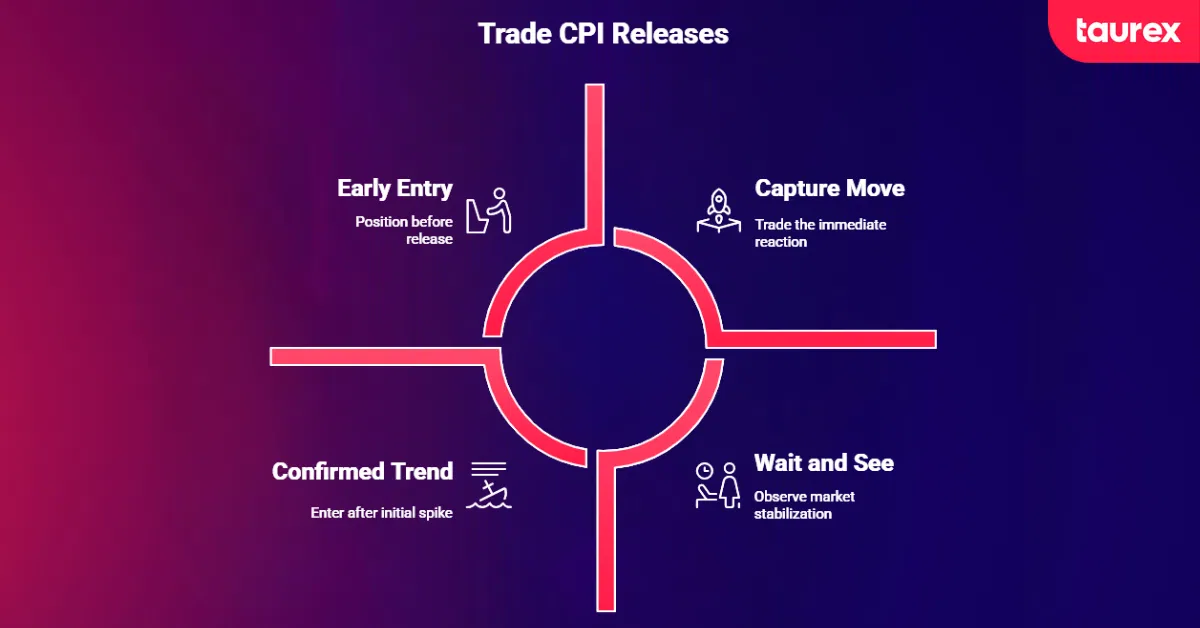
Several CPI trading strategies are commonly used:
- Pre-CPI positioning involves taking a directional view before the release based on prior inflation trends and forecasts. This carries a higher risk but may deliver an early entry advantage if the analysis proves correct.
- Post-CPI news trading means entering after the release once the initial spike settles, giving a clearer read on direction with less noise.
- The Second Wave approach is based on the observation that in the first 0 to 60 seconds, bank algorithms pull their limit orders to avoid being caught on the wrong side, creating a liquidity gap. Between minutes 1 and 10, the price attempts to find the fair value. Around the 15-minute mark, the true institutional trend tends to begin as spreads normalize.
- The straddle strategy involves placing both buy and sell orders around the current price just before the release, aiming to capture the large move in whichever direction it goes.
- Breakout trading focuses on watching key levels and entering when the price breaks through with momentum after the release.
- Trend following uses indicators like RSI, Bollinger Bands, or moving averages to confirm whether a CPI-driven move has enough strength to sustain, which ties well into broader fundamental analysis methods.
One thing to keep in mind: pay attention to the gap between Headline CPI and Core CPI. If they diverge significantly, the initial move may not hold, as traders reassess which reading carries more weight for policy.
How CPI Reports Impact the Forex Market
CPI releases are among the most volatile events on the Forex calendar. Options traders, for instance, were pricing in an average 38-pip move in EUR/USD and a 58-pip move in USD/JPY ahead of a single 2024 CPI release. Major pairs react directly to U.S. CPI, and commodity-linked currencies such as AUD/USD and USD/CAD often follow.
The general pattern tends to play out like this:
- Hot CPI (above forecast): USD may strengthen, EUR/USD and GBP/USD may decline, risk currencies and gold may weaken, and rate hike expectations may accelerate.
- Soft CPI (below forecast): USD may weaken, EUR/USD and GBP/USD may rise, gold and risk assets may benefit, and rate cut expectations may grow.
In October 2024, Core CPI unexpectedly widened to 3.3% with the shelter index rising 4.9% YoY, causing EUR/USD to bounce from 1.0900 back to 1.0937 in an immediate reaction. In 2022, as U.S. CPI surged while Japan’s remained subdued, USD/JPY appreciated significantly from March to November, driven by the stark policy difference between the Federal Reserve and the Bank of Japan.
There is also the “priced in” dynamic to consider. If markets have been buying USD in anticipation of a hot CPI reading for 48 hours before the release, the actual print, even if it meets or slightly beats expectations, can trigger a “sell the fact” reversal that may catch directional traders off guard.
What to Look for Inside the CPI Report
Headline CPI and Core CPI usually attract the most attention, but the components behind the numbers can help explain why inflation changed and how markets may interpret the release.
- Shelter costs make up a large share of the CPI basket and tend to adjust more slowly than many other categories. Persistent shelter inflation can keep core inflation elevated even when price pressures elsewhere are easing.
- Services excluding shelter, sometimes referred to as “supercore” inflation, can provide additional insight into underlying service-sector price pressures. Strong readings may reinforce expectations that interest rates could remain higher for longer.
- Used vehicles and core goods can be more volatile from month to month and may reflect temporary factors such as supply conditions. Traders may therefore look at how much these categories contributed to the overall CPI surprise before judging the broader inflation trend.
For CPI in Forex trading, the headline surprise is only part of the picture. Traders can compare the actual reading with the forecast, then look at which components drove the difference. A broad-based inflation surprise may carry different implications for interest rate expectations than a move concentrated in one volatile category.
Average Pip Movement: CPI Days vs. Normal Days
U.S. CPI releases can increase volatility across major USD pairs and gold, especially when the actual reading differs significantly from market expectations. Traders may react quickly as they reassess inflation, interest rate expectations and the outlook for Federal Reserve policy.
The size and direction of a CPI Forex move are not fixed. Market reactions can depend on the size of the surprise, differences between Headline and Core CPI, existing positioning, liquidity and broader economic conditions.
The table below shows which instruments are typically most sensitive to U.S. CPI releases and the main factors that can influence their reaction.
| Instrument | Typical CPI Sensitivity | What Can Drive the Reaction |
| EUR/USD | High | Changes in USD rate expectations and Fed outlook |
| GBP/USD | High | U.S. inflation surprise and USD repricing |
| USD/JPY | High | U.S. yields and interest rate differentials |
| USD/CAD | Moderate to High | USD reaction alongside Canadian market factors |
| AUD/USD | Moderate to High | USD sentiment and broader risk appetite |
| XAU/USD | High | Changes in real yields, interest rate expectations and USD strength |
Pairs such as EUR/USD, GBP/USD and USD/JPY can be especially sensitive to CPI news because changes in U.S. rate expectations directly affect the relative outlook for the dollar. Gold can also experience increased volatility as real yields and USD expectations shift.
How Global Inflation Trends Affect Forex Markets
Inflation is not just a U.S. story. Every major economy is at a different stage of its inflation cycle, and these differences are what drive many Forex opportunities. Central banks respond to their own CPI data by adjusting interest rates. When inflation rises, rates often go up, which can strengthen a currency. When inflation falls, rates may be cut, which can weaken it.
In recent years, central banks have taken different paths. The U.S. raised rates aggressively and held them at elevated levels before beginning to cut in late 2025, while the Eurozone moved toward rate cuts earlier as inflation eased more quickly. The UK followed a mixed path, and Japan remained an outlier with very low rates.
This gap between countries is known as inflation divergence, and it is one of the main drivers of currency movements. For example, when the U.S. raised rates while Japan held steady, USD/JPY moved sharply higher.
CPI releases are key moments for traders. Each report can trigger fast price movements, especially when the data differs from expectations. U.S. CPI affects all USD pairs, while UK and Eurozone data mainly impact their own currencies.
The key is not simply whether CPI rises or falls. Traders also watch how the result compares with forecasts, which components drove the change and how the release may affect expectations for future monetary policy.
How to Read CPI Alongside PPI and PCE
Experienced traders do not look at CPI on its own. Two other inflation measures help give a clearer picture.
The Producer Price Index (PPI) looks at inflation earlier in the supply chain, before products reach consumers. It measures price changes at the wholesale level. If PPI is rising, it often means higher costs may reach consumers later, which can push CPI higher in the future.
When both PPI and CPI are rising together, it may suggest stronger inflation pressure and a higher chance of interest rate hikes. If PPI starts to fall while CPI is still high, it can mean inflation may ease in the coming months.
The Personal Consumption Expenditures (PCE) Price Index is the Federal Reserve’s preferred inflation measure. It is similar to CPI but uses a different method. It gives more weight to healthcare and adjusts more easily when people change what they buy. The Fed focuses on Core PCE, which removes food and energy prices, when aiming for its 2 percent inflation target. Because of this, a CPI surprise may not have a lasting effect on the market if PCE tells a different story.
In simple terms, CPI often triggers the first market reaction, PPI can hint at where inflation is heading next, and PCE is the key measure the Federal Reserve relies on most.
Risks and Challenges of Trading CPI Reports
CPI is one of the highest impact events a Forex trader will face, and it carries proportional risks.
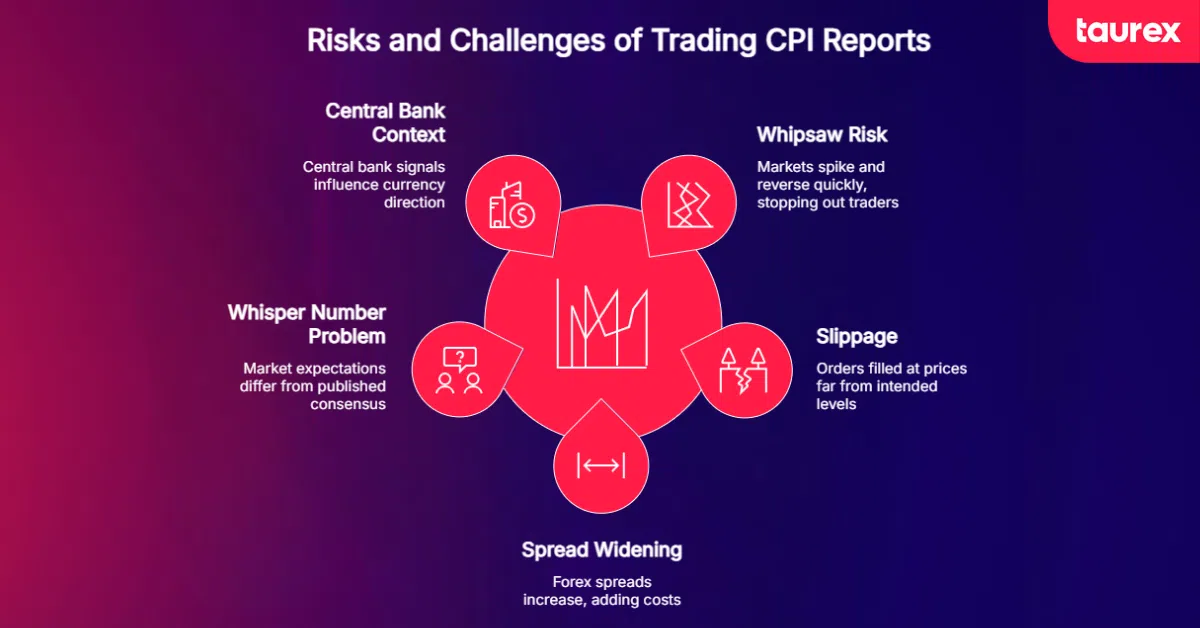
- Whipsaw risk is the most common concern. Markets may spike sharply in one direction during the first 60 seconds, then reverse just as quickly, stopping out traders who chased the initial move. A 0.1% deviation from consensus is often enough to create this kind of choppy, directionless price action.
- Slippage becomes a real concern during CPI releases. Bank algorithms pull their limit orders immediately after the number is published, creating liquidity gaps where orders may get filled at prices far from intended levels. Wider stop-losses and smaller position sizes can help manage this.
- Spread widening adds another layer of cost. Forex spreads on major pairs can spike in the seconds before and after a CPI print, increasing both entry and exit costs. This is something to factor into your risk-to-reward calculation before placing any order.
- The “Whisper Number” problem may catch traders by surprise. Sometimes CPI beats the published consensus forecast, yet the USD sells off because institutional desks had been positioning for an even higher number. If the market spent 48 hours buying USD in anticipation, the move was already priced in, and even a strong print may trigger a “sell the fact” reaction.
- Central bank context also matters. A high CPI number does not always strengthen a currency if the central bank has already signaled it will look past near-term inflation spikes. There are periods where CPI and the U.S. Dollar Index diverge, suggesting other forces are driving currency direction.
For those still developing their trading approach, observing CPI behavior in a demo environment first is a prudent step. Trading smaller than normal, always using a stop-loss, and avoiding the first 60 seconds of a release are practical steps that may help manage volatility without taking on disproportionate risk. When trading high-impact events, choosing a broker with reliable execution matters.
A broker like Taurex offers fast execution, tight spreads, and stable trading conditions during volatile events like CPI, helping traders manage risk more effectively when market conditions become unpredictable. You can practice these strategies safely by opening a demo account with Taurex and testing your trades in real market conditions without risking real money.
FAQ
How does CPI affect Forex?
CPI shows how fast prices are rising. Central banks use it to decide interest rates. If CPI is higher than expected, traders may expect rate hikes. This can make the currency stronger. If CPI is lower, traders may expect rate cuts, which can weaken the currency. The biggest moves happen when the result is very different from what the market expected.
How often are CPI reports released?
In the United States, CPI is released once a month, usually on the second Tuesday at 8:30 AM Eastern Time. Other countries have different schedules. The UK and Eurozone also report monthly, while Australia reports quarterly. Traders track these dates in advance because CPI is one of the most important market events.
Does CPI affect all Forex pairs equally?
No, the impact is not the same for all pairs. U.S. CPI affects the most pairs because the dollar is widely used in global trading. This means pairs like EUR/USD, USD/JPY, and GBP/USD often react strongly. CPI from other regions mostly affects their own currencies. For example, UK CPI moves GBP pairs, and Eurozone CPI moves EUR pairs.
Is a lower or higher CPI figure good for markets?
It depends on the situation. Higher CPI can strengthen a currency because it may lead to higher interest rates. But it can also put pressure on stocks and risk assets. Lower CPI can support stocks because it may lead to lower rates, but it can weaken the currency. What matters most is how the number compares to expectations.
What is CPI used for in Forex trading?
CPI in Forex trading helps traders assess inflation trends and potential changes in monetary policy. Traders compare actual CPI with forecasts and previous readings to understand how inflation data could affect interest rates, currency demand and market volatility.