
What Are Currency Futures? A Beginner’s Trading Guide
Currency markets saw around $9.51 trillion in average daily trading volume in April 2025, according to CME Group’s 2026 analysis of BIS data. This record level of activity highlights the scale of the FX market and helps explain why multiple ways of trading currencies have developed over time.
Currency futures are one of these methods. They offer a more structured and regulated way to take part in the market. Some traders use them to manage risk, while others may trade based on market expectations or to diversify.
In this guide, we will cover the key concepts in simple terms, including how contracts work, how margin is used, and the main risks to be aware of.
What Are Currency Futures?
A currency futures contract is a standardized agreement to buy or sell a set amount of a currency at a predetermined price on a future date. These contracts trade on regulated exchanges and have defined contract sizes, expiration dates and settlement terms.
Currency futures are commonly based on pairs such as EUR/USD and USD/JPY, so their prices move in response to changes in exchange rates and other market factors.
For example, traders familiar with Forex trading may use Euro FX futures if they expect the euro to strengthen against the US dollar.
Currency futures come in standardized contract sizes. For example, a standard CME Euro FX futures contract represents €125,000, while a Micro EUR/USD futures contract represents €12,500. Smaller contracts can therefore provide lower notional exposure than standard futures.
Settlement depends on the specific contract. Many major CME FX futures, including EUR/USD, GBP/USD and JPY/USD futures, are physically settled, while some contracts use cash settlement. Traders can also close or roll a position before expiration.
Standard vs. Micro Currency Futures
Currency futures are available in different contract sizes. Standard contracts provide larger notional exposure, while micro contracts use smaller standardized sizes that can make position sizing more flexible.
| Standard Currency Futures | Micro Currency Futures | |
| Contract size | Larger | Smaller |
| Notional exposure | Higher | Lower |
| Capital required | Generally higher | Generally lower |
| Position sizing | Less flexible | More flexible |
For example, a standard Euro FX futures contract represents €125,000, while a Micro EUR/USD futures contract represents €12,500. Micro futures are separate standardized contracts rather than fractions of a standard contract.
The smaller contract size can help traders manage exposure more precisely and may be more suitable for smaller accounts or strategies that require tighter position sizing.
What Are The Key Differences Between Spot Rate Vs. Futures Rate?
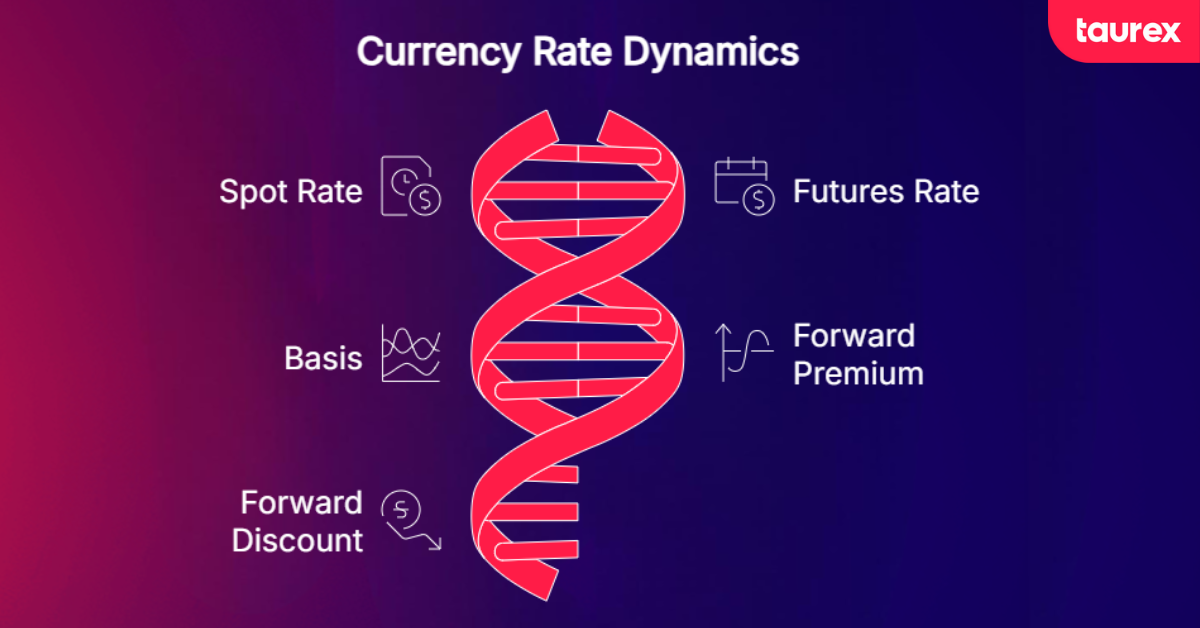
The spot rate is the current market price for exchanging one currency for another. For example, the USD/JPY spot rate shows how many Japanese yen are required to buy one US dollar.
The futures price is the price of a standardized currency futures contract with a specified expiration date. It can trade above or below the spot price depending mainly on interest rate differences between the two currencies and the time remaining until expiration.
The difference between the spot price and futures price is known as the basis. As a currency futures contract approaches expiration, its price generally moves closer to the spot price.
For example, AUD/USD futures may trade above the current AUD/USD spot rate when interest rate differences support a higher futures price. In this case, the futures contract trades at a premium to spot. If the futures price is lower than the spot rate, it trades at a discount.
Price is only one difference between the two markets. Currency futures and spot Forex also differ in how they are traded, structured and settled.
Currency Futures vs. Spot Forex
Currency futures and spot Forex trading both provide exposure to currency price movements, but they operate differently.
| Currency Futures | Spot Forex | |
| Market | Regulated exchanges | Over-the-counter (OTC) market |
| Contract size | Standardized | More flexible |
| Expiration | Fixed expiry dates | No fixed expiry |
| Pricing | Centralized exchange pricing | Prices vary between brokers and liquidity providers |
| Margin | Based on futures requirements | Depends on broker and account conditions |
Currency futures have standardized contract sizes and expiration dates. Spot Forex offers more flexibility in position sizing and does not require traders to manage contract expiry.
Both markets can be used to speculate on currency movements or manage currency exposure, but their trading mechanics, costs and settlement structures differ.
How Do Currency Futures Markets Work?
Currency futures are mainly traded on large exchanges. The Chicago Mercantile Exchange is one of the most widely used, but other exchanges in the US, Europe, and Asia also offer these contracts.
These exchanges play an important role in how trading works. They act as a middle party between buyers and sellers, which can reduce the risk of one side not meeting their obligation. They also make trading data public, so prices and trading activity are more transparent compared to some other markets.
Forex trading hours usually run almost all day during the week, with short breaks. Prices are often updated and settled daily, which means profits or losses may be added to or taken from your account at the end of each trading day, not just when the contract ends.
Currency futures prices may move based on several factors. These include interest rates, inflation, economic data, and decisions made by central banks. Global events and trade conditions can also have an impact.
If you are familiar with Forex technical analysis, you may notice that similar charts and tools can be used to analyse currency futures.
Why Do Forex Traders Use Currency Futures?
Currency futures can serve different purposes depending on a trader’s goals, from managing exchange-rate risk to taking a position on future currency movements.
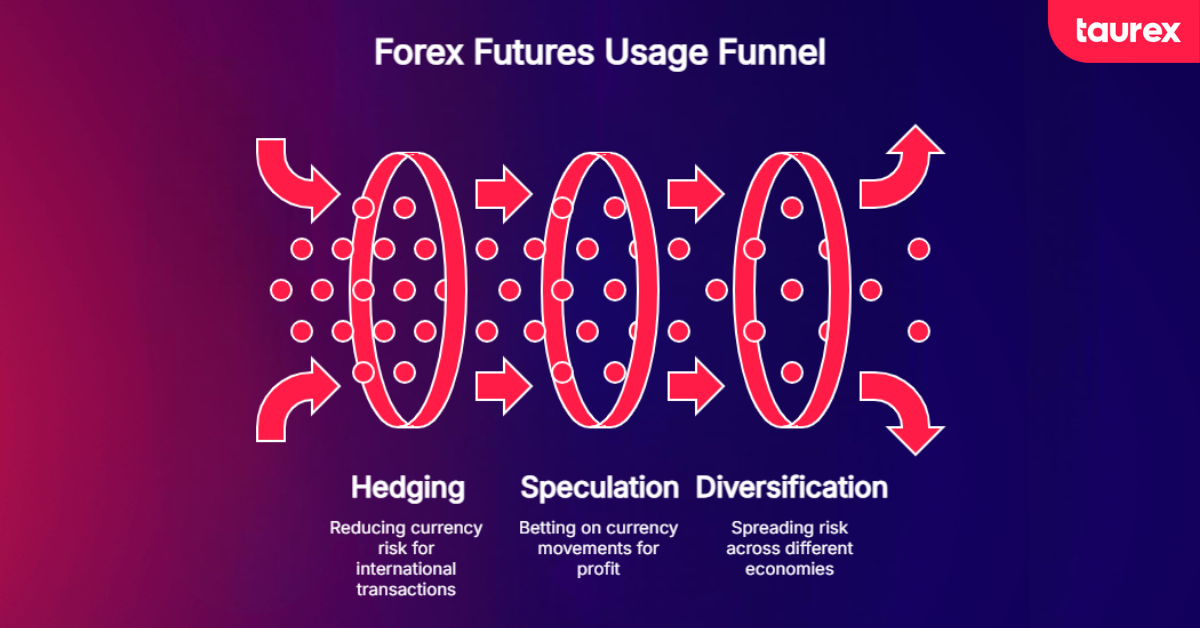
Hedging
Companies and investors with international currency exposure can use futures to reduce uncertainty around future exchange rates. For example, a US business that needs to make a payment in euros may use currency futures to manage the risk of the euro strengthening before the payment is due.
If the euro rises, gains on the futures position may help offset the higher cost of buying euros in the spot market. Currency futures have standardized contract sizes and expiration dates, making them transparent and exchange-traded, though less customizable than OTC forward contracts.
Speculation
Traders can also use currency futures to take positions based on expected exchange-rate movements. For example, a trader who expects the British pound to strengthen against the US dollar may take a position based on movements in GBP/USD.
Currency futures are traded on margin, allowing traders to control a larger notional position with less capital than the full contract value. This can increase potential gains, but it can also magnify losses. Unlike spot Forex, futures trade on regulated exchanges with standardized contracts and centralized clearing.
Diversification
Currencies often move independently of stocks and bonds, so they can help spread risk. Looking at different economies, FX futures prices let traders gain exposure to EUR for Europe, JPY for Japan, AUD for Australia, or MXN for Mexico. Micro contracts allow smaller traders to buy fractions of standard contracts, making it easier to diversify even with a modest account size.
What Is The Role Of Margin In Currency Futures?
Margin in currency futures may feel familiar if you have experience with stocks, but it works a bit differently. In futures, margin is not a loan. It can be thought of as a deposit or performance bond that may cover potential losses on your position. Futures margin can be around 3 to 12% of the total contract value, which is often much lower than the margin required for stocks.
There are two main types:
- Initial margin is the amount you may need to open a new position.
- Maintenance margin is the minimum balance you may need to keep to hold that position. If your balance falls below this level, a margin call can occur, which may mean adding more funds or having the position closed automatically.
For example, one standard CME Swiss Franc futures contract represents CHF 125,000. Traders familiar with the USD/CHF pair can use this as a reference point when comparing spot and futures exposure.
The margin required is only a fraction of the contract’s total notional value and can change with market conditions. Micro Swiss Franc futures use a smaller standardized contract size, which can reduce the amount of capital needed compared with the standard contract.
Margins can change. During periods of higher volatility, exchanges may raise requirements to manage risk. Some traders, like hedgers with underlying cash positions, may see lower margins than speculators. The daily mark-to-market process means your account can gain or lose value every day depending on price movements.
What Are The Risks of Trading Currency Futures?
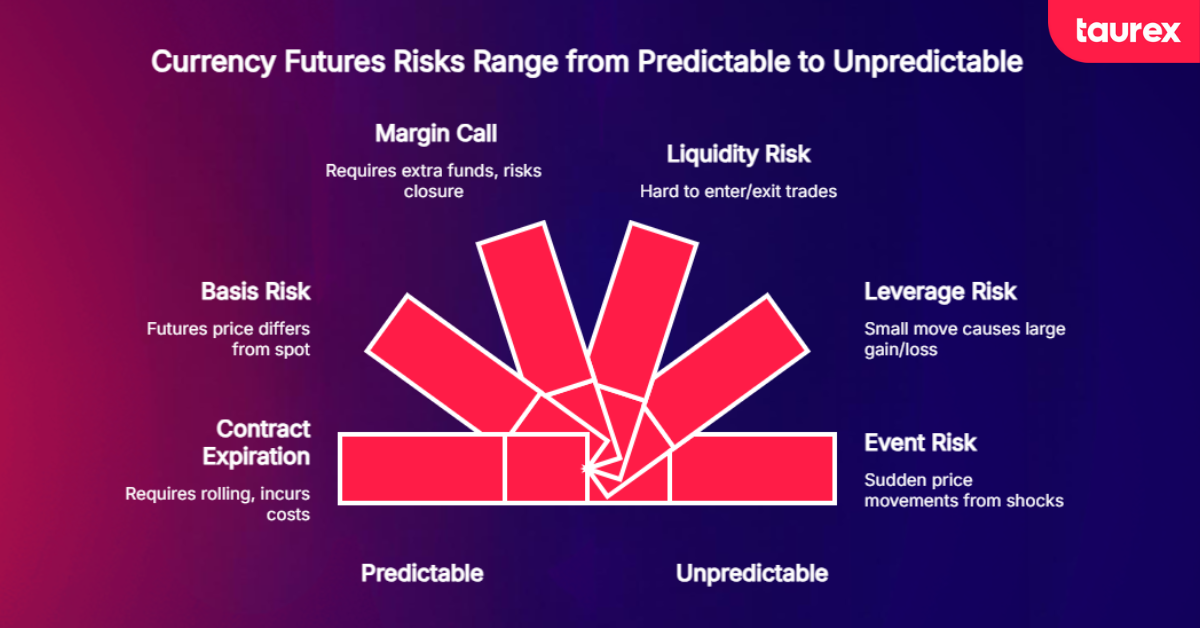
Trading currency futures may involve several types of risk that traders might want to consider:
- Leverage risk: Because futures allow you to control a large contract with a smaller deposit, even a small change in the exchange rate can lead to a relatively large gain or loss on your margin. For example, a 0.5% move on a $137,500 EUR/USD futures contract could translate to roughly $700, which is about 28% of a $2,500 margin deposit.
- Margin call risk: If the market moves against you, your broker may ask for extra funds to maintain the position. If additional funds are not added, the position could be closed automatically, sometimes at a less favorable price.
- Liquidity risk: Less popular currency pairs, such as USD/ZAR or USD/HUF, may have wider spreads and thinner order books. This can make it harder to enter or exit trades at the expected price, especially during fast-moving markets.
- Basis risk: For hedgers, the futures price may not always match the spot rate at contract expiry. This difference can make the hedge outcome slightly different from expected.
- Event and geopolitical risk: Central bank decisions, elections, or macroeconomic shocks can create sudden price movements. For example, the USD fell roughly 12% from January to early July 2025, which caught some traders by surprise.
- Contract expiration risk: Futures contracts have fixed expiry dates. If you want to continue a position past expiry, you may need to “roll” it by closing the expiring contract and opening the next one. This can involve extra costs and small differences in pricing. The mechanics of tick sizes, order types, and roll logistics all require dedicated learning before committing real capital.
Overall, trading in currency futures will benefit from careful risk management, such as controlling position size, understanding leverage, and considering stop-loss levels. For beginners in Forex trading, we suggest practicing with a demo account to get familiar with these mechanics before trading with real money.
Currency Futures Trading Examples
To understand how to trade currency futures, it can help to look at practical examples. Seeing how hedgers and speculators use these contracts in real situations shows the mechanics of entering, managing, and closing positions, as well as the risks and potential rewards involved.
Hedging A Future Payment In Euros
Imagine a US software company needs to pay a German supplier €250,000 in three months. The current EUR/USD futures price is around 1.10, which means the payment would cost about $275,000. The company is worried that the euro could rise to 1.15, which would make the payment $287,500, an extra $12,500.
To manage this risk, the company can buy 2 standard CME EUR/USD futures contracts, 2 times €125,000 equals €250,000, at 1.10. If the euro does rise to 1.15, the higher cost in the spot market may be partially offset by the gain on the futures contracts. This way, the company can effectively lock in the 1.10 rate and plan its costs with more certainty.
EUR/USD Futures Contract Example: Speculating on USD Strength
A retail trader thinks the US dollar will become stronger while the euro stays stable. With EUR/USD at 1.10, the trader can sell 1 CME EUR/USD futures contract, which controls €125,000 with roughly $2,500 in margin.
If EUR/USD falls to 1.07, the trader may buy back the contract at a lower price and make a gain based on the 300 pip move. On a standard contract, each pip is worth about $12.50, so the move could be around $3,750. But if EUR/USD rises to 1.13 instead, the trade may move against the trader by a similar amount, which could result in a $3,750 loss.
These examples show how trading in currency futures can be used for both hedging and speculation. They also show why understanding FX futures prices and leverage is important because even small price changes can have a large effect on your account.
How to Trade Currency Futures: Getting Started Step by Step
Trading currency futures can seem complex at first, but breaking it down into steps makes it manageable. Here’s a straightforward approach for getting started:
1. Understand How Currency Futures Work
Before trading, learn the basic mechanics of currency futures, including standardized contract sizes, tick values, expiration dates, margin requirements and daily mark-to-market settlement.
It is also important to understand how currency futures differ from spot Forex and Futures CFDs, as these instruments have different trading and settlement structures.
2. Choose a Trading Platform or Broker
Select a platform that offers currency futures with competitive fees, reliable execution, and access to real-time data. Make sure it aligns with your account size and trading goals. Taurex provides reliable execution, real-time data, and tools to analyze markets. Whether you are just starting or scaling up, Taurex supports different account sizes and trading styles.
3. Review the Contract Specifications
Before opening a position, check the specifications of the selected futures contract. Key details include the contract size, minimum price movement or tick, tick value, expiration date and margin requirement.
Understanding common Forex trading terminology can also make it easier to interpret concepts such as margin, leverage, pips and position size.
4. Analyze the Currency Market
Use technical and fundamental analysis to assess factors that can affect exchange rates. Interest-rate decisions, inflation data, employment reports and central bank policy can all influence currency futures prices.
An economic calendar can help traders track scheduled economic releases and events that may affect currency markets.
5. Manage Your Risk
Decide how much of your account to risk per trade, set stop-loss and take-profit levels, and avoid overleveraging. Futures can move quickly, so protecting your capital is critical.
6. Start Small and Track Performance
Open a demo account with Taurex first to practice without risking real money. Track your trades, refine your strategy, and gradually increase position sizes as you gain confidence.
By following these steps, traders can approach currency futures strategically rather than impulsively, building skills that translate into better decision-making and risk control.
FAQ
How do currency futures and forwards differ?
Futures trade on regulated exchanges with standardised contract sizes and fixed expiry dates, while forwards are OTC agreements with fully customisable terms covering amount, date, and collateral. Futures offer greater price transparency and remove counterparty risk through centralised clearing; forwards provide more flexibility for precise hedging needs.
Where are currency futures traded?
The primary venue is the Chicago Mercantile Exchange (CME) in the United States. Other major exchanges include the Intercontinental Exchange (ICE), Eurex in Europe, and Singapore Exchange (SGX). Retail traders access these markets through regulated Forex brokers and trading platforms.
Are currency futures the same as Futures CFDs?
No. Currency futures are standardized contracts traded on regulated exchanges. Futures CFDs are derivative products that track futures price movements without giving the trader ownership of the underlying futures contract. Their trading conditions, costs and settlement mechanics can therefore differ.
What are the costs associated with trading currency futures?
Key costs include broker commissions per contract, exchange fees, the bid-ask spread, and overnight margin costs. Traders comparing these costs with spot Forex should also understand common Forex trading fees. Unlike some spot Forex brokers, futures exchanges do not embed hidden markups in the spread, making the total cost structure more transparent and easier to calculate.
Can I use currency futures for hedging my Forex positions?
Yes. Currency futures are one of the most widely used hedging tools available. Businesses and traders use them to lock in exchange rates for future transactions, protecting against adverse currency movements in their spot Forex or commercial exposures.
What is the expiry date in a futures contract?
The expiry date is the final date by which the futures contract must be settled. For CME FX futures, expirations typically fall on the third Wednesday of the contract month on a quarterly cycle: March, June, September, and December. Traders who want to maintain exposure beyond expiry must roll their contract into the next active month.
How do prices move in currency futures markets?
Currency futures prices reflect the spot exchange rate adjusted for the interest rate differential between the two currencies, a relationship governed by covered interest rate parity. Prices respond to central bank decisions, economic data releases, geopolitical events, inflation readings, and shifts in global risk sentiment. Learning to read charts and Forex quotes can help you interpret these price movements more effectively.
What are the risks of trading currency futures?
Key risks include leverage-amplified losses, margin calls, basis risk where the futures price diverges from spot at expiry, liquidity risk in thinly traded markets, contract expiration risk, and heightened volatility around macroeconomic events. Proper position sizing and stop-loss orders remain some of the most practical risk management tools available.
Are currency futures physically settled?
Settlement depends on the specific contract. Many major FX futures are physically deliverable, while others may use cash settlement. Traders can also close or roll their positions before the contract reaches settlement.