The U.S. accounts for 18.6% of global Forex turnover, making it the second-largest FX trading center after the UK, while the U.S. dollar appears on one side of about 89% of currency trades worldwide. In a market this active, exchange rates can shift sharply within minutes or even seconds. Traders call this constant movement Forex volatility, and it plays a central role in trading decisions.
Forex volatility describes the size and speed of a currency pair’s price movements over a defined period. Higher volatility means prices are moving more sharply or rapidly, while lower volatility indicates smaller or more gradual changes. Volatility measures the extent of price movement, not the direction in which a currency pair will move.
Understanding Forex market volatility can help traders compare currency pairs, assess market conditions and adjust their position size, stop-loss placement and trading approach. This guide explains what causes volatility, how it is measured, which indicators traders use and how risk can be managed during volatile market conditions.
What Is Volatility In Forex?
In simple terms, volatility in Forex describes how much a currency pair’s price changes over time. A pair that moves 150 pips in a session is more volatile than one that drifts only 20 pips over the same period. The speed and size of those moves both matter because a slow, steady climb and a sudden spike are both forms of volatility, yet each one calls for a very different response from a trader.
Not every currency pair behaves the same way. Major pairs like EUR/USD, USD/JPY, and GBP/USD tend to be less volatile because they are backed by deep liquidity and stable economies. Exotic pairs like USD/ZAR and USD/MXN sit at the other end of the spectrum, with thinner order books, wider spreads, and sharper price moves. Commodity-linked currencies such as AUD, CAD, and NZD fall somewhere in between, often reacting to shifts in raw material prices and global risk appetite.
Neither high nor low volatility is inherently good or bad. Your strategy and context determine whether a volatile environment works in your favour. What matters is that you understand the typical FX volatility profile of any pair before you trade it, because that profile shapes your stop-loss placement, position sizing, and order type selection.
How Is Forex Volatility Measured?
Traders use a mix of historical and forward-looking tools to gauge FX market volatility. Some indicators tell you what has already happened, while others estimate what the market expects next. Using both together gives you the clearest picture.
On platforms like Taurex, traders can access key volatility indicators directly within MetaTrader 4 and MetaTrader 5, including ATR and Bollinger Bands, making it easier to measure volatility in real time without relying on external tools.
VIX and Currency Volatility Indexes
The CBOE Volatility Index (VIX), often called the “Fear Gauge,” measures the market’s expectation of 30-day volatility on the S&P 500. It typically sits between 12 and 35, but according to CEPR research, it jumped above 50 following the sweeping US tariff announcements on 2 April 2025.
For Forex-specific readings, currency versions of the index exist: EUVIX (euro), JYVIX (Japanese yen), and BPVIX (British pound). These are less accessible for retail traders, but they are worth monitoring when you need a sense of implied FX volatility ahead of major events. The key distinction is that the Forex volatility index family measures what the market expects, not what has already happened.
Average True Range (ATR)
Created by J. Welles Wilder Jr., the Average True Range is the most practical volatility tool for Forex traders. It calculates the average price range over a set number of periods, with 14 as the default.
To do this, it takes the largest of three values. These are the current high minus the current low, the difference between the current high and the previous close, and the difference between the current low and the previous close.
Simply put, a higher ATR reading signals higher volatility, while a lower ATR tells you the market is quieter. Most Forex traders use 14 or 20 periods, depending on the pair, and the indicator’s real strength lies in stop-loss and position sizing, which we cover later in this guide.
Bollinger Bands
Developed by John Bollinger in 1980, Bollinger Bands plot a 20-period simple moving average with two bands set at two standard deviations above and below. When the bands widen, volatility expands. When they squeeze together, the market is consolidating, and a breakout often follows.
Statistically, about 68% of closing prices fall within one standard deviation of the mean, and roughly 95% fall within two. Key patterns to watch include the bullish W-Bottom, a potential mean-reversion buy signal, and the bearish M-Top, a potential reversal signal. Understanding how to read charts with these bands applied can give you a real edge when volatility regimes are shifting.
Historical Vs. Implied Forex Volatility
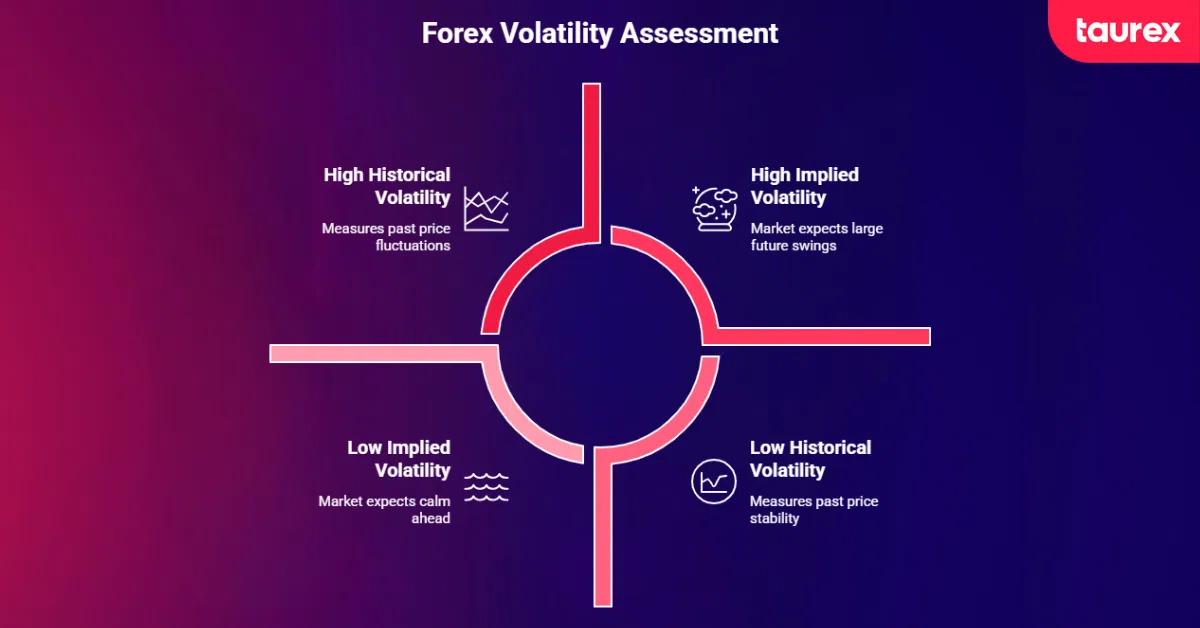
Historical volatility (HV), also called “realised volatility,” measures past price fluctuations over a defined period and is expressed as an annualised percentage. If a pair shows 12% HV, its price moved within roughly a 12% range over the year. Both ATR and Bollinger Bands are HV-based tools.
Implied volatility (IV) works differently. It is forward-looking, derived from Forex options pricing, and reflects the market’s consensus expectation for future price movement. When IV rises, options premiums climb because the market anticipates larger swings.
The VIX and its currency-specific versions fall into this category. Experienced traders use both approaches together: HV establishes a baseline for typical risk, while IV flags upcoming event-driven moves that could push volatility well beyond normal levels.
What Are The Causes Of Volatility In Forex?
Multiple forces drive currency fluctuations at the same time, and understanding them helps you anticipate what is coming rather than simply react to it.
Geopolitical Events
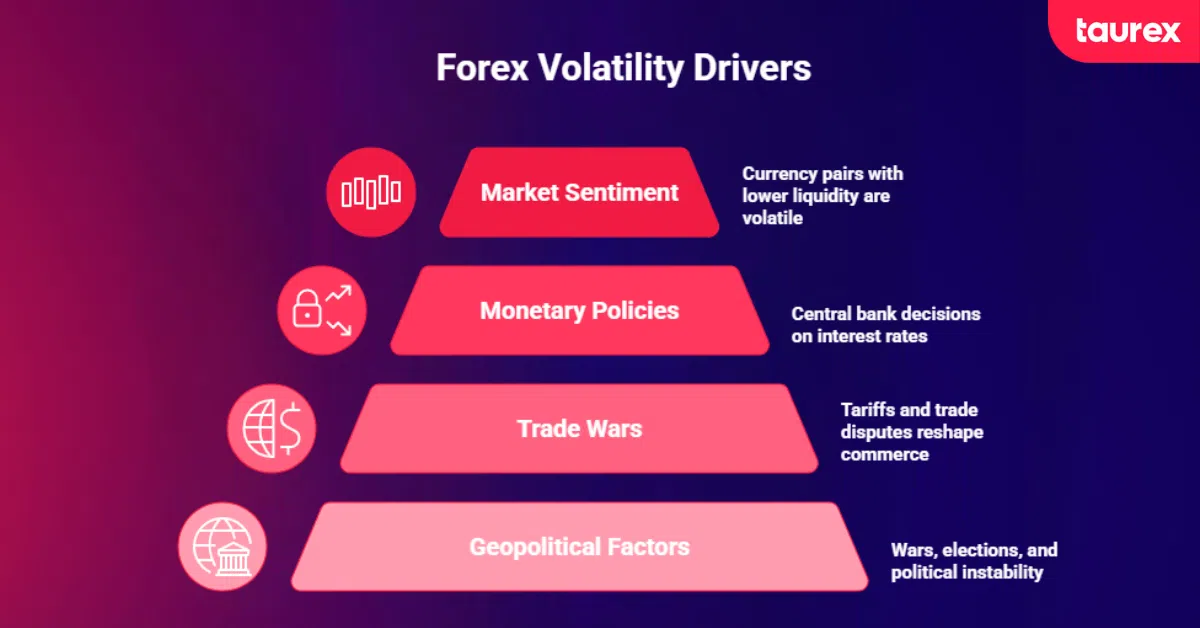
Wars, elections, sanctions, and political instability can move currencies within seconds. During periods of uncertainty, traders tend to shift capital into safe-haven currencies like the USD, CHF, and JPY. Brexit is a well-known example: it caused GBP/USD to plunge to a 31-year low immediately after the 23 June 2016 referendum result. The first half of 2025 followed a similar pattern, with rising trade tensions and fiscal sustainability concerns in the US acting as persistent FX volatility drivers.
Trade Wars and Tariffs
Tariffs and trade disputes reshape international commerce patterns and directly alter currency demand. The US-China trade war, for example, heavily impacted both the Chinese yuan and the Australian dollar due to Australia’s reliance on Chinese trade. After the 2 April 2025 sweeping US tariff announcements, the US Dollar Index (DXY) dropped from 110.14 to 97.94 over the following months, a sharp, tariff-driven decline that caught many traders off guard.
Central Bank and Monetary Policy Decisions
Central bank decisions on interest rates, quantitative easing, and forward guidance are among the most powerful structural drivers of FX volatility. Events such as FOMC meetings can trigger sharp movements in USD pairs when policy decisions or guidance differ from market expectations.
According to CME Group analysis, the Bank of Japan’s 13-year dovish stance contributed to USD/JPY surging from around 102.53 in early 2021 to historic highs near 160 by 2024, before a sharp reversal followed.
| Currency Category | Example Pairs | Volatility Level | Best Strategy |
| Major Currency Pairs | EUR/USD, USD/JPY | Low – Medium | Day Trading / Scalping |
| Commodity-linked Currencies | AUD/USD, USD/CAD | Medium | Swing Trading |
| Exotic Currency Pairs | USD/ZAR, USD/TRY | High – Extreme | Position Trading (with wide stops) |
Market Sentiment And Liquidity
Currency pairs with lower liquidity are more volatile by nature because fewer market participants mean each price move is amplified. Exotic pairs like USD/TRY and USD/ZAR carry wider spreads and are far more sensitive to sentiment shifts as a result.
During risk-off episodes, safe-haven flows into the USD, CHF, and JPY can trigger simultaneous volatility across many pairs at once. The IMF’s October 2025 Global Financial Stability Report noted that shocks in this environment can raise funding costs, widen bid-ask spreads, and intensify exchange rate volatility across the board.
What Are The Types Of Forex Volatility?
Not all Forex volatility looks the same, and learning to identify the current regime is one of the most useful skills a trader can develop.
Low Volatility
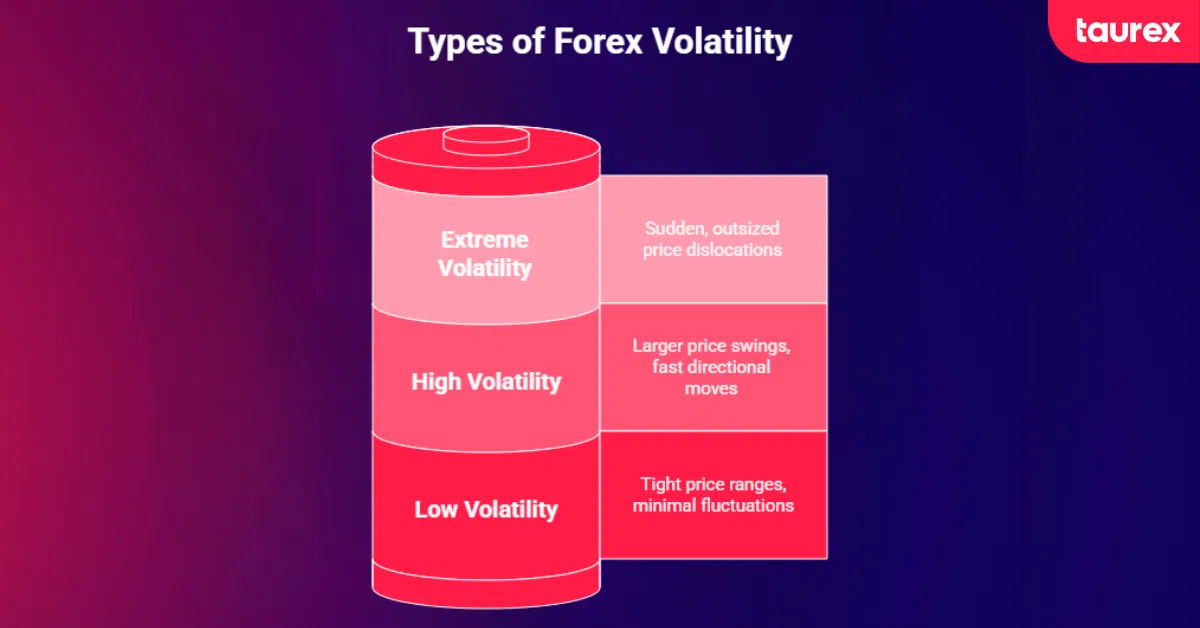
Low-volatility environments are characterised by tight, stable price ranges and minimal fluctuations. You will often see this in major pairs during quiet macroeconomic periods, or during the Asian session (the Tokyo and Sydney overlap). Spreads tend to be narrower, and risk is lower, though profit potential is limited as a result.
Pairs from the least volatile Forex pairs category, such as EUR/CHF or EUR/GBP, during policy-aligned periods often fit this profile. Range trading and mean-reversion setups tend to perform well in these conditions.
High Volatility
High volatility brings larger price swings and fast directional moves, typically triggered by major economic releases, central bank surprises, or geopolitical developments. GBP/JPY, nicknamed “the Dragon,” regularly sees daily moves exceeding 100 pips. Among the most volatile Forex pairs, USD/TRY routinely posts daily ranges of 1,000 to 2,000 pips. For European and cross pairs, the London session, especially its first two hours, is where these high-volatility bursts are most common.
Extreme Volatility
Extreme volatility is rare, but it can be devastating if you are unprepared. These are sudden, outsized price dislocations driven by black swan events such as the Brexit overnight crash, the COVID outbreak in March 2020, and the April 2025 tariff shock. During these moments, bid-ask spreads widen dramatically, liquidity can vanish, and slippage reaches levels that make standard order execution unreliable. Pairs like USD/ZAR can exceed 1,000 pips per day under these conditions, making risk management the only priority.
How Does Forex Volatility Impact Trading Strategies?
The right strategy must match the current volatility regime. A strategy that works in calm markets may fail in fast-moving conditions.
At Taurex, traders can choose between different account types such as Standard Zero, Pro Zero, and Raw. Each offers a different spread structure, which can suit different volatility trading styles.
For example, tighter spreads on Raw accounts may benefit scalpers during high volatility, while Standard or Pro accounts may suit swing traders who hold positions longer and focus less on spread sensitivity.
- Scalping thrives in high-volatility environments, where traders capture small but frequent pip moves by entering and exiting positions within minutes. It demands tight spreads, fast execution, and liquid pairs. If you are scalping EUR/USD during the London open, Forex volatility is your fuel.
- Day trading similarly targets peak market hours where FX volatility is highest, particularly the London and New York sessions. Tight stop-loss and take-profit limits are non-negotiable in these conditions, and economic calendars have become standard equipment for day traders in 2025.
- Swing trading suits medium-volatility conditions, where positions are held for days or weeks, and traders capitalise on intermediate trends using Forex technical analysis tools like Fibonacci retracements and trendlines. It requires less screen time than day trading, though it does carry overnight gap risk.
- Breakout trading works best at the transition point from low to high volatility. When Bollinger Bands squeeze, or ATR drops to unusually low levels, a breakout is often approaching, making these setups especially effective around session opens and after major news releases.
- Position trading aligns with macro trends and sits at the opposite end of the spectrum, largely insulated from short-term FX volatility. Trades are held for weeks or months with wider stops and more capital commitment, making it a strategy that rewards patience and conviction above all else.
- Volatility trading, as a broader discipline, applies across all of these approaches. The key is identifying which regime you are in before placing a trade, rather than forcing a strategy onto a market that does not suit it.
What Tools And Indicators Should Traders Use To Manage Forex Volatility?
Best Forex Volatility Indicators and Tools
Managing volatility is one of the most important skills in Forex trading. Prices can move quickly, so using the right indicators helps you control risk and find opportunities.
Traders use different tools to measure how fast the market is moving and how wide price swings are. These indicators are key for anyone focused on volatility trading.
ATR (Average True Range)
The most accessible and practical indicator for Forex traders. Use it for stop-loss sizing, position sizing, and identifying breakout conditions. It is available natively on most trading platforms.
Bollinger Bands
Spot volatility regimes at a glance. A squeeze signals consolidation, while expansion signals a move is underway. Useful for both mean-reversion and breakout setups.
VIX and Currency VIX (EUVIX, JYVIX, BPVIX)
Best for gauging implied volatility and overall market fear. Less practical for entry and exit signals, but excellent for macro awareness.
Keltner Channels
ATR-based dynamic bands similar to Bollinger Bands. Popular on MT4 for identifying trends and volatility shifts.
Donchian Channels
Plots the highest high and lowest low over a set period. Useful for breakout identification and trend following.
Standard Deviation
Measures how far prices deviate from their mean. It is the mathematical foundation of Bollinger Bands and gives you a statistical read on price dispersion.
Trading Platforms for Volatility Trading with Taurex
Choosing the right platform is important when trading volatile markets. You need fast execution, reliable tools, and access to key indicators.
- MetaTrader 4 (MT4) is widely used in Forex trading. It includes built-in indicators like ATR and Bollinger Bands, along with many custom tools.
- MetaTrader 5 (MT5) offers more timeframes, advanced order types, and better backtesting features. It is designed for traders who want more flexibility.
Both platforms are available through Taurex, along with the Taurex mobile app for trading on the go. These platforms give traders the tools needed to track volatility and execute trades efficiently.
It is also important to use a reliable economic calendar. This helps you stay updated on events like NFP, CPI, and central bank decisions, which often cause the biggest moves in the market.
How to Manage Risk During High Forex Volatility
Managing risk in Forex is essential when trading in volatile Forex markets. Price movements can be fast and unpredictable, so having a clear plan helps protect your capital and stay consistent over time.
- Use volatility-based position sizing. Adjust your position size based on market conditions. A common approach is to risk only 1 to 2% of your account per trade. As volatility increases, reduce your position size. If volatility doubles, your position size should be smaller to keep risk under control.
- Place stop-losses based on market volatility. Instead of using fixed pip distances, base your stop-loss on indicators like ATR. Placing stops at around 1.5 to 2 times the ATR gives your trade enough room to move without being stopped out too early.
- Use trailing stops to protect profits. Trailing stops help lock in gains as the market moves in your favour. In volatile conditions, wider trailing stops can prevent early exits, while still protecting profits if the market reverses.
- Reduce leverage in volatile markets. Leverage increases both gains and losses. During high-impact events, Taurex applies a leverage cap of 1:200, helping traders limit excessive exposure when markets become unstable. This built-in control acts as an additional layer of risk protection.
- Avoid trading without preparation. Always check your economic calendar before entering trades. Events like central bank decisions or major data releases can cause sharp and unpredictable moves. If you are unsure, it is often better to stay out of the market.
- Diversify your trades. Avoid opening multiple positions that depend on the same currency. Spreading your trades across different Forex pairs can reduce overall risk and protect your account from sudden shocks.
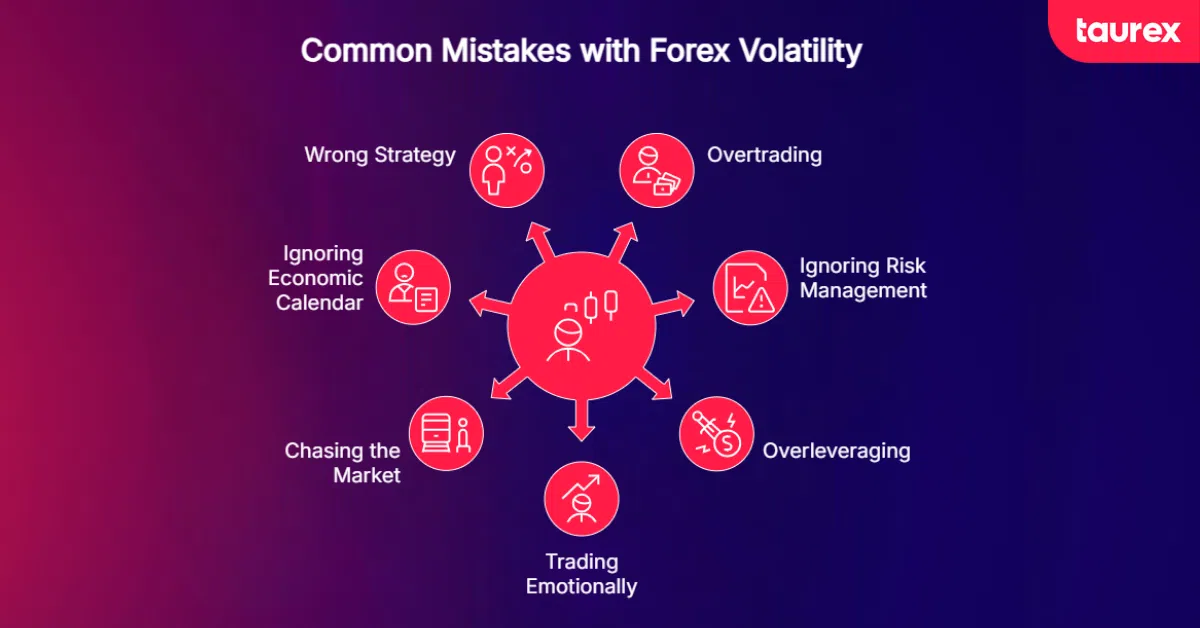
What Common Mistakes Do Traders Make With Forex Volatility?
Many Forex traders lose money, often due to poor risk management and emotional decision-making. Here are the most common pitfalls and how to address them.
- Overtrading during volatile sessions. Excitement, FOMO, or the urge to recover losses quickly leads to too many positions, emotional fatigue, and rising transaction costs. Setting a daily trade limit and focusing only on quality setups is one of the most practical ways to counter this tendency.
- Ignoring risk management. Many beginners risk 5 to 10% of their account per trade, which means a short losing streak can wipe out weeks of progress. Committing to the 1 to 2% rule and always using stop-loss orders makes a meaningful difference over time.
- Overleveraging. High leverage amplifies the impact of every volatile move. Starting with lower leverage and scaling up only as your experience and strategy improve is a far more sustainable approach.
- Trading emotionally. Fear, greed, and revenge trading lead to premature exits, manually moved stop-losses, and poor consistency. Automating exits where possible and stepping away from charts after an emotionally draining session can help break that cycle.
- Chasing the market after big moves. Entering a position after a major move has already happened often means poor entry prices and elevated reversal risk. Pre-planning entries at key levels and setting price alerts is a far more disciplined approach.
- Ignoring the economic calendar. Forex markets react sharply to events like Non-Farm Payrolls, CPI releases, and FOMC meetings. Being uninformed about what is coming is a reliable recipe for being caught off guard.
- Applying the wrong strategy to the wrong volatility regime. A scalping approach during a low-volatility session burns time and commission. A wide-stop position trade during extreme volatility can produce outsized losses. The fix is to identify the current regime first, using ATR readings and Bollinger Band behaviour, and then select the strategy that fits. This is one of the most effective Forex trading rules you can follow.
For traders still learning, practising in a risk-free environment can make a significant difference. Taurex’s demo account allows you to test strategies and understand volatility without risking real capital.
Volatility can be a trader’s friend or foe. By understanding market conditions, managing risk, and avoiding emotional or impulsive decisions, you can navigate Forex volatility more effectively. Smart preparation, disciplined execution, and awareness of economic events are key to turning market swings into opportunities rather than losses.
Ready to practice these strategies without risking real money? Open a demo account with Taurex today and experience Forex trading in a safe, risk-free environment.
FAQ
What does volatile mean in Forex?
In Forex, “volatile” describes a currency pair that experiences relatively large or rapid price movements over a given period. Highly volatile pairs can move sharply within minutes or hours, while low-volatility pairs usually trade within narrower ranges.
How can traders benefit from Forex volatility?
Traders can aim to capture price swings through strategies such as scalping, day trading, or breakout trading. Larger price movements create bigger potential on well-placed trades, but this requires disciplined risk management, including proper position sizing, appropriate stop-loss placement, and matching the strategy to the current volatility regime. Learning how to become a trader who respects volatility is a long-term process built on education and practice.
What is the best time to trade in a volatile market?
The most volatile and liquid windows are the London session open (early morning GMT) and the London-New York overlap, when the largest price swings occur on major pairs. Periods just before and immediately after high-impact economic releases, such as NFP, CPI, and central bank decisions, also produce sharp volatility spikes. Exotic pairs should generally be traded during their peak Forex market hours to avoid excessively wide spreads.
What is the most volatile Forex pair?
Among major currency pairs, GBP/JPY (“the Dragon”) is widely considered one of the most volatile, with daily moves regularly exceeding 100 pips. Among exotic pairs, USD/TRY is consistently among the most volatile Forex pairs globally, with daily ranges of 1,000 to 2,000 pips driven by Turkey’s high inflation and political instability. USD/ZAR and USD/BRL are also highly volatile exotic pairs that attract traders looking for large moves.