
Recent Japanese economic data show weakness in performance, with the Tokyo Consumer Price Index falling 2.3% year-on-year, below expectations of 2.5% and lower than the previous reading of 2.8%. Industrial production declined 2.6% month-on-month, a larger drop than the expected 1.9%, compared with a prior increase of 1.5%.
Retail sales, however, grew 1% year-on-year, slightly above the forecast of 0.9% but below the previous 1.7% reading. The services Purchasing Managers’ Index also fell to 51.6 points, below expectations of 52.5 and the previous 53.2, reflecting a slowdown in the services sector.
In the bond market, the gap between Japanese government bond yields and US Treasury yields is narrowing. For example, the ten-year Japanese government bond yield is around 2.088%, while the US ten-year Treasury yield is about 4.175%, resulting in a gap of roughly 2.09%, reflecting a reversal in the carry trade.
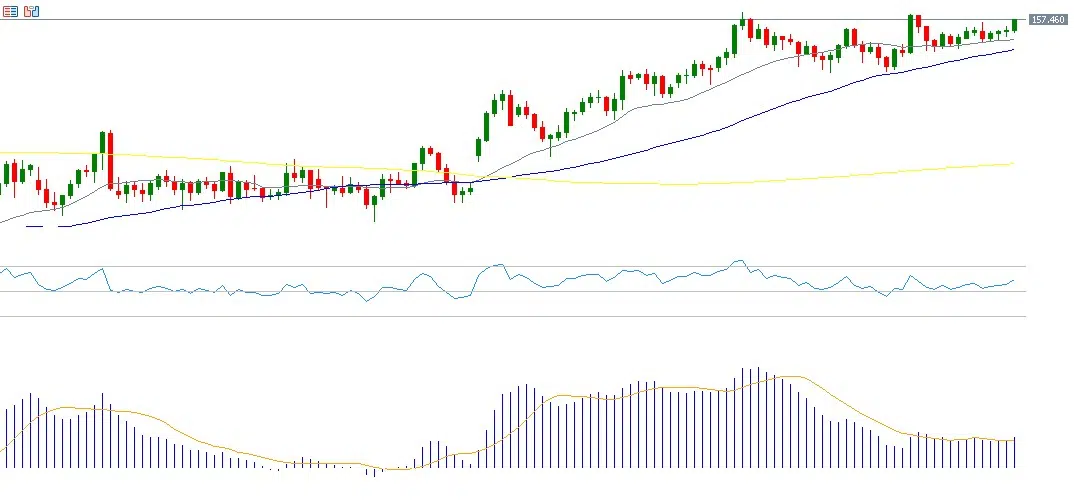
The US dollar against the Japanese yen has continued to rise for the fourth consecutive session, reaching 157.46 today, with gains of approximately 1% since the start of the year. In this context, the Bank of Japan has warned of excessive exchange rate volatility, indicating a potential intervention to support the local currency.
On the technical side, indicators show mixed signals. The relative strength index currently stands at 60, suggesting moderate positive momentum for the pair. The MACD shows a bullish crossover between the main line and the signal line, supporting the likelihood of continued upward momentum.
If the pivot level at 156.80 for the dollar/yen pair is broken downward, support levels may be targeted at 156.52, 156.17, and 155.89. If the pivot level is exceeded to the upside, resistance levels are likely at 157.15, 157.43, and 157.78.
Please note that this analysis is provided for informational purposes only and should not be considered as investment advice. All trading involves risk.