Bull Flag Trading Strategy: How to Trade the Pattern in Forex
Strong uptrends in Forex pairs like EUR/USD are rarely straight lines. After a sharp rally, the price often pauses and moves sideways for a short period before continuing in the same direction. This brief consolidation is where the bull flag pattern appears.
For Forex traders, a bull flag trading strategy offers a structured way to join an existing uptrend rather than guess at it, with clear rules for entries, exits, and risk when the price pauses mid-trend.
This guide breaks down what the bull flag chart pattern is, how it forms, how to identify a valid setup, and how to build a complete, rules-based strategy around it.
What Is a Bull Flag Chart Pattern in Forex Trading?
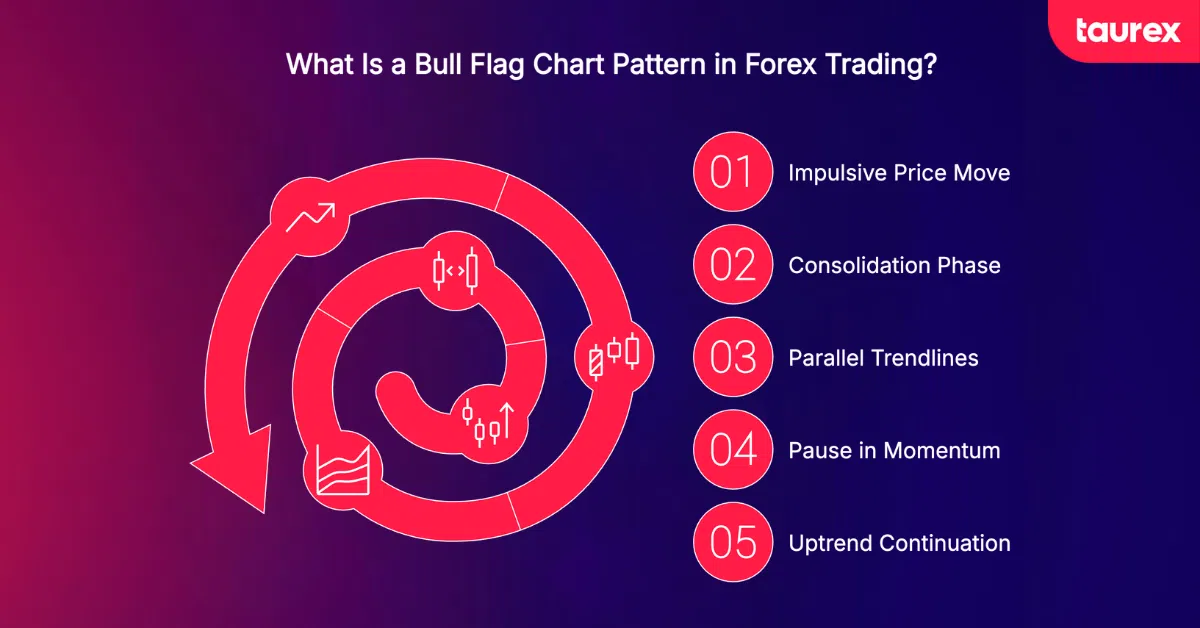
A bull flag is a bullish continuation pattern that forms during an uptrend. It has two main components. The first is the flagpole, which is a sharp and impulsive price move driven by strong buying pressure. The second is the flag, a short consolidation phase where the price moves slightly lower or sideways within parallel trendlines.
The pattern signals a pause in momentum rather than a reversal, suggesting that the prevailing uptrend may continue once consolidation ends.
The bull flag chart pattern is widely studied in classical technical analysis and appears across all major Forex pairs, including GBP/USD and GBP/JPY, and across timeframes from intraday charts to longer-term trends.
Taurex traders can apply this pattern across more than 1,500 instruments using MetaTrader 4, MetaTrader 5, or the trading app, all with built-in charting tools for pattern analysis.
How the Bull Flag Pattern Forms in Forex
The bull flag follows a predictable four-phase cycle. Once you learn to read each stage, you can often anticipate the pattern before it fully completes.
Strong Initial Price Movement (The Flagpole)
The pattern begins with the flagpole, a sharp and aggressive rally driven by strong buying pressure. This move is often triggered by major news events such as central bank decisions, Non-Farm Payrolls, or other high-impact macroeconomic releases. Price rises quickly with large bullish candles and limited pullbacks, usually accompanied by rising volume.
Temporary Profit-Taking and Consolidation
After the impulsive move, the price enters a consolidation phase as traders take profits. This forms the flag, where price drifts slightly lower or sideways within two parallel trendlines. The movement is typically orderly, not aggressive, which is what distinguishes a bull flag from a potential reversal.
Decreasing Momentum During the Pullback
A healthy bull flag pulls back only part of the flagpole. Many traders use Fibonacci retracement levels to gauge the depth, with the 23.6% to 50% zone often viewed as a healthier consolidation area. Declining volume during this phase suggests limited selling pressure and an intact broader uptrend.
Breakout and Trend Continuation
The pattern completes when the price breaks above the upper boundary of the flag, ideally supported by an increase in volume. Traders often measure the height of the flagpole and project that distance upward from the breakout point to estimate a potential target.
How to Identify a Valid Bull Flag Pattern
Accurate pattern recognition is key to avoiding false signals. A simple checklist helps confirm whether you are dealing with a valid bull flag or just similar-looking price action.
Characteristics of a Strong Flagpole
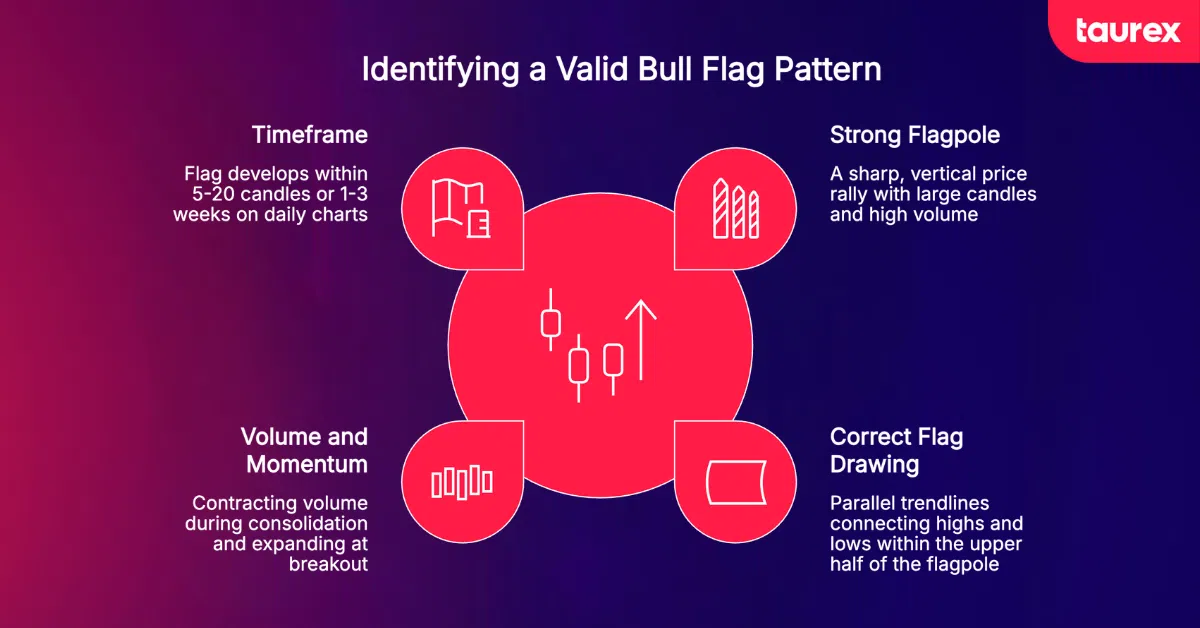
A valid flagpole is formed by a sharp and almost vertical price rally. Candles are large and directional, with minimal wicks, and volume is typically elevated during the move. There should be little to no meaningful consolidation within the impulse leg. The cleaner and more decisive the move, the more reliable the setup tends to be.
Drawing the Flag Correctly
Draw the flag by connecting the highs and lows of the consolidation with two parallel trendlines. This channel should slope slightly downward or move sideways, stay in the upper half of the flagpole, and avoid retracing more than 50% of the move. A well-formed flag is usually a short-term consolidation, not a long sideways range; deeper retracements suggest weakening momentum.
Volume and Momentum Considerations
Volume typically contracts during the consolidation phase and then expands sharply at the breakout. This expansion helps confirm that buyers are regaining control. In Forex, however, volume represents tick activity rather than centralized exchange volume, so it should always be interpreted alongside price action.
On platforms like Taurex MT4 and MT5, traders can combine volume indicators with momentum tools directly on the chart to get a clearer view of the setup in real time.
Common Signs of a Weak Bull Flag
Be cautious if the retracement exceeds 50% of the flagpole, if consolidation drags on for several weeks, or if volume does not contract during the flag. A choppy or sideways market structure, rather than a clear uptrend, also weakens the setup. If price begins forming lower lows during consolidation, it may indicate a reversal instead of continuation.
Bull Flag Pattern Trading Strategy: Step-by-Step
Here is where the theory turns into an actionable bull flag trading strategy. Follow these steps in order, and resist the temptation to skip ahead.
- Identify the existing uptrend: Start on higher timeframes, such as the daily or weekly chart, and confirm a clear pattern of higher highs and higher lows. The bull flag only has validity within a strong uptrend.
- Confirm the flag formation: Identify the consolidation phase and draw two parallel trendlines around price action. Volume should generally decline as the flag develops, and price movement should remain orderly without sharp, erratic swings.
- Wait for the breakout: Do not enter early. Wait for a full candle close above the upper trendline, ideally supported by an increase in volume to confirm buying strength.
- Plan the trade entry: Use a breakout entry at the candle close, a retest entry at the broken trendline acting as support, or a buy-stop above the upper trendline. Factor in Forex spreads and trading fees, since these affect the true cost of entry and can shift the effective risk-to-reward ratio on tighter setups.
- Set stop loss and take profit levels: Place the stop-loss order below the lowest point of the flag. Measure the height of the flagpole and project it upward from the breakout point to estimate the target. Maintain a minimum 2:1 risk-to-reward ratio and risk around 1% to 2% per trade.
What Are Popular Bull Flag Trading Setups?
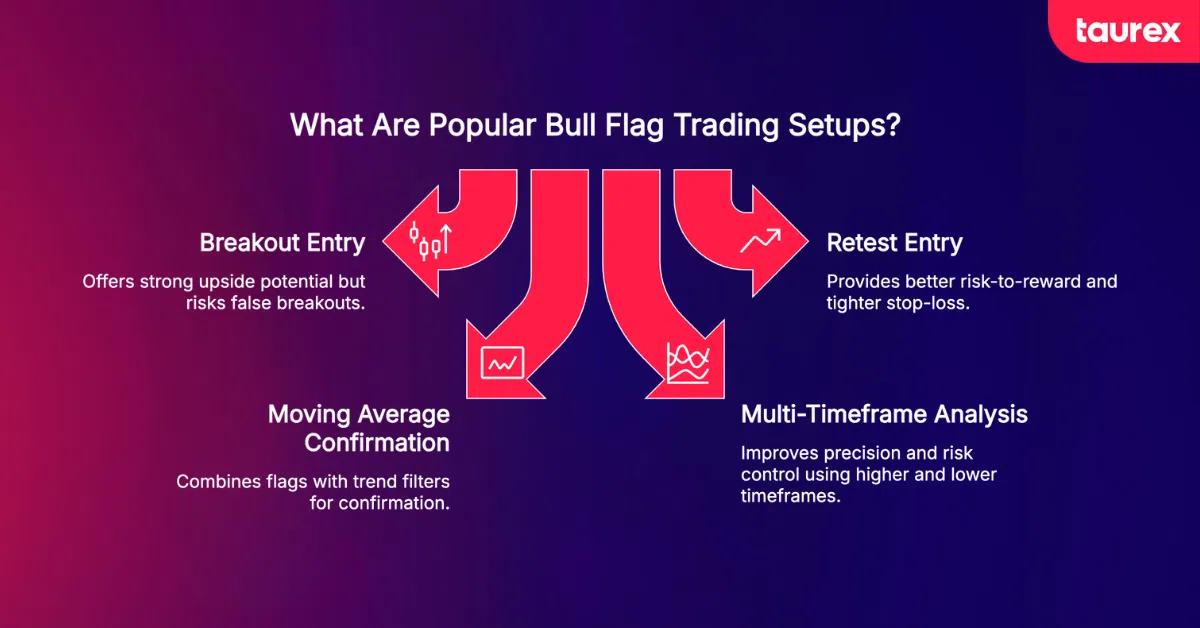
There is no single “correct” way to trade the pattern. Most traders gravitate toward one of four variations depending on their timeframe and risk appetite.
Breakout Entry Strategy
This is the most direct approach. Traders enter when the price closes above the upper flag boundary, ideally with a noticeable volume spike. It offers strong upside potential, but also carries the risk of false breakouts if momentum fades quickly. Traders who also follow price gap trading strategies may look for an opening gap above the flag boundary as additional breakout confirmation at the start of a new session.
Retest Entry Strategy
After the breakout, the price may pull back to retest the broken upper trendline, which often acts as new support. This approach typically provides a better risk-to-reward ratio and allows for tighter stop-loss placement, making it popular among swing traders.
Moving Average Confirmation Strategy
This setup combines bull flags with a trend filter, such as a 20-period or 50-period EMA. The ideal condition is a flag forming above a rising moving average, with entries triggered when the price breaks resistance or bounces from the EMA in line with the trend.
Multi-Timeframe Bull Flag Strategy
Traders identify the bull flag on a higher timeframe, such as the daily chart, to confirm the overall trend, then use lower timeframes like the 4-hour or 1-hour chart to refine entry timing. On intraday charts, this approach pairs naturally with an opening range breakout framework, where the early session range helps define the entry trigger within the broader flag structure.
This combination helps improve precision and risk control, especially when used on platforms like MT5 through Taurex, which supports seamless multi-timeframe analysis.
How to Confirm a Bull Flag Breakout
Breakouts are most reliable when multiple signals align. Relying on the pattern alone raises the risk of false breakouts in fast-moving markets.
Volume
A strong breakout is usually supported by volume around 1.5 to 2 times the recent average. In Forex, tick volume serves as a proxy. Strong breakout candles, especially bullish engulfing structures, add further validation.
RSI
During the flag, RSI often stabilises in the 40 to 50 range, indicating controlled consolidation. A move back above 50 at the breakout supports continuation, while bearish divergence during the flag is a warning sign.
MACD
A bullish bias strengthens when the MACD line sits above the signal line at the breakout. A fresh bullish crossover or expanding histogram confirms building momentum.
Support and Resistance Confluence
Breakouts near key levels, horizontal resistance, psychological round numbers, or Fibonacci levels tend to be more reliable. Avoid setups that break directly into major overhead resistance, which can limit follow-through.
Bull Flag vs Other Forex Continuation Patterns: Which Pattern Is More Reliable?
Several continuation patterns resemble the bull flag at first glance, but important structural differences affect how they behave in live markets. Understanding these distinctions helps avoid misidentification and improves execution quality.
Bull Flag vs Pennant
Both bull flags and pennants are bullish continuation patterns that form after a strong upward move. The main difference is the shape of the consolidation phase.
| Factor | Bull Flag | Pennant |
| Structure | Strong flagpole followed by a parallel channel | Strong flagpole followed by converging trendlines |
| Consolidation shape | Rectangular or slightly sloping channel | Small symmetrical triangle |
| Formation speed | Can take slightly longer to form | Often forms more quickly |
| Breakout style | Breakout is usually easier to plan | Breakout can be sharper and faster |
| Trade planning | Clearer levels for entry, stop-loss, and target placement | Can be harder to define because the range narrows |
Bull Flag vs Ascending Triangle
Both bull flags and ascending triangles are bullish continuation patterns, but they form in different ways and suit different trading setups.
| Factor | Bull Flag | Ascending Triangle |
| Structure | Sharp upward move followed by a controlled pullback | Flat resistance level with rising lows |
| Flagpole | Clear impulsive flagpole is usually present | Usually no sharp flagpole is required |
| Consolidation shape | Parallel or slightly downward-sloping channel | Triangle with horizontal resistance and rising support |
| Formation time | Usually shorter-term | Often develops over a longer period |
| Trading style | Momentum-based continuation setup | Breakout setup based on pressure building below resistance |
| Entry planning | Often used for faster trend-based entries | Often used for breakout entries above resistance |
Bull Flag vs Rising Channel
Both patterns can appear during an uptrend, but they show different types of price movement.
| Factor | Bull Flag | Rising Channel |
| Structure | Sharp upward move followed by a controlled pullback | Gradual upward movement between parallel trendlines |
| Flagpole | Clear explosive flagpole is usually present | No strong flagpole is required |
| Price movement | Impulse, then consolidation | Rotational movement within a steady uptrend |
| Momentum | More momentum-driven | More gradual and trend-based |
| Breakout timing | Usually gives a clearer breakout entry | Breakout timing can be less precise |
| Target planning | Measured move is often based on the flagpole | Targets are usually based on channel support and resistance |
Bull Flag vs Bear Flag
Bull flags and bear flags have a similar structure, but they signal opposite market directions.
| Factor | Bull Flag | Bear Flag |
| Market direction | Forms during an uptrend | Forms during a downtrend |
| Initial move | Sharp upward move | Sharp downward move |
| Consolidation | Brief pullback or sideways pause | Brief upward correction or sideways pause |
| Pattern bias | Bullish continuation | Bearish continuation |
| Breakout direction | Breakout usually occurs to the upside | Breakout usually occurs to the downside |
| Trade direction | Traders look for long entries | Traders look for short entries |
Advantages and Limitations of the Bull Flag Trading Strategy
The bull flag is popular because it provides structure and measurable trading rules, but it also has clear weaknesses that become more visible in certain market conditions.
| Advantages | Limitations |
| Clear entry, stop-loss, and profit target rules | Tick volume in Forex is less reliable than centralized volume |
| Measurable price target using flagpole projection | Performance drops in sideways or choppy markets |
| Success rates of roughly 60% to 85% in strong trends | False breakouts are common in low-volume conditions |
| Works across Forex pairs and multiple timeframes | Retracements beyond 50% can invalidate the setup |
| Flexible strategy (breakout, retest, indicator confirmation) | Requires experience to distinguish from similar-looking patterns |
| Suitable for both day trading and swing trading | Needs a strong market context to avoid low-quality signals |
How to Manage Risk When Trading Bull Flags
Solid Forex risk management is what allows a bull flag strategy to remain effective over time. Even high-probability setups can fail, so controlling downside exposure is essential.
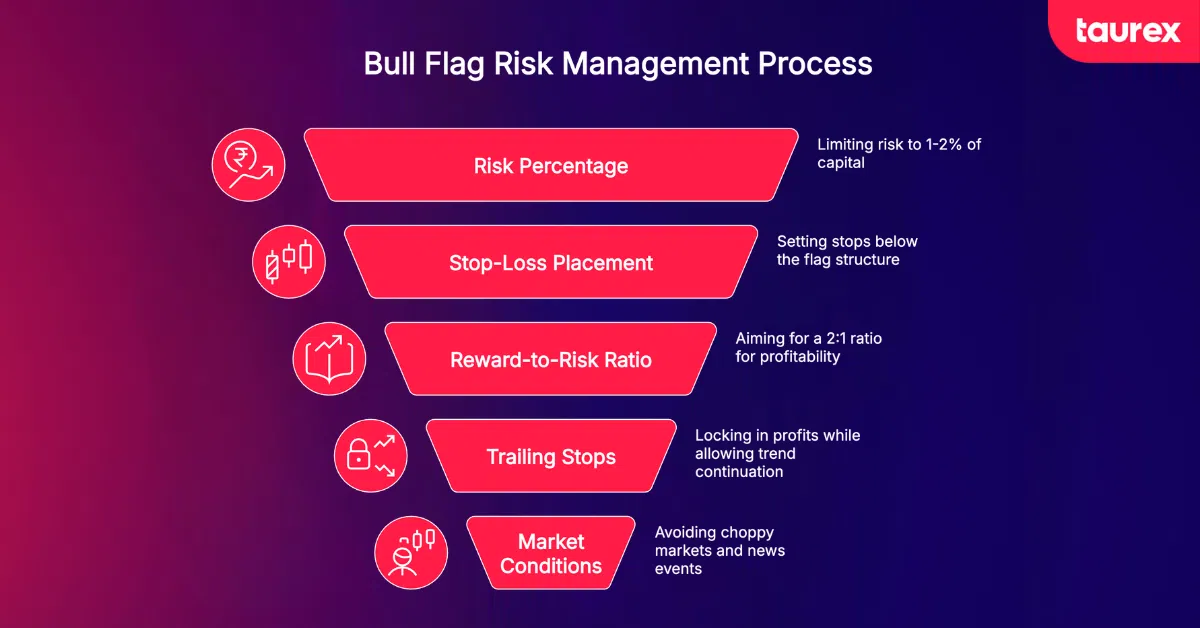
- Risk a small percentage per trade: Limit risk to around 1% to 2% of capital per position, the most reliable way to limit Forex drawdown through losing streaks.
- Place stops below the flag structure: A stop below the flag’s lowest point protects the trade if the breakout fails and price re-enters consolidation.
- Keep a favourable reward-to-risk ratio: Aim for at least 2:1 so winners can outweigh losers even with a moderate win rate.
- Use trailing stops: As the price moves in your favour, a trailing stop locks in gains while leaving room for the trend to extend.
- Avoid low-quality conditions: Be cautious in choppy markets or around high-impact news unless the setup is driven by that catalyst. After a failed breakout, avoid revenge trading, which compounds losses rather than recovers them.
- Use platform risk tools: Taurex provides built-in risk management on MT4, MT5, and its trading app, letting traders set stop-loss and take-profit levels directly at execution.
- Practise before trading live: A Taurex demo account allows you to test bull flag strategies in real market conditions without risking capital, helping you build consistency and confidence.
Final Thoughts
The bull flag is one of the most widely used continuation patterns in Forex because it offers a clear structure: a strong flagpole, a controlled consolidation, and a breakout that can be projected using the flagpole method. A bull flag trading strategy works best when it is treated as a rules-based setup, not as a guaranteed signal. When combined with volume confirmation and disciplined risk management, it provides a practical way to trade trending markets.
No pattern is consistently reliable on its own, so long-term results depend more on execution, patience, and risk control than on the setup itself.
To put the strategy into practice in real market conditions, open a free Taurex demo account and start testing bull flag setups on MT4 and MT5 without risking real capital.
FAQ
What is a bull flag pattern in Forex?
A bull flag is a bullish continuation chart pattern that forms during an uptrend. It consists of a sharp upward move, known as the flagpole, followed by a short consolidation phase bounded by two parallel downward-sloping trendlines, known as the flag. A breakout above the upper trendline signals a potential continuation of the uptrend.
Is a bull flag pattern bullish or bearish?
A bull flag is a bullish pattern. It suggests that after a brief consolidation within an uptrend, buying pressure is likely to resume and push the price higher. The pattern is confirmed when the price breaks above the upper boundary of the flag.
How reliable is the bull flag trading strategy?
The bull flag typically shows a success rate of around 60% to 85% in strong trending conditions. When combined with volume confirmation and proper trade execution, reliability can improve further. Results still depend on correct identification and disciplined risk management.
What is the best entry point for a bull flag breakout?
The most common entry is after a candle closes above the upper trendline with strong momentum. More conservative traders wait for a retest of the broken trendline acting as support before entering, which can offer a better risk-to-reward setup.
What indicators work best with bull flags?
Volume, RSI, MACD, and moving averages are the most commonly used confirmation tools. RSI helps confirm momentum strength, MACD signals trend continuation, and moving averages help verify overall trend direction.
How do you calculate a bull flag price target?
Measure the height of the flagpole from the start of the impulse move to its peak, then project that distance upward from the breakout point. This gives the standard measured move target.
What is the difference between a bull flag and a pennant?
Both patterns share the same flagpole but differ in consolidation shape. A bull flag forms a parallel channel, while a pennant forms converging trendlines that resemble a small triangle. Pennants tend to form faster but are generally considered less consistent than bull flags.
Can bull flag patterns fail?
Yes. Bull flags can fail due to weak breakout volume, deep retracements beyond 50% of the flagpole, or unfavourable market conditions such as choppy or range-bound price action. Proper confirmation and stop-loss placement are essential to manage this risk.