
Forex trading can be profitable, but profits are never guaranteed. A trader’s results depend on their strategy, risk management, trading costs, leverage, market conditions, discipline and ability to control losses.
The data shows why profitability should be approached realistically. According to the CFTC, around 33% of customers at registered OTC forex dealers made a profit over the referenced year, while around 67% lost money, after credits, financing charges, fees and other expenses were included. This means beginners should focus on risk control, realistic expectations and a structured trading plan instead of treating forex as a quick way to make money.
This guide explains whether forex trading is profitable, what affects forex trading profit, why many traders lose money and how beginners can build a more structured approach before trading live.
Key Takeaways
- Forex trading can be profitable, but it is not always profitable.
- Profit depends on strategy, risk management, trade size, costs, leverage, discipline and market conditions.
- Many traders lose money because they overuse leverage, trade emotionally, ignore costs or lack a clear plan.
- A trader can have winning trades and still lose money if losses are larger than gains.
- Beginners should practise with a demo account and build risk management habits before trading with real money.
Is Forex Trading Profitable?
Forex trading can be profitable when traders manage risk, follow a tested strategy and control trading costs. However, forex is not profitable for every trader, and no strategy can guarantee consistent returns.
A profitable trader usually needs more than accurate market direction. They also need to control position size, use stop-losses, understand forex spreads, avoid emotional decisions and review performance regularly.
For example, a trader may correctly predict that a currency pair will rise. But if the position size is too large, the stop-loss is too wide or the spread is high, the trade may still create unnecessary risk. Profitability depends on the full trading process, not only on prediction.
Can You Really Make Money From Forex Trading?
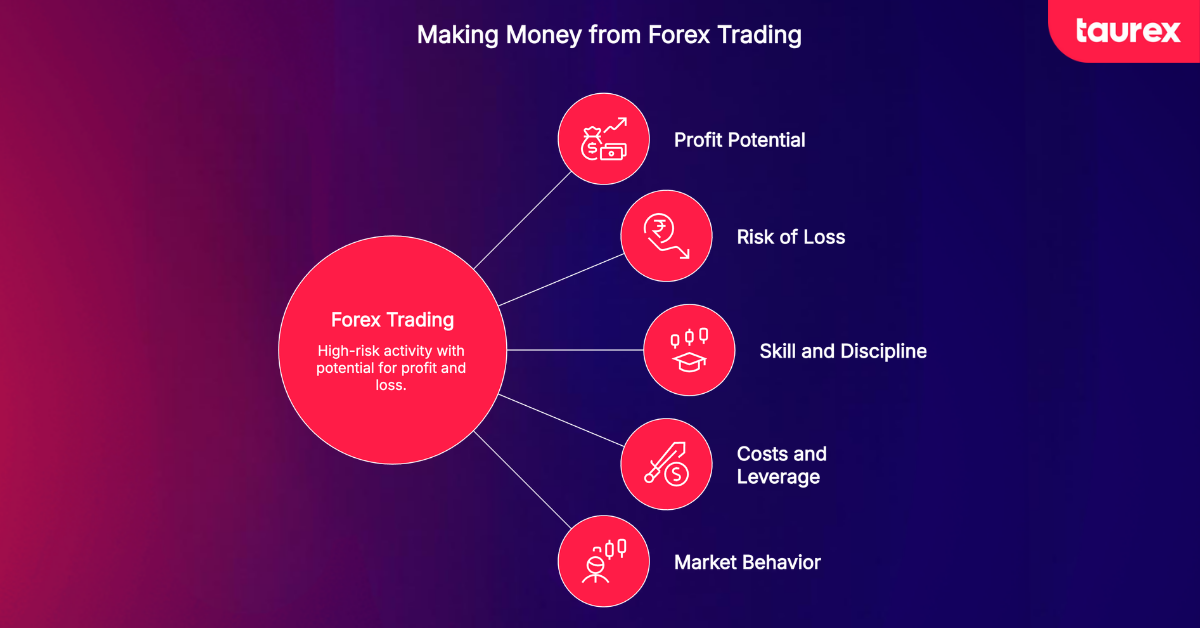
Yes, it is possible to make money from forex trading, but it is also possible to lose money. Forex trading is not a salary, passive income stream or guaranteed investment return. It is a high-risk activity where outcomes depend on skill, discipline, costs, leverage and market behaviour.
Traders may make money when they correctly identify price movement and manage trades well. They may lose money when price moves against them, trading costs reduce returns or emotions lead to poor decisions.
Beginners should avoid entering forex with unrealistic expectations. The goal at the start should be to understand how currency pairs move, learn the platform, practise risk management and avoid risking money they cannot afford to lose.
Is Forex Trading Always Profitable?
No, forex trading is not always profitable. Even experienced traders can have losing trades, losing days or losing months. Currency prices can move unexpectedly because of economic data, central bank decisions, geopolitical events or sudden changes in market sentiment.
A realistic trading plan should expect losses. Before opening a position, traders should already know:
- why they are entering the trade
- where the stop-loss will be placed
- how much of the account is at risk
- where profit may be taken
- what market condition would invalidate the setup
The aim is not to win every trade. The aim is to keep losses controlled and avoid one poor decision turning into a large drawdown in forex.
How Profitable Is Forex Trading?
There is no fixed profitability level in forex trading. One trader may lose money, another may break even and another may make consistent profits, depending on their strategy, costs, risk level and discipline.
Forex trading profit is usually affected by:
| Factor | Why it matters |
| Win rate | Shows how often trades close in profit |
| Average winning trade | Shows how much profitable trades usually make |
| Average losing trade | Shows how much losing trades usually cost |
| Spread and commissions | Reduce net results over time |
| Leverage | Can increase both profits and losses |
| Trade frequency | More trades can mean more costs and more emotional pressure |
| Risk per trade | Controls how much the account can lose on one setup |
| Market conditions | Trends, ranges, news and volatility can change results |
A trader can have a high win rate and still lose money if losing trades are much larger than winning trades. A trader can also have a lower win rate and still be profitable if losses are small and winning trades are larger.
This is why risk-to-reward, position sizing and trade management matter as much as market direction.
Why Forex Trading Profit Is Not Only About Win Rate
A trader does not need to win every trade to be profitable. Profitability depends on the relationship between average winning trades, average losing trades and trading costs.
For example, a trader with a 60% win rate can still lose money if their losing trades are much larger than their winning trades. Another trader with a 40% win rate may be profitable if their winning trades are significantly larger than their losing trades.
| Trader profile | Win rate | Average win | Average loss | Result logic |
| Trader A | 60% | $50 | $150 | Can lose money because losses are too large |
| Trader B | 40% | $200 | $75 | Can be profitable if winners outweigh losses |
| Trader C | 50% | $100 | $100 | May break even before costs |
| Trader D | 55% | $120 | $80 | May be profitable if costs are controlled |
This is why forex trading profit depends on risk-to-reward, position sizing and discipline, not only on being right more often.
A trader should also consider consistency. One profitable week does not prove that a strategy works long term. Traders need enough results to see if their process remains stable across different market conditions, such as trends, ranges, high-volatility news sessions and quiet trading periods.
What Affects Forex Trading Profit?
Forex trading profit depends on several connected factors. A trader should look at profitability as a full process rather than one isolated result.
| Factor | How it affects profitability |
| Trading strategy | Defines when a trader enters, exits and manages trades |
| Risk management | Helps limit losses and protect account balance |
| Leverage | Can increase both potential gains and potential losses |
| Spreads and trading fees | Reduce net trading results |
| Market conditions | Trends, ranges, volatility and news can affect outcomes |
| Discipline | Helps traders follow the plan instead of reacting emotionally |
| Trade size | Controls how much each trade can gain or lose |
| Experience | Helps traders recognise setups, risks and mistakes more clearly |
For example, a strategy may perform well in trending markets but fail during choppy price action. A trader may also have a good setup but lose money because the position size is too large or the trade is opened before a major news event.
Checking the economic calendar can help traders see when high-impact events are scheduled and prepare for possible volatility.
How Trading Costs Affect Forex Profit
Trading costs can reduce profitability, especially for short-term traders who open and close many positions. Even when a trade moves in the expected direction, spreads, commissions and overnight financing charges can affect the final result.
For example, a trader who takes many small trades may need price to move far enough to cover the spread before the trade becomes profitable. If the trader enters during low-liquidity periods or volatile news events, spreads may widen and make short-term setups harder to manage.
Common trading costs include:
| Cost | How it affects profit |
| Spread | The difference between the buy and sell price |
| Commission | A fee charged on some account types or trades |
| Swap or overnight financing | A cost or credit for holding positions overnight |
| Slippage | The difference between expected and executed price |
| Currency conversion | A possible cost when account and trading currencies differ |
Traders should calculate profit after costs, not only by looking at price movement. A strategy that looks profitable before costs may become weaker once spreads, commissions and overnight charges are included.
Why Many Forex Traders Lose Money
Many traders lose money because they focus on potential profit before understanding risk. Forex prices can move quickly, and leveraged trading can increase losses if trades are not controlled.
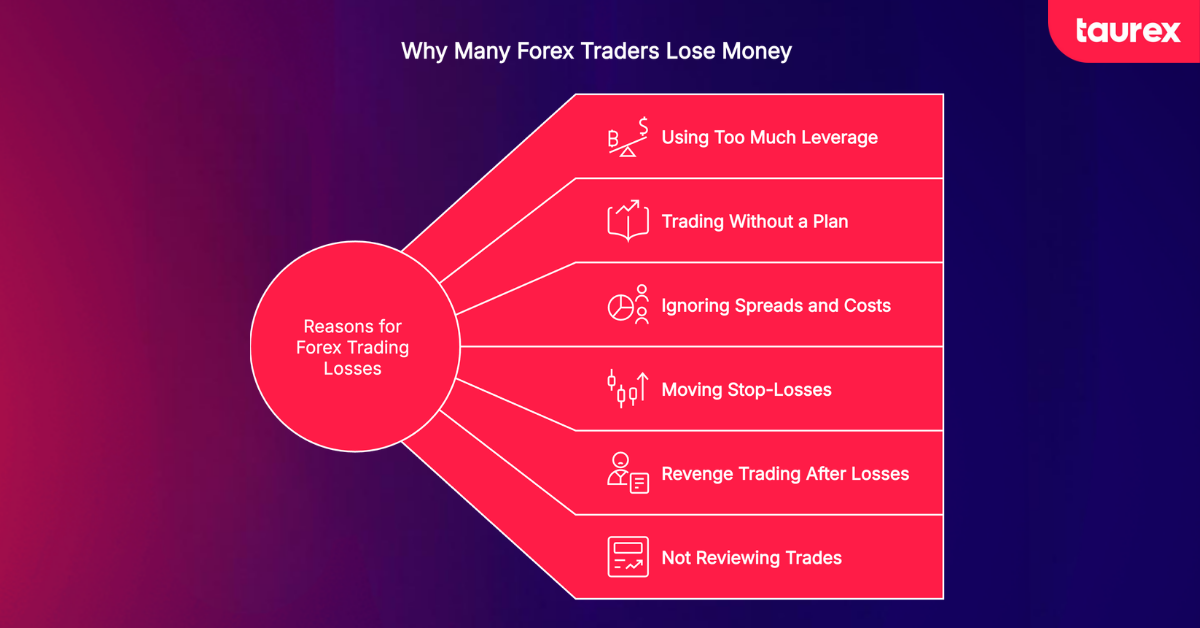
Common reasons traders lose money include:
Using Too Much Leverage
Leverage allows traders to control a larger position with a smaller deposit. This can increase potential profit, but it can also increase losses. Beginners may underestimate how quickly a leveraged position can move against them.
Trading Without a Plan
A trading plan should define the market, setup, entry, stop-loss, take-profit target, position size and maximum risk. Without a plan, traders may enter positions based on emotion, news headlines or short-term price movement.
Ignoring Spreads and Costs
Trading costs reduce net results. Short-term traders may be especially affected by spreads because they enter and exit more often. Understanding costs is part of building realistic profit expectations.
Moving Stop-Losses
A stop-loss is designed to limit risk. Moving it further away because a trade is losing can turn a planned loss into a much larger one.
Revenge Trading After Losses
Revenge trading happens when a trader opens impulsive trades after a loss to recover money quickly. This can lead to overtrading, larger position sizes and deeper losses.
Not Reviewing Trades
Traders who do not review their results may repeat the same mistakes. A trading journal can help identify weak setups, emotional decisions, poor timing and risk management problems.
How Does Leverage Affect Forex Trading Profit?
Leverage can make forex trading more accessible, but it can also increase losses quickly. A small price movement may have a larger effect on the account when the position size is too large.
For example, if a trader uses excessive leverage and opens a large position, even a normal market move can create a significant loss. The trade may be closed by a stop-loss, margin call or manual exit before the original analysis has time to develop.
This is why leverage should be treated as a risk tool, not a shortcut to higher profit. Beginners should understand margin requirements, stop-loss placement and position size before using leveraged trades.
A better approach is to decide the risk first, then choose the position size. If the trade size is selected only because the platform allows it, the trader may take more risk than their account can handle.
Can You Trade Forex for a Living?
Trading forex for a living is possible for some experienced traders, but it is not realistic for most beginners. Full-time forex trading usually requires significant capital, a tested strategy, strict risk controls, emotional discipline and the ability to handle losing periods.
A trader who wants to rely on forex income needs to consider:
- account size
- monthly expenses
- expected drawdowns
- trading costs
- risk per trade
- strategy consistency
- emotional pressure
- tax and regulatory considerations
Beginners should not treat forex trading as a replacement for stable income. A more practical goal is to learn the market, practise with a demo account and build consistency before considering larger financial goals.
Is Forex Trading Worth It for Beginners?
Forex trading may be worth learning for beginners who are interested in financial markets, willing to study and able to manage risk carefully. It may not be suitable for people looking for fast profits, guaranteed income or low-risk returns.
Forex trading can help beginners learn about:
- currency pairs
- global economic events
- chart analysis
- risk management
- trading psychology
- market behaviour
However, beginners should understand that learning forex takes time. The market can be volatile, and losses are part of trading. A beginner should start with education, demo practice and small steps rather than rushing into live trading.
Who Is Forex Trading More Suitable For?
Forex trading may be more suitable for beginners who are willing to learn gradually, follow a plan and accept that losses are part of the process. It may be less suitable for people who want fast income, guaranteed returns or low-risk results.
| May be suitable for | May not be suitable for |
| Traders willing to study and practise | People looking for guaranteed income |
| Traders who can follow risk limits | People who cannot accept losses |
| Traders who use a demo account first | People who want fast profits |
| Traders who review mistakes | People who trade emotionally |
| Traders who can be patient | People using money they cannot afford to lose |
This makes forex trading a learning process rather than a quick profit method. A beginner who is willing to practise, review mistakes and control risk is usually in a better position than someone focused only on short-term returns.
How to Improve Your Chances of Forex Trading Profit
There is no guaranteed way to make forex trading profitable, but traders can improve their process by focusing on risk, structure and review.
Learn How Forex Works
Before trading live, beginners should understand currency pairs, pips, spreads, leverage, margin, order types and market sessions. A basic understanding of forex market hours can help traders see when liquidity and volatility may change.
Use a Trading Plan
A trading plan gives structure to every decision. It should explain what the trader will trade, which setups they will use, how much they will risk and when they will stop trading.
Practise Risk Management
Strong forex risk management helps traders protect their account from oversized losses. This includes using stop-losses, controlling trade size and avoiding excessive leverage.
Track Trading Costs
A profitable setup can become less effective if costs are too high. Traders should consider spreads, commissions, swaps and other fees when calculating potential results.
Keep a Trading Journal
A trading journal helps traders review what worked and what did not. It can include the currency pair, entry, exit, trade reason, risk level, result and emotional notes.
Avoid Emotional Decisions
Fear, greed and frustration can affect trading results. Traders should avoid chasing trades, increasing size after a loss or entering positions without a clear setup.
Choose a Suitable Broker
A broker should provide clear pricing, suitable platforms, account information and access to support. Beginners can review how to choose a forex broker before opening an account.
How to Build a More Realistic Forex Profit Plan
A realistic forex profit plan should start with risk, not expected returns. Instead of asking how much money they can make, beginners should first decide how much they can afford to lose on each trade and across a trading day or week.
A basic plan may include:
- best forex pairs for beginners
- the strategy or setup they will use
- maximum risk per trade
- maximum daily or weekly loss
- preferred trading hours
- rules for using leverage
- stop-loss and take-profit rules
- trade review process
This helps traders measure performance more objectively. A trader can then review if losses came from the strategy, poor timing, oversized positions, emotional decisions or changing market conditions.
A profit plan should also be flexible. Market conditions change, so traders should regularly review their results instead of assuming one strategy will work in every environment.
For beginners, the first goal should not be a specific income target. A more useful first goal is to prove that they can follow rules, limit losses, record trades and avoid emotional decisions over a meaningful sample of trades.
How to Practise Before Trading Live
A forex demo account allows beginners to practise trading with virtual funds before using real money. This can help traders learn the platform, test strategies and build a routine without financial risk.
A demo account can be used to practise:
- reading charts
- placing market and pending orders
- setting stop-loss and take-profit levels
- checking spreads
- testing trading strategies
- managing position size
- reviewing trade results
Demo trading is not the same as live trading because real money creates emotional pressure. Still, it can help beginners build familiarity with the platform and practise risk rules before opening a live account.
To make demo practice more useful, traders should use realistic position sizes and treat virtual losses seriously. This makes the move from demo to live trading more structured.
Wrapping Up
Forex trading can be profitable, but it is not always profitable and profits are not guaranteed. Some traders make money, while many others lose money because of poor risk control, excessive leverage, emotional trading or unrealistic expectations.
The most important profit factors are strategy, trade size, risk management, costs, discipline and market conditions. Traders should focus less on quick returns and more on building a repeatable process.
For beginners, the safest starting point is education, demo practice, careful forex broker selection and strict risk management. Forex trading may be worth learning, but it should be approached as a high-risk activity that requires patience, preparation and discipline.
FAQs
Is forex trading always profitable?
No, forex trading is not always profitable. Even experienced traders can have losing trades or losing periods. A realistic trading plan should expect losses and define how risk will be controlled.
Can you really make money from forex trading?
Yes, it is possible to make money from forex trading, but it is also possible to lose money. Forex trading is high risk and should not be treated as guaranteed income.
What is a realistic forex trading profit for beginners?
There is no fixed realistic forex trading profit for beginners. Results depend on capital, risk per trade, strategy, costs, leverage and discipline. Beginners should focus first on learning the platform, controlling losses and following a trading plan rather than aiming for a specific profit target.
Can you trade forex for a living?
Some experienced traders may trade forex for a living, but it is not realistic for most beginners. Full-time trading usually requires capital, experience, a tested strategy and strong emotional discipline.
Why do many forex traders lose money?
Many forex traders lose money because they use too much leverage, trade without a plan, ignore spreads and costs, move stop-losses, overtrade or make emotional decisions after losses.
What affects forex trading profit?
Forex trading profit is affected by strategy, risk management, leverage, spreads, commissions, market conditions, trade size, discipline and experience.
How can beginners improve their chances of forex trading profit?
Beginners can improve their process by learning the basics, using a trading plan, practising risk management, keeping a journal, avoiding emotional trades and testing strategies in a demo account.
Should beginners practise with a forex demo account first?
Yes. A forex demo account helps beginners practise trading with virtual funds before using real money. It can help traders learn the platform, test strategies and build risk management habits.