
A contingent order is one of the most practical tools available to Forex traders, and one of the least understood. The Forex market handles more than $7.5 trillion in daily trading volume. This means prices can move at any time, across different sessions and currency pairs. It may not be possible for traders to watch the market all the time. Prices can change while you are asleep, working, or away from your screen.
Contingent orders can help traders automate decisions in advance. A contingent order is a trade instruction that activates only when a predefined condition is met. It follows a simple rule: “if this happens, then do that.” Until the trigger occurs, such as price reaching a selected level or another order being executed, the instruction remains inactive.
In this article, we explain what contingent orders are, how they work in Forex trading, the main types you may see, and simple examples of when traders might use them.
What Is a Contingent Order in Forex?
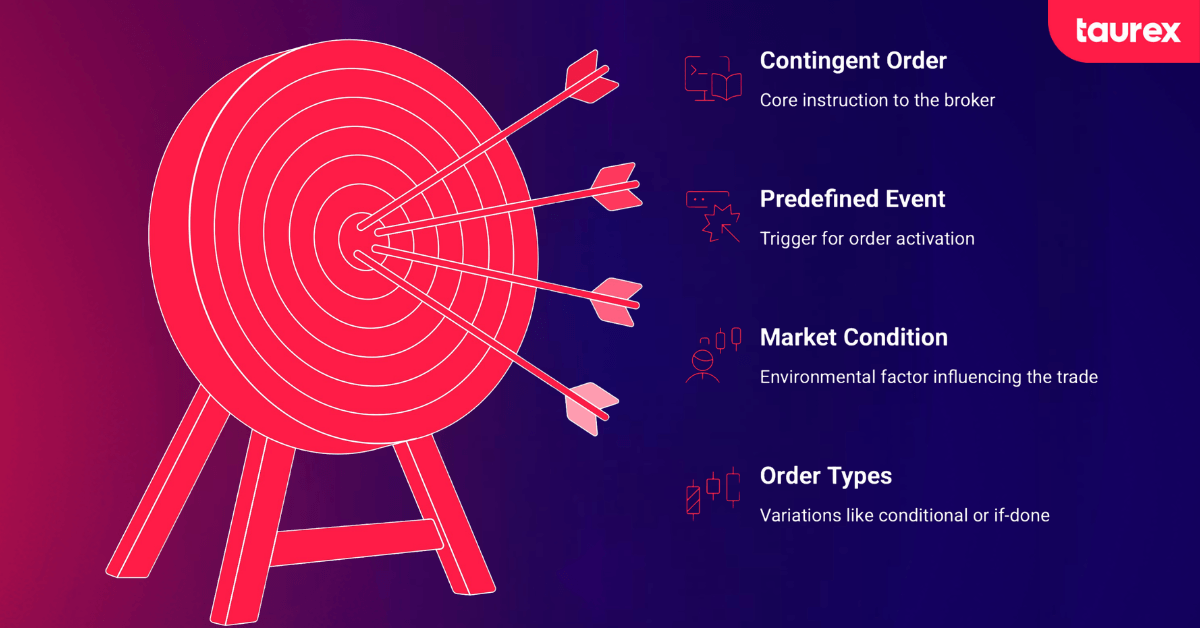
A contingent order is a conditional instruction you give to your broker that only becomes active once a predefined event or market condition occurs. If that condition never materialises, the order stays inactive and is never executed. It simply sits with your broker, waiting.
The underlying logic is straightforward: “If this happens, then execute that.” You might, for example, instruct your platform to buy EUR/USD if the price drops to 1.0800. Until EUR/USD actually reaches 1.0800, nothing happens. The moment it does, your order springs to life.
This is different from a market order, which is executed right away at the best available price. A market order focuses on speed, while a contingent order focuses more on control over when a trade happens.
Contingent orders can be based on price levels, the triggering of other orders, time limits, or market conditions. You may also see them called conditional orders or if-done orders, depending on the platform or broker, but the idea is generally the same.
How Does a Contingency Order Work in Forex Trading?
The mechanics of a contingent order follow a parent-child structure. You place a primary (parent) order that is immediately active and watches the market. Attached to it are one or more secondary (child) orders that remain dormant until the primary fires.
Here is the step-by-step sequence:
- You place a primary order on your platform with one or more attached contingent orders.
- The primary order monitors the market for your specified condition.
- When the market reaches that condition, the primary order triggers.
- The secondary order (or orders) automatically become eligible for execution.
If the primary order is never triggered, the secondary orders stay inactive indefinitely or until you cancel them.
Let us put this into a real example. Say you are watching GBP/USD and believe it will drop to 1.2600 before rallying. You set a limit buy at 1.2600 as your primary order. Attached to it, you place a take-profit at 1.2750 and a stop-loss at 1.2530. Neither the take-profit nor the stop-loss activates until your buy at 1.2600 fills. Once it does, both secondary orders go live automatically.
Several structural variants exist for linking these orders together:
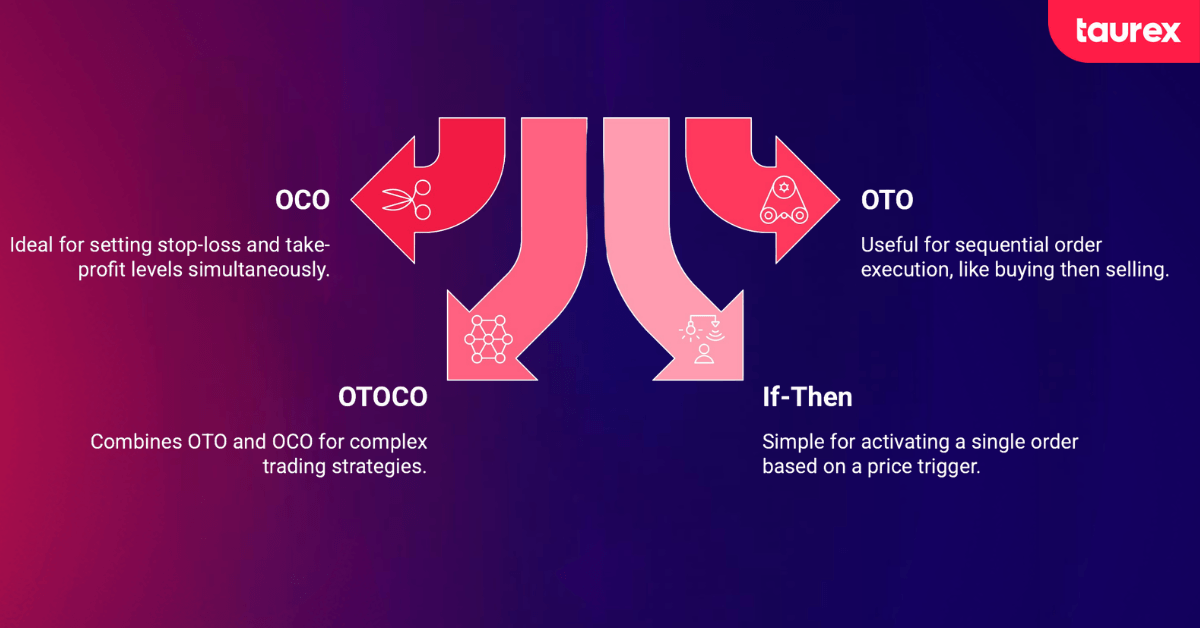
- OCO (One-Cancels-the-Other): Two linked orders where the execution of one automatically cancels the other. This is the classic stop-loss and take-profit pairing.
- OTO (One-Triggers-the-Other): A primary order that, once filled, activates a secondary order. The GBP/USD example above follows this structure.
- OTOCO (One-Triggers-One-Cancels-the-Other): A primary order triggers two secondary orders that are linked via OCO. When one of those secondaries fires, the remaining one cancels.
- If-Then: A non-executable price trigger that activates a secondary executable order once the specified rate is reached.
The key benefit is automation. Traders can define their entry, exit, and risk parameters in advance, while the platform handles execution once the required conditions are met. This is especially useful because forex market hours span 24 hours a day, five days a week, making it difficult to monitor every price movement.
Contingent orders can still be affected by market gaps and slippage during periods of high volatility in forex or around major news events. In fast-moving conditions, the trigger price and actual fill price may differ because liquidity and available prices can change quickly. This is a normal execution risk rather than a flaw in the order type, and a clear approach to forex risk management can help traders account for it.
What Are Examples of Contingency Orders?
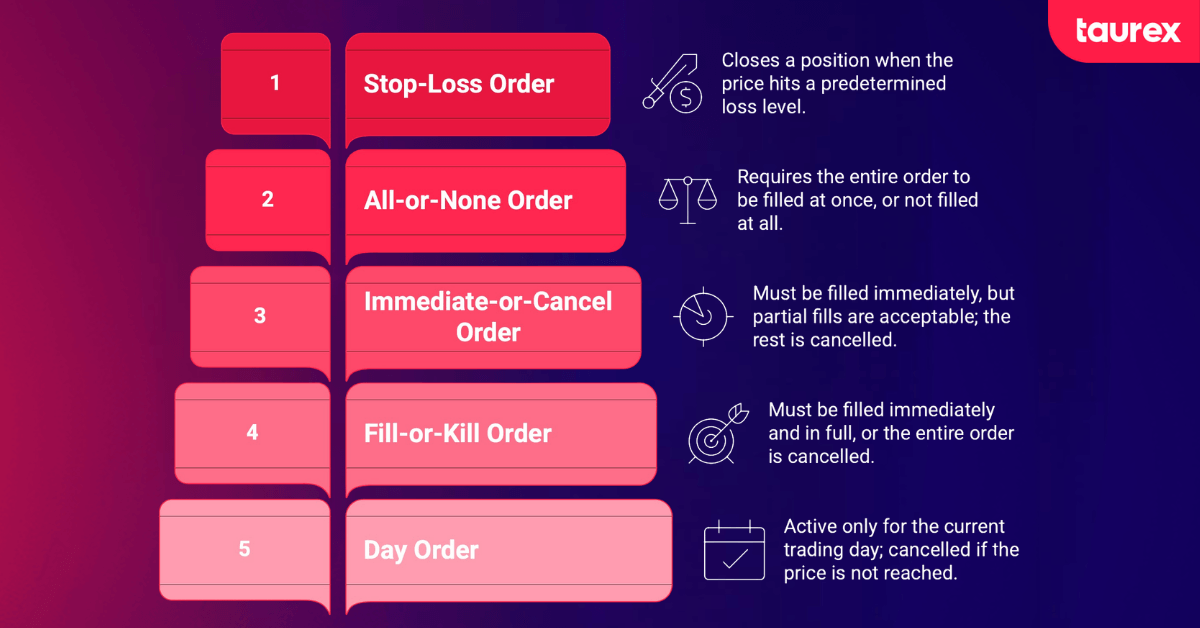
Contingent orders come in several distinct forms, each designed around a specific execution goal. Some focus on loss protection. Others address fill precision or time constraints. Below is a closer look at the most common types you will encounter.
Stop-Loss Order
The stop-loss order is the most widely recognised contingent order in Forex. It instructs your broker to close your position when the price hits a predetermined loss level. Execution is contingent on the market reaching that threshold; if it never does, the order stays inactive.
For a trader holding a long position on USD/JPY, placing a stop-loss 50 pips below the entry means the position will automatically close if the price drops to that level. This is especially useful in a market that trades around the clock, where prices can shift meaningfully while you are away from the screen.
It is important to know that a stop-loss does not always guarantee the exact price you set. In fast-moving markets, the final price may be different due to slippage. This can happen during major news events or sudden market changes. Many stop-loss orders may be triggered by short-term price movements rather than long-term trend changes.
Taurex’s MT4 and MT5 platforms support straightforward stop-loss placement and management, with the ability to modify levels as your trade develops.
All-or-None Order
An all-or-none (AON) order requires that the entire order be filled at once, or not filled at all. No partial fills are accepted. If you want to buy 100,000 units of AUD/USD and the market only has liquidity for 60,000 units at your price, the order will not execute.
The key distinction from a fill-or-kill order (which we will cover next) is timing. AON orders may wait for the necessary liquidity to become available to fill the entire order. There is no urgency requirement. The order can sit patiently until the full volume is available at the specified price.
This order type tends to be most useful for larger-volume trades where receiving a partial fill would create sizing issues or throw off the intended risk-to-reward structure of a position.
Immediate-or-Cancel Order
An immediate-or-cancel (IOC) order demands instant execution, but it is more flexible than it might sound. The order must be filled immediately, yes, but partial fills are perfectly acceptable. Whatever portion of the order cannot be filled right away is automatically cancelled.
Say you place an IOC order to buy 200,000 units of EUR/JPY at a specific price. If 150,000 units are available at that price immediately, you get those 150,000, and the remaining 50,000 are cancelled. No waiting around.
IOC orders tend to be more commonly used than fill-or-kill orders because they offer a higher likelihood of at least partial execution. They work well when you have a firm price target, but can live with getting slightly less volume than originally intended.
Fill-or-Kill Order
The fill-or-kill (FOK) order is the strictest execution-style contingent order available. It must be filled immediately and in full, or the entire order is cancelled outright. No partial fills. No delays. Everything or nothing, right now.
FOK orders are particularly prevalent in Forex due to tight profit margins and high trading volumes. When a trader is entering a large position where even a slight price deviation or incomplete fill could undermine the strategy, a FOK order ensures that the execution is either perfect or non-existent.
In practical terms, an FOK order combines the all-or-nothing requirement of an AON order with the immediacy of an IOC order. It is a demanding instruction, and it is best suited for situations where precision matters more than the probability of getting filled.
Day Order
A day order is an instruction to buy or sell at a specific price that is only active for the current trading day. If the price is not reached before the session ends, the order is cancelled automatically.
Traders who focus on short-term trades often use day orders because they do not need to cancel them manually. This can help avoid old or unwanted orders staying active into the next trading session.
Day orders are different from Good-Till-Cancelled orders, which stay active until they are filled or removed. In Forex, the end of the trading day may depend on the broker, but it is often around 5:00 PM EST.
For intraday traders, day orders may be useful for setting entry points without the risk of the order being triggered later when market conditions have changed.
Advantages and Risks of Contingent Orders
Contingent orders allow traders to plan entries, exits, and risk controls before the market reaches a selected level. Once the predefined condition is met, the platform activates the instruction automatically.
What Are the Advantages of Contingent Orders?
| Advantage | How It Helps Traders |
| Reduced screen time | Orders can activate automatically, so traders do not need to monitor every price movement. |
| Planned execution | Entry prices, stop-loss levels, and profit targets can be defined in advance. |
| More disciplined decisions | Predefined conditions may reduce impulsive trading caused by fear, greed, or short-term market movements. |
| Automated risk controls | Stop-loss and take-profit instructions can help manage losses and secure profits. |
| Efficient order management | Linked orders such as OCO and OTO can trigger or cancel related instructions automatically. |
| Flexible strategy execution | Traders can use contingent orders for breakouts, pullbacks, ranges, and other planned setups. |
What Are the Risks of Contingent Orders?
Contingent orders do not guarantee execution at the requested price. During fast-moving or low-liquidity markets, slippage may cause an order to fill at a different price. Price gaps and wider spreads can also activate orders unexpectedly or lead to less favourable execution.
High volatility can increase these risks, especially around major economic releases. Checking the economic calendar before placing or leaving an order active can help traders identify scheduled events that may cause sudden price movement. Some orders may also remain unfilled if the required price or execution conditions are not available.
Traders should review active orders regularly, as an older order may no longer match current market conditions. Contingent orders work best when trigger levels, expiry settings, position size, and execution risks are considered before the order is placed.
Common Mistakes When Using Contingent Orders
One common mistake is confusing stop orders with limit orders. Stop orders generally activate after price moves beyond a specified level, while limit orders aim to enter at a more favourable price. Selecting the wrong order type can cause a trade to activate under unintended conditions.
Another mistake is placing trigger levels too close to the current market price. Normal price fluctuations or forex spread changes may activate the order before the expected setup develops.
Traders should also avoid assuming that the trigger price is the guaranteed execution price. During volatile conditions, an entry or stop-loss order may be filled at the next available price.
Other common mistakes include:
- Forgetting to set or review the order expiry
- Leaving outdated pending orders active
- Ignoring forex spread widening around economic releases
- Using linked orders without checking which instruction triggers or cancels the others
- Placing stop-loss levels without considering position size and total account risk
Traders leaving orders active during major announcements should understand forex news trading strategies, as spreads and execution conditions can change quickly
How to Use Contingent Orders in Forex Trading
Contingent orders can help Forex traders set their trade rules in advance and let the platform handle execution when certain conditions are met. In a market that runs almost all day, this type of setup may make it easier to manage trades across different pairs and sessions.
Different types of contingent orders can serve different purposes. Stop-loss orders may help limit losses. Orders like AON, IOC, and FOK can give more control over how and when trades are filled. Day orders can keep trades limited to one session, while OCO orders can link two trades so that one cancels the other.
Learning how to use these order types may help traders become more consistent and structured. Instead of reacting to every price move, traders can plan ahead and let the platform follow those instructions.
If you want to practise using contingent orders, you can open a demo account with Taurex. This will allow you to test different order types on MT4 or MT5 using virtual funds before trading with real money. You can also explore beginner guides to build a stronger foundation over time.
FAQ
How do contingent orders work in forex trading?
A contingent order activates only after a predefined condition is met, such as price reaching a selected level or another order being executed. Linked structures such as OTO and OTOCO may use a primary order that triggers one or more secondary orders.
What are the most common contingent orders in forex?
Common contingent orders include stop-loss, take-profit, buy-limit, sell-limit, buy-stop, sell-stop, trailing-stop, and OCO orders. Instructions such as AON, IOC, and FOK control how an order is filled rather than the price condition that activates it.
What is the difference between a contingent order and a market order?
A market order executes immediately at the best available price the moment you submit it. A contingent order only executes when a specific, predefined condition is met, such as a certain price being reached. Market orders prioritise speed of execution; contingent orders prioritise control over the conditions of execution.
How are stop-loss and take-profit orders used as contingent orders?
Both stop-loss and take-profit orders are triggered only when the price reaches a specific level, making them conditional by nature. They are commonly linked together as an OCO pair in the same position: when one triggers, the other is automatically cancelled. You can set these up directly through the trading tools available on MT4 and MT5.
What is an OCO (One-Cancels-the-Other) order in Forex?
An OCO, or One-Cancels-the-Other, order links two instructions. When one order executes, the other is cancelled automatically. Traders may use an OCO setup to manage two possible price scenarios or link exit conditions.
When should traders use contingent orders?
Contingent orders are particularly useful when you cannot monitor the market continuously, when you are implementing a pre-planned trading strategy, or when trading around high-volatility news events. Given the 24-hour nature of Forex, they allow traders to set their trade plan and step away without missing their target levels.
Do contingent orders help with risk management?
Yes. Contingent orders can help with risk management by setting exit points in advance, such as stop-loss levels. They may also help limit exposure by controlling how and when trades are executed. Since they follow pre-set rules, they can reduce the need for emotional decisions during trading.
Can contingent orders be set automatically on trading platforms?
Yes, many Forex trading platforms allow this. Platforms like MT4 and MT5, which are supported by Taurex, let traders set contingent orders such as stop-loss, take-profit, and other conditional setups. Once placed, these orders may execute automatically when the set conditions are met, without needing further action.
Are contingent orders available with all Forex brokers?
Most Forex brokers offer basic contingent orders like stop-loss, limit, and day orders. More advanced types, such as OCO or FOK, may depend on the broker and platform. It can be useful to check which order types are available before choosing a Forex broker.