Uncertainty and lack of visibility continue to dominate global financial markets amid the ongoing war, with no clear timeline for how or when it will end, or whether it could escalate further. However, it has become evident that statements and social media posts by US President Donald Trump are the primary drivers of financial markets, overshadowing fundamentals and economic data. When his comments signal de-escalation, we typically see declines in crude oil prices, the US dollar, and US Treasury yields across maturities, alongside gains in equities, bonds, precious metals, foreign currencies, and cryptocurrencies. Conversely, any escalation signals tend to trigger the opposite reaction across these asset classes.
It is also important to highlight two key developments currently shaping markets. First, there are growing concerns about insider trading and market manipulation at this stage, which is both alarming and significant. Second, the inversion of the US Treasury yield curve between the 2-year and 3-year maturities is a concerning signal, reflecting rising fears of stagflation that could emerge in the near term and persist long enough to weigh on economic growth.
How are financial markets behaving in this environment?
The US dollar index continues to show strength, up around 1% since the start of the year, but it is facing strong resistance at 100.54, which represents a double top formed on March 13, 2026, and May 29, 2025. A successful breakout above this level could open the door toward 102 and 103.
Crude oil prices remain highly volatile and continue to act as the main driver across asset classes, maintaining a strong upward trend. Oil is up approximately 58% year-to-date, currently trading above $96 and outperforming most other assets. Expectations point to further upside if the conflict persists, particularly with the closure of the Strait of Hormuz and increasing strikes on energy infrastructure in the Middle East, which could push prices toward $130–$140.
Global government bond yields, especially US Treasuries, have risen despite their traditional role as safe-haven assets during periods of uncertainty. This shift is largely due to rising energy prices, which are expected to fuel inflation. As a result, the Federal Reserve may be forced to keep interest rates higher for longer or even raise them further if inflation accelerates and moves further away from the 2% target.
Notably, the US 2-year Treasury yield, which is highly sensitive to monetary policy, is approaching 4%, while the 10-year yield, more sensitive to fiscal policy, is nearing 4.50%. These levels appear to be politically sensitive for President Donald Trump, as interventions through calming statements or policy reversals have been observed when yields approach these thresholds, given their direct impact on US borrowing costs.
US equity markets declined in the previous session, with the VIX volatility index rising to 28, reflecting increased anxiety among investors.
Gold prices rose today to levels above $4,500, despite continued strength in the US dollar, persistent inflation concerns, and a decline in central bank gold purchases, along with investors selling of gold to cover losses in other assets. However, ongoing negotiations between the United States and Iran, which could potentially lead to an agreement, have provided positive momentum for the precious metal.
Cryptocurrency prices also increased, led by Bitcoin and Ethereum, which traded above $71,000 and $2,100 respectively, supported by cautious de-escalation between the United States and Iran.
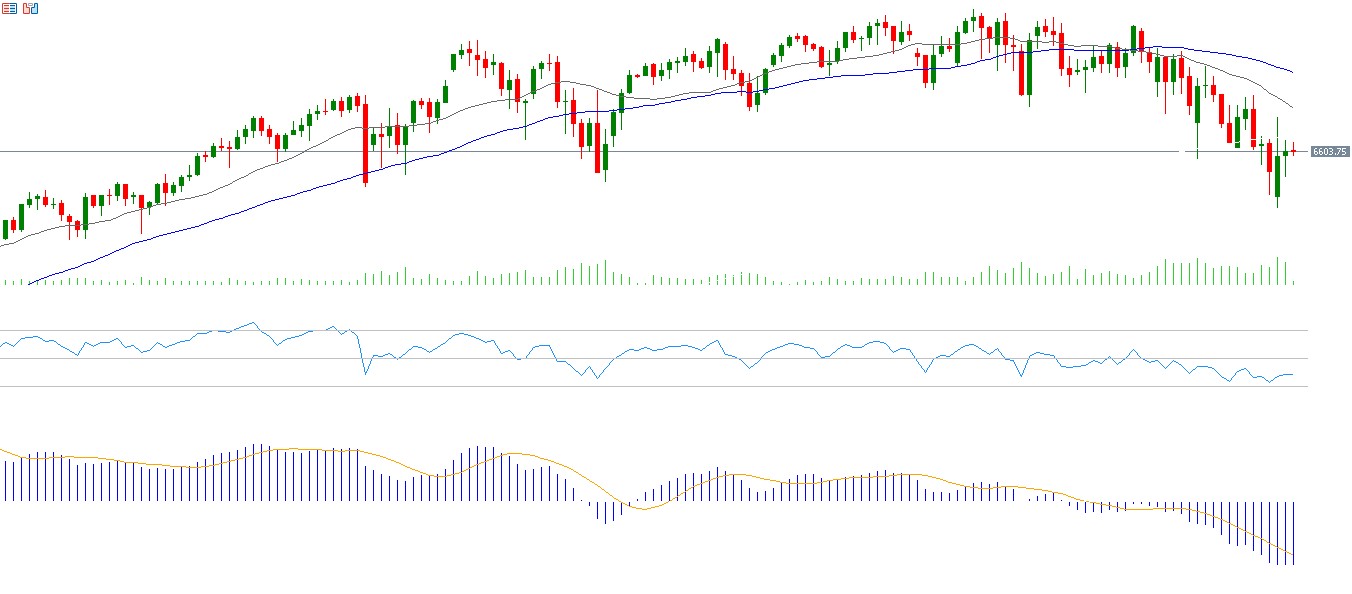
From a technical perspective, the S&P 500 shows bearish signals, with a downside crossover between the 20-day and 50-day moving averages, suggesting the potential start of a downward trend. The Relative Strength Index stands at 36, indicating negative momentum, while a bearish crossover between the MACD line and the signal line further supports the likelihood of continued downside pressure.
Please note that this analysis is provided for informational purposes only and should not be considered as investment advice. All trading involves risk.