The Forex market moves about $9.6 trillion every day, making it the largest financial market in the world. By comparison, the New York Stock Exchange and NASDAQ together trade around $500 billion daily.
Many traders are drawn to Forex because it is highly liquid, runs 24 hours a day during the week, and often has lower trading costs than other markets.
However, these advantages also come with risks. According to European regulatory data, about 74 to 89% of retail CFD traders lose money.
In this article, we explain 10 key Forex trading advantages and the important risks you should understand before you start.
What Are The Main Benefits Of Forex Trading?
Here are 10 specific advantages, each broken down with the data and context you need.
| Advantage | Details |
| 24-Hour Access | Trades 5 days/week across all time zones |
| High Liquidity | $9.6T daily volume, fastest execution of any market |
| Low Costs | Spreads under 1 pip on major pairs, no commissions on many accounts |
| Leverage Available | Up to 50:1 (US), 30:1 (EU), amplifies both gains and losses |
| Trade Rising and Falling Markets | Go long or short with equal ease |
| Wide Pair Selection | 170+ currencies, 7 major pairs drive 66% of volume |
| Low Capital Entry | Micro accounts from $1, recommended start: $500–$1,000 |
| Macro-Driven Signals | Tradeable via economic data, interest rates, and geopolitics |
| Hedging Tool | Used by corporations and traders to manage currency exposure |
| Accessible Platforms | MT4/MT5, mobile apps, copy trading, demo accounts |
24-Hour Market Access
Forex is the only major financial market with extended market hours, operating nearly 24 hours a day during the trading week. Trading follows four main global sessions. The week begins when the Sydney market opens on Sunday evening. Trading then moves to Tokyo, then London, and finally New York before the cycle repeats. The market closes on Friday afternoon in New York.
This is important because many other markets have fixed hours. For example, the New York Stock Exchange closes at 4 PM EST. If major news appears after the market closes, stock traders must wait until the next day to react. Forex traders can respond immediately when events happen.
Some sessions are more active than others. The London session handles about 38% of global Forex trading. The US session accounts for about 19%, and Singapore has grown to around 11.8%. Traders can choose the session that fits their schedule and the type of price movement they want to trade.
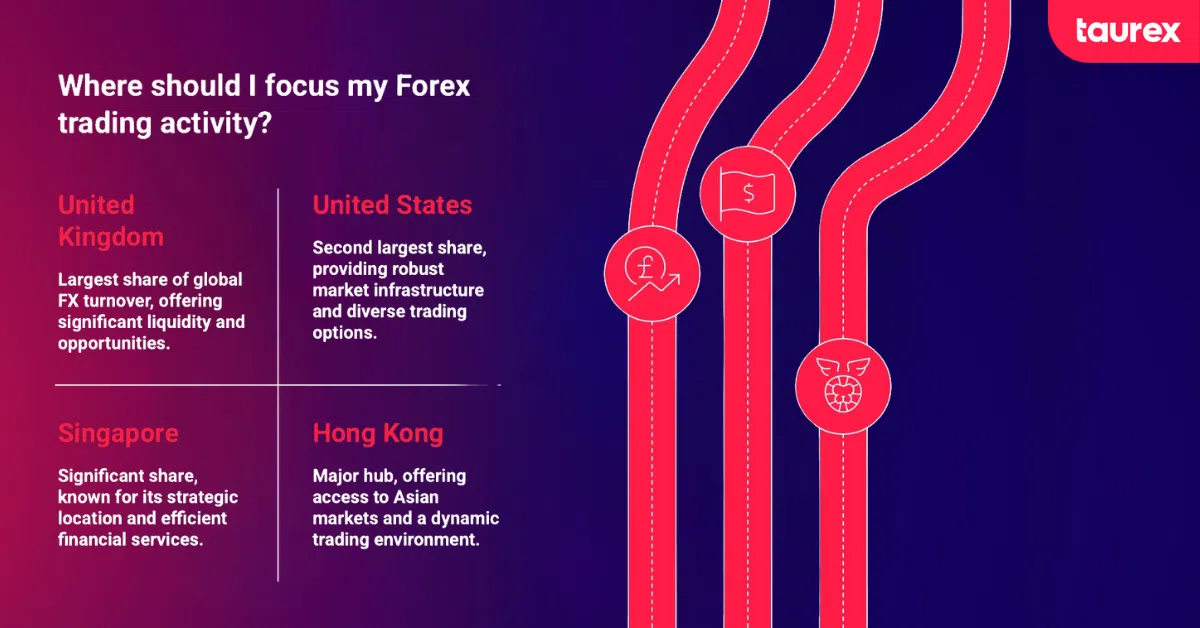
Global Forex trading activity is concentrated in a few major dealing centres. According to the Bank for International Settlements Triennial Survey, the United Kingdom accounts for the largest share of global FX turnover, followed by the United States, Singapore, and Hong Kong. Singapore alone represents about 11.8% of global activity, and together these major financial hubs handle roughly 75% of total Forex trading volume.
High Liquidity And Fast Order Execution
Major currency pairs such as EUR/USD and USD/JPY usually execute trades in milliseconds with very little slippage in normal conditions. In April 2025, EUR/USD trading in the UK alone exceeded $1 trillion in daily volume.
High liquidity matters because it helps orders fill close to the price you see on the screen. Your trade entry is usually very close to your intended price. In markets with lower liquidity, such as small company stocks or some crypto tokens, prices can move quickly between the time you place and execute a Forex order.
In Forex, major currency pairs normally provide stable execution even for retail traders.
Tight Spreads And Low Transaction Costs
Forex is one of the lowest-cost markets to trade. On major pairs, spreads are often under one pip. For example, EUR/USD spreads often range from about 0.1 to 1.5 pips depending on the trading session and broker.
Many brokers also offer accounts where the spread is the only trading cost, meaning there are no separate commissions.
To give a simple example, opening a $10,000 position on EUR/USD with a 0.5 pip spread costs roughly $5 for the full trade. This is often lower than traditional stock trading fees or many crypto exchange charges.
However, spreads are not always the same. They usually widen during quieter trading periods or during major news releases such as US employment data or central bank announcements.
Electronic trading platforms now handle more than 76% of Forex trading. This growth has helped reduce spreads over the last decade.
Leverage And Capital Efficiency
Leverage allows traders to control a larger position using a smaller deposit. For example, with 50:1 leverage, a $1,000 account can control a position worth $50,000.
Leverage limits depend on regulations. In the United States, traders can use up to 50:1 leverage on major currency pairs and 20:1 on minor pairs. In the UK and Europe, regulations usually limit leverage to 30:1 on major pairs.
Some offshore brokers offer much higher leverage, sometimes up to 500:1, but these options carry much higher risk and often less regulatory protection.
Leverage can increase potential profits, but it also increases losses. A small market move against your position can remove a large part of your account balance. This is one reason many retail traders lose money.
For beginners, using lower leverage such as 5:1 or 10:1 is usually a safer starting point.
Ability To Trade Rising And Falling Markets
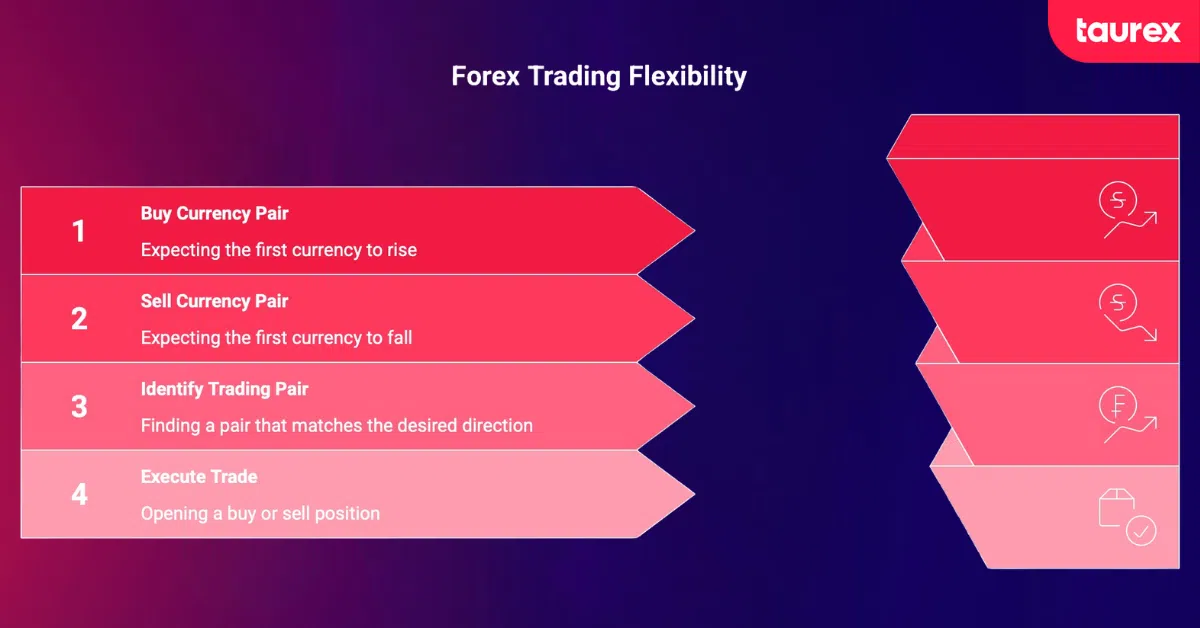
Forex trading allows you to trade both rising and falling prices easily. When you buy a currency pair, you expect the first currency to rise against the second. When you sell a pair, you expect the first currency to fall.
Currencies always move in relation to another currency. This means there is always a pair that reflects the direction you want to trade.
For example, if the US dollar becomes stronger, a trader might sell EUR/USD or buy USD/JPY to follow that move.
In stock markets, betting on falling prices often requires borrowing shares or using special trading rules. In Forex, opening a sell position works the same way as opening a buy position.
Wide Selection Of Currency Pairs
The Forex market includes more than 170 currencies. However, most trading activity focuses on a smaller group of pairs.
The 7 major pairs include EUR/USD, USD/JPY, GBP/USD, USD/CHF, AUD/USD, USD/CAD, and NZD/USD. Together, they account for about 66% of total Forex trading volume.
Minor pairs, also called crosses, include combinations such as EUR/JPY or GBP/JPY. These pairs usually have good liquidity but slightly wider spreads.
Exotic pairs involve currencies from smaller or emerging economies, such as USD/ZAR or USD/MXN. These pairs can have higher volatility and wider spreads, so they are usually traded by more experienced traders.
Having many pairs allows traders to focus on the currencies and economic trends that interest them.
Lower Capital Requirements
Forex has a relatively low barrier to entry. Some brokers allow accounts with deposits as small as $1 to $20. These accounts allow trading micro lots where one pip is worth about $0.10.
Standard accounts usually require deposits between $100 and $1,000. However, very small accounts can make risk management difficult. Many professionals suggest starting with about $500 to $1,000. With proper risk management, traders often risk only 1 to 2% of their account on a single trade.
For example, on a $1,000 account, a 1% risk equals $10 per trade, which is easier to manage than risking only a few cents on a very small account.
Many beginners start with a demo account to practise trading with virtual money before moving to a small live account.
Strong Macro Fundamentals
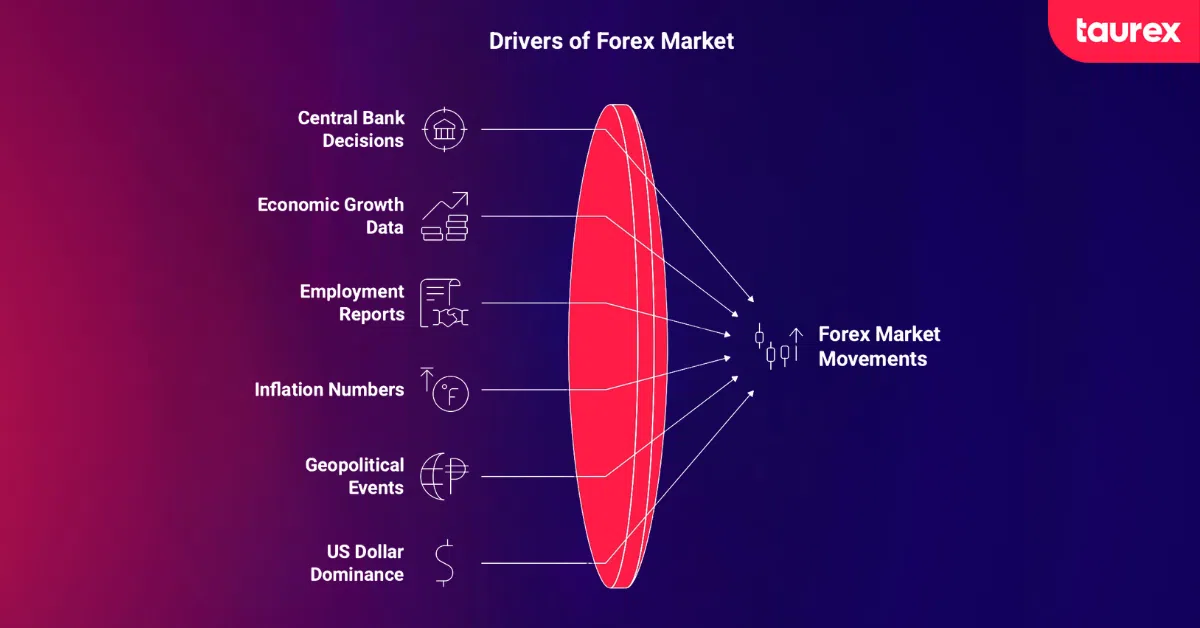
Another advantage of Forex trading is that its main drivers are easy to track. Currency prices often react to large economic factors rather than individual company news.
Important drivers include central bank interest rate decisions, economic growth data, employment reports, inflation numbers, and geopolitical events. Many of these events are listed in economic calendars that show when new data will be released.
The US dollar plays a major role in global Forex trading. It appears in almost 90% of all currency trades and remains the largest global reserve currency.
Because of this, following US economic data and Federal Reserve policy often helps traders understand movements in the most active currency pairs.
Hedging Capabilities
Forex trading is not used only for speculation. It is also widely used by companies and investors to manage currency risk.
For example, a US company that sells products in Europe may receive payment in euros. If the euro weakens before the payment arrives, the company receives fewer dollars when the money is converted. To reduce this risk, companies can use Forex contracts to lock in exchange rates in advance.
Common hedging tools include forward contracts, currency options, and currency swaps. These tools help companies protect future income from large exchange rate changes.
Retail traders sometimes use simpler hedging methods by holding positions in different but related currency pairs to reduce risk.
High Market Accessibility Through Online Platforms
Technology has made Forex trading easier to access than ever before. Electronic trading platforms now handle more than 76% of global Forex transactions.
MetaTrader 4 and MetaTrader 5 are the most widely used trading platforms. They are free, widely supported by brokers, and include many tools for technical analysis and automated trading.
Mobile trading apps also allow traders to monitor and manage trades from anywhere with an internet connection.
Many brokers also offer demo accounts. These simulate real market conditions using virtual funds, allowing beginners to practise trading strategies without risking real money.
What Are the Advantages of Forex Trading vs Other Markets?
To understand the Forex trading advantages and disadvantages, it helps to compare Forex with other financial markets such as stocks, crypto, and futures. Looking at these differences gives a clearer picture of where Forex offers benefits and where other markets may be stronger.
Below is a simple comparison between Forex and the stock market.
Forex vs Stocks: Which Market Suits You More?
| Factor | Forex | Stocks |
| Trading Hours | 24/5 | 9:30 AM–4:00 PM EST (limited after-hours) |
| Minimum Capital | $1–$1,000 (typical) | $25,000 for US pattern day traders |
| Leverage (retail) | Up to 50:1 (US), 30:1 (EU) | 2:1 retail, 4:1 intraday |
| Transaction Cost | Under 1 pip spread | ~$4.95/trade or 0% on some apps |
| Short Selling | No borrowing required | Requires borrowing shares, fees |
| Market Size | $9.6 trillion/day | ~$500 billion/day (NYSE + NASDAQ) |
| Liquidity | Extremely high (majors) | High (large-cap), low (small-cap) |
| Ownership | None (currency pairs only) | Dividends, voting rights, equity stake |
Forex is often more suitable for active traders. The market is open almost all day during the week, trading costs are usually lower, and traders can easily buy or sell currency pairs.
Stocks offer different advantages. Investors own shares in a company, which means they can receive dividends and voting rights. Stock markets are also more tightly regulated, which may offer stronger investor protection.
In simple terms, Forex is commonly used for short to medium term trading, while stocks are often better for long term investing and building ownership in companies. The right choice depends on your goals and trading style.
Forex vs Crypto: Which Market Suits You More?
| Factor | Forex | Crypto |
| Trading Hours | 24/5 | 24/7 |
| Leverage | 30:1–50:1 (regulated) | 5:1–100:1 (varies) |
| Spread Cost | Under 1 pip on majors | 50 pips equivalent on many coins |
| Volatility | Moderate (major pairs) | Extreme (30%+ swings possible) |
| Regulation | Strong (FCA, CFTC, ESMA, ASIC) | Fragmented, MiCA from Dec 2024 (EU) |
| Liquidity | Deep (major pairs) | Varies, altcoins often thin |
Crypto markets run 24 hours a day and often show much larger price swings. This can create more trading opportunities, but it also increases risk.
Forex markets are generally more stable and are regulated by authorities such as the FCA, CFTC, ESMA, and ASIC. This provides clearer trading rules and stronger protection for traders.
Liquidity is another difference. Major Forex pairs have very deep liquidity, which helps trades execute close to the expected price. In crypto markets, most liquidity is concentrated in Bitcoin and Ethereum, while smaller coins can have thin order books and larger price gaps.
In simple terms, Forex suits traders who want a more stable and regulated market. Crypto may appeal to traders who are comfortable with higher volatility and risk.
Forex vs Futures: Which Market Suits You More?
| Factor | Forex | Futures |
| Market Type | Over the counter (OTC), continuous | Exchange-traded, fixed expiry |
| Trading Hours | 24 hours a day, 5 days a week | Exchange hours only |
| Pricing & Transparency | Broker-dependent, small differences possible | Centralised, same price for all traders |
| Contract Size | Flexible, no minimums | Fixed, set contract sizes |
| Position Duration | Can be held indefinitely, overnight swaps apply | Expires at contract end, may require rollover |
| Regulation | Depends on the broker and jurisdiction | Strongly regulated through exchanges |
| Best Suited For | Retail traders, flexible trading, lower minimums | Institutions and traders needing transparency and strict regulation |
Futures are exchange-traded contracts with fixed expiry dates. Forex spot is traded over the counter and can stay open indefinitely, though overnight swap fees may apply.
Futures offer centralised pricing and full transparency. Forex prices can vary slightly between brokers.
Futures contracts have fixed sizes and expire, while Forex allows smaller trades with no contract minimums and flexible position holding.
Futures are strongly regulated through exchanges. Forex regulation depends on the broker and jurisdiction.
In short, futures suit institutions seeking transparency and strict regulation, while Forex is more flexible for retail traders, offering lower minimums, a wider range of currency pairs, and continuous 24/5 trading.
Pros and Cons of Forex Trading: Key Risks to Know
Understanding the pros and cons of forex trading is essential before entering the market. While opportunities exist, trading forex may involve risks that can affect account performance, and some retail traders experience losses, making it important to set realistic expectations.
| Risk Factor | What Can Happen |
| Leverage | High leverage may magnify losses. Beginners may benefit from using lower leverage (5:1–10:1). |
| News Volatility | Economic releases and central bank announcements can cause rapid price moves, wider spreads, and possible slippage. |
| Broker Risk | Using unregulated brokers may increase exposure to price manipulation or fund security issues. Regulated brokers (FCA, CFTC, ASIC) may offer more protection. |
| Psychological Pressure | The 24/5 nature of Forex may encourage overtrading or impulsive decisions. A structured trading plan may help manage this. |
| Loss Rate | Data from ESMA suggests that 74–89% of retail CFD accounts may lose money. Profitability may require skill, practice, and consistent risk management. |
Are The Advantages Of Forex Trading Worth The Risks?
Understanding the pros and cons of Forex trading helps traders decide whether the market fits their goals and risk tolerance. Forex offers benefits such as 24/5 market access, low spreads, and the ability to trade with relatively small starting capital, but leverage and price volatility can also increase the risk of losses.
How useful these advantages are depends largely on the trader’s approach. Those who learn first, practise on a demo account, limit risk, and follow a structured plan may use Forex’s features more effectively, while traders seeking quick profits without preparation may face a higher chance of losses.
Open a demo account at Taurex to explore Forex trading safely and see how it may fit your strategy.
FAQ
Is Forex trading better than stocks?
Neither is always better. Forex may offer 24/5 trading, lower capital requirements, easier short selling, and tighter spreads. Stocks may provide stronger protections, ownership rights, and lower long-term leverage risk.
Is it beneficial to become a Forex trader?
It can be, but success may require preparation. Forex may offer deep liquidity, low costs, and constant market access, but many retail traders may lose money without proper education, capital, and discipline. Those who study and practise first may use these advantages more effectively.
How can I manage my risks in Forex?
Risk management may be the most important skill. Traders can limit losses by risking 1–2% per trade, using stop-losses, practising on a demo account, and keeping a trading journal. Avoid high-impact news events until enough experience is gained.
Is Forex trading profitable long-term?
Long-term profitability is possible but uncommon. Only a small percentage of retail accounts may sustain full-time profits. Adequate account capital and consistent practice over months or years may improve chances.
What are the benefits of Forex trading for beginners?
Beginners may use Forex to learn safely. Demo accounts, micro-lot trading, and low minimum deposits can limit risk while building skills. If you’re just starting out, learning how to become a trader the right way can make a real difference. Spending months on practice before using real money may help avoid early losses.