
Forex payment methods decide how quickly money reaches a trading account, what it costs to move and how easily it comes back out. Some methods are fast but cost more, others are cheaper but slower, and a few carry withdrawal rules that catch new traders out.
If you are new to Forex trading, you should know what FX payments are first. FX payments are payments that move money across borders or between currencies. In trading, Forex payments are the deposits and withdrawals that move money between your bank, card or wallet and your broker. The five main options are bank transfers, cards, e-wallets, local payment methods and cryptocurrency.
In this guide, we explain how each one works, how to compare them, what they may cost and how to check them for safety. The last section covers the options available at Taurex.
What Are the Most Common Forex Payment Methods?
Most Forex brokers accept bank transfers, credit and debit cards, and e-wallets. Some also support local payment methods or cryptocurrency, depending on the broker and your country.
- Bank transfers: Send money directly from your bank account to the broker. In 2025, 75% of SWIFT payments reached the receiving bank within 10 minutes, although this refers to the payment instruction rather than the funds appearing in your account. International transfers can still take several business days and may involve intermediary bank fees of $10 to $100 or more.
- Credit and debit cards: Card deposits are often processed within minutes. However, foreign transaction fees typically range from 1% to 3% when applicable, and withdrawal options depend on the broker’s rules.
- E-wallets and digital payment services: Services such as Skrill and Neteller let you transfer funds without sharing your card or bank details directly with the broker. They may charge additional fees or set transaction limits.
- Local bank transfers and regional payment methods: Local systems can make deposits faster and reduce international transfer costs. For example, SEPA Instant transfers in the euro area can make funds available within 10 seconds. Other regional options include Pix in Brazil and FPX in Malaysia, depending on your location and broker.
- Cryptocurrency payments: Some brokers accept stablecoins such as USDT, which is designed to maintain a value of $1. Network fees vary. For example, USDT transfers on Tron generally cost less than transfers on Ethereum. However, stablecoins can lose their intended value, and transfers sent to the wrong address are often difficult or impossible to reverse.
The table below compares the five methods side by side.
| Payment method | Typical processing time | Potential fees | Main consideration |
| Bank transfer | Several business days, depending on the banks involved | Bank and intermediary fees may apply | Suitable for larger transfers, but processing can take longer |
| Credit or debit card | Deposits are often processed quickly | Issuer or conversion fees may apply | Convenient, but withdrawal rules can differ |
| E-wallet | Often quick, depending on the provider | Provider fees and currency conversion charges may apply | Convenient for supported accounts and currencies |
| Local payment methods | Varies by country and provider | Depends on the payment service | May offer convenient domestic transactions |
| Cryptocurrency | Varies by network and platform | Network and conversion fees may apply | Only available with brokers that explicitly support it |
How to Choose the Best Forex Payment Method
There is no single method that suits every trader. The right fit depends on your priorities and on your broker’s rules, and these six points can help you compare your options.
- Deposit and withdrawal processing times. Deposits are usually quick. Withdrawals often take longer, as brokers run anti-money-laundering (AML) checks first. AML rules exist to stop criminals moving money through financial firms.
- Transaction fees and currency conversion costs. The visible fee is rarely the full cost. A 2025 Financial Stability Board report found that currency conversion was the largest part of measured cross-border payment costs. This is a general benchmark for cross-border payments, not a broker figure.
- Minimum and maximum transaction limits. Each method may have its own lower and upper limits. Minimum withdrawals often range from $50 to $500 or more, and cards tend to have lower caps than bank transfers.
- Payment security and account verification. Brokers must confirm who you are before any withdrawal. Having your ID and proof of address ready may save time later.
- Availability in your country. Accepted methods can differ by country of residence. Check both the deposit and withdrawal lists, as they aren’t always the same.
- Withdrawal restrictions and payment method matching. Many brokers follow a closed-loop policy, which means money returns to the source it came from, up to the amount you deposited.
These points work best alongside the other checks you make when choosing a broker, such as regulation, account terms, and fees.
Forex Deposit Methods vs. Withdrawal Methods
Deposits and withdrawals follow different rules, so it pays to plan the withdrawal route before the first deposit.
How to Deposit Money Into a Forex Trading Account
- Log in to the client area and open the deposit section.
- Choose a payment method and enter the amount.
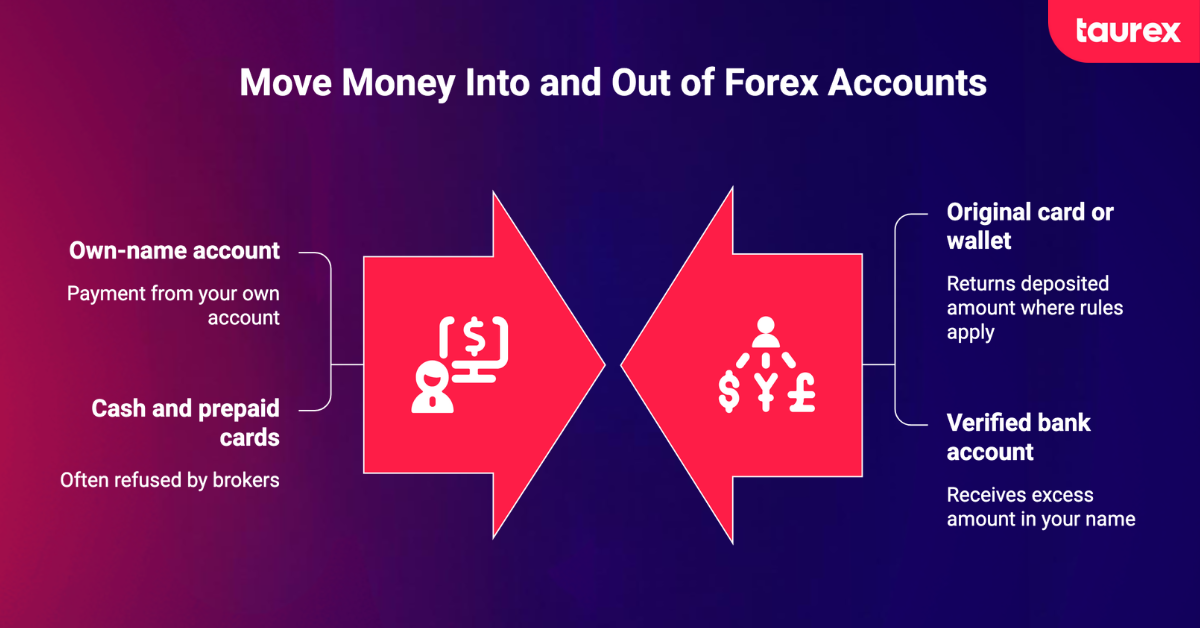
- Confirm the payment from an account in the trader’s own name.
- Check the balance once funds arrive, in the client area or on the Forex trading platform.
Cash and prepaid cards are often refused because the source of the money cannot be checked.
How to Withdraw Money From a Forex Trading Account
Open the withdrawal section, choose your method, enter the amount and confirm. The broker may then ask you to complete extra checks. Where matching rules apply, the amount you deposited goes back to the original card or wallet, and any amount above that usually goes to a verified bank account in your name.
Why Withdrawals May Take Longer Than Deposits
Withdrawals face know-your-customer (KYC) and AML checks that deposits often skip. KYC means the broker confirms your identity and address. After the broker releases the money, your bank or wallet adds its own processing time.
As a benchmark, one broker reviewed by BrokerChooser showed one-day withdrawals with no fee across four methods in August 2025, but times vary a lot between brokers.
How Identity Verification Affects Payment Processing
If your account is not fully verified, a withdrawal may be delayed or rejected. The name on your card, wallet or bank account must match the name on your trading account. Some brokers ask for extra documents after your first deposit and before your first payout, so uploading them early may help.
What to Do If a Forex Withdrawal Is Delayed
Start by checking the requests or documents section of your account for anything missing, then upload it. If nothing is outstanding, contact support and quote your withdrawal reference. Keeping screenshots of the payment terms shown when you deposited can help if you need to raise a dispute. Be very cautious if a broker asks you to pay a ‘release fee’ or ‘clearing fee’ before it sends your money, as this is a common scam sign.
How Much Do Forex Payment Methods Cost?
The headline fee is rarely the full cost of Forex payments. Several layers of charges can apply to a one transfer:
- Broker deposit and withdrawal fees. Some brokers charge nothing. Others charge by method, such as a flat fee for wire withdrawals.
- Bank and payment provider charges. A broker may charge no fee, but your bank or e-wallet may still add one.
- Currency conversion and exchange rate fees. If you deposit euros into a US dollar account, the money converts at a rate linked to the EUR/USD pair, often with a markup. The same applies to pounds and the GBP/USD rate. Card networks usually charge around 1% for conversion, and issuers may add more. Knowing how to read Forex quotes can help you check the rate you receive.
- International transfer and intermediary bank fees. Intermediary charges are often deducted before the money arrives, so less may land than you sent.
- How to compare the total cost of a transaction. Add the deposit fee, withdrawal fee, conversion cost and any intermediary charges for the full round trip.
For a wider view, World Bank data for Q3 2025 put the average cost of sending $200 across borders at 6.36%, and 4.59% for digital services. This is a general remittance benchmark, not a broker fee, but it shows how small charges can add up on smaller amounts.
The guide to hidden Forex trading costs covers the wider picture, including inactivity fees.
Are Forex Payment Methods Safe?
Your money’s safety depends on the broker, the payment method, and how you protect your account. These six checks can help reduce the risk of fraud and payment problems.
- Check the broker’s regulatory status. Verify the broker’s legal entity on the regulator’s official register and review warning lists for reports of potentially fraudulent activity. It also helps to understand the differences between regulated and unregulated Forex brokers before opening an account.
- Use payment methods in your name. Brokers commonly reject third-party payments to meet anti-money laundering (AML) requirements. Make sure your payment account matches your trading account details.
- Enable two-factor authentication. Two-factor authentication (2FA) adds a second verification step when you log in. Enable it for your broker account and e-wallet where available.
- Verify payment details before transferring money. Double-check the account name, IBAN, and payment reference. Some payment systems, such as Verification of Payee in the euro area, also check whether the recipient’s name matches the account details.
- Watch for deposit and withdrawal scams. Be wary of guaranteed returns, pressure to deposit quickly, unclear regulatory details, and demands for extra fees before withdrawals. Learn to recognise common Forex scam tactics. You can also test a broker’s payment process with a small deposit and withdrawal.
- Understand chargebacks. A chargeback lets you dispute a card payment through your card issuer, but approval isn’t guaranteed. Bank transfers generally don’t offer the same protection, so check payment details carefully before sending money.
Which Forex Payment Method Is Best for Different Traders?
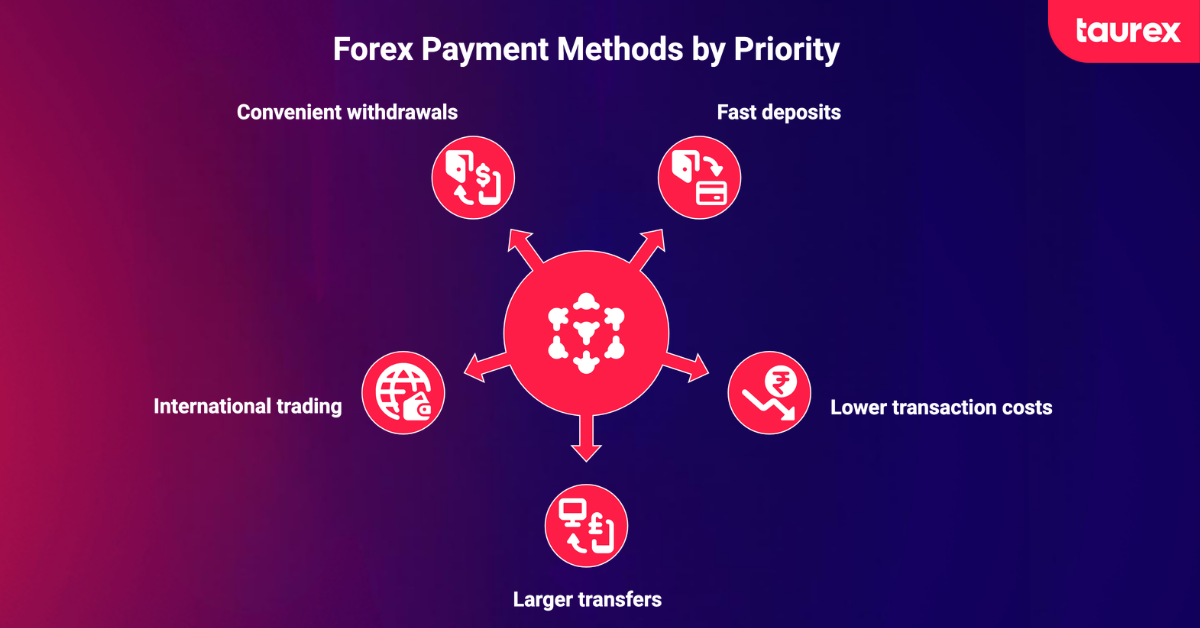
No single method suits everyone. The right fit often comes down to which priority matters most to you.
- Fast deposits: Cards and e-wallets often credit within minutes. For euro transfers, SEPA Instant may be faster where your bank and broker support it. Bank wires sent late on a Friday may wait until the next business day, so plan around banking days and Forex market hours.
- Lower transaction costs: Local transfers often avoid intermediary bank fees, and SEPA Instant cannot cost more than a standard SEPA transfer. Cards may add 1% to 3% in foreign transaction fees when currencies differ.
- Larger transfers: Bank transfers often suit larger sums, as some brokers set no daily maximum for them. Cards and e-wallets may have lower transaction limits.
- International trading: E-wallets and regional payment methods can offer more options in countries where international bank transfers are slow or costly.
- Convenient withdrawals: Using the same method for deposits and withdrawals can simplify payments, although broker rules may require withdrawals to return to the source. E-wallet withdrawals are often quicker than card refunds, which can take several working days to appear.
What Forex Payment Methods Does Taurex Support?
Taurex supports several deposit and withdrawal methods, including debit and credit cards, bank wire transfers, Skrill, Neteller, cryptocurrencies, Apple Pay, Google Pay, and mobile payments. Available options depend on your region and IP address, so you need to open a trading account to check which methods are available in your country.
Processing times vary by method:
- Debit and credit cards: Deposits are instant, and withdrawals take up to 3 hours.
- Bank wire transfers: Deposits and withdrawals can take up to 3 business days.
- Skrill and Neteller: Deposits and withdrawals are processed instantly.
- Cryptocurrencies: Deposits are generally instant, subject to conditions and deposit amounts. Withdrawals are listed as instant.
- Apple Pay, Google Pay, and mobile payments: Deposits are instant. Withdrawals take up to 24 hours for these methods.
Accepted currencies also vary. Taurex lists USD, EUR, and GBP for card payments, while bank transfers, e-wallets, and some other methods support multiple currencies.
Taurex follows anti-money laundering requirements when processing payments. For more information about the entity handling your account and the protections that apply, review Taurex’s global regulations and safety of funds pages.
When you’re ready, you can open a trading account to check the payment methods available to you. If you’d prefer to practise first, you can also use a Taurex demo account to trade with virtual funds.
Risk warning: Trading involves significant risk, including potential loss of principal. Trading leveraged products carries a high risk of losing money. Past performance does not guarantee future results, and you may get back less than you put in. This article is for education only and is not financial advice.
FAQ
What are FX payments?
FX payments are payments that move money across borders or between currencies. In trading, Forex payments are the deposits and withdrawals that move money between your bank, card or wallet and your broker.
What are the most common Forex payment methods?
The most common Forex payment methods are bank transfers, credit and debit cards and e-wallets. Some brokers offer local payment methods and cryptocurrency too, depending on your country.
Which Forex payment method is the fastest?
Cards and e-wallets are often the fastest Forex payment methods for deposits and can credit within minutes. Local instant transfers, such as SEPA Instant, may be faster where available.
Which Forex payment method has the lowest fees?
The Forex payment method with the lowest fees depends on your broker and country. Local transfers often avoid intermediary bank fees, but cards can add foreign transaction fees of 1% to 3%.
Can I deposit money into a Forex account using a credit card?
Yes, many brokers accept credit card deposits, but prepaid cards are often refused. The card must be in your name, and some brokers return only your deposited amount to a card.
How long do Forex withdrawals take?
Forex withdrawals can take from about one business day to several business days. The time depends on the broker’s checks, your verification status and the payment method you choose.
Can I withdraw money to a different bank account?
You can usually withdraw money to a different bank account only if it is verified and registered in your name. Brokers reject payments to accounts held by other people.
Why do Forex brokers require payment verification?
Forex brokers require payment verification to follow anti-money-laundering and know-your-customer rules. These checks confirm your identity and make sure money moves only through accounts that belong to you.
Can I use different payment methods for deposits and withdrawals?
You can sometimes use different methods, but many brokers return withdrawals to the original deposit method up to the amount deposited. Any amount above that may then go to a verified bank account.