
Tier-1 liquidity providers are the largest banks and trading firms that quote buy and sell prices in the global currency market. Every price on a retail trading platform starts somewhere, and for major currency pairs it usually starts with them. They rarely deal with retail traders directly, but their quotes shape the spreads, fills and slippage traders see.
The market they anchor is vast. According to the Bank for International Settlements (BIS), FX turnover averaged $9.6 trillion a day in April 2025, a month of unusually high volatility after trade policy announcements.
This guide explains what a liquidity provider in Forex does, what makes one Tier-1, how brokers connect to them and what that means for trading conditions.
Examples of Tier-1 Forex Liquidity Providers
Names often linked with tier 1 liquidity providers include JPMorgan Chase, UBS, Citigroup, Barclays and Goldman Sachs. These banks appear in recent industry overviews as major sources of institutional Forex pricing. Other major global banks such as Deutsche Bank and HSBC are commonly associated with institutional Forex too.
How Do Tier-1 Forex Liquidity Providers Work?
Tier 1 liquidity providers do three main jobs. They quote prices, they take the other side of orders and they deliver all of this through electronic networks. Each part plays a different role in getting a price to your screen.
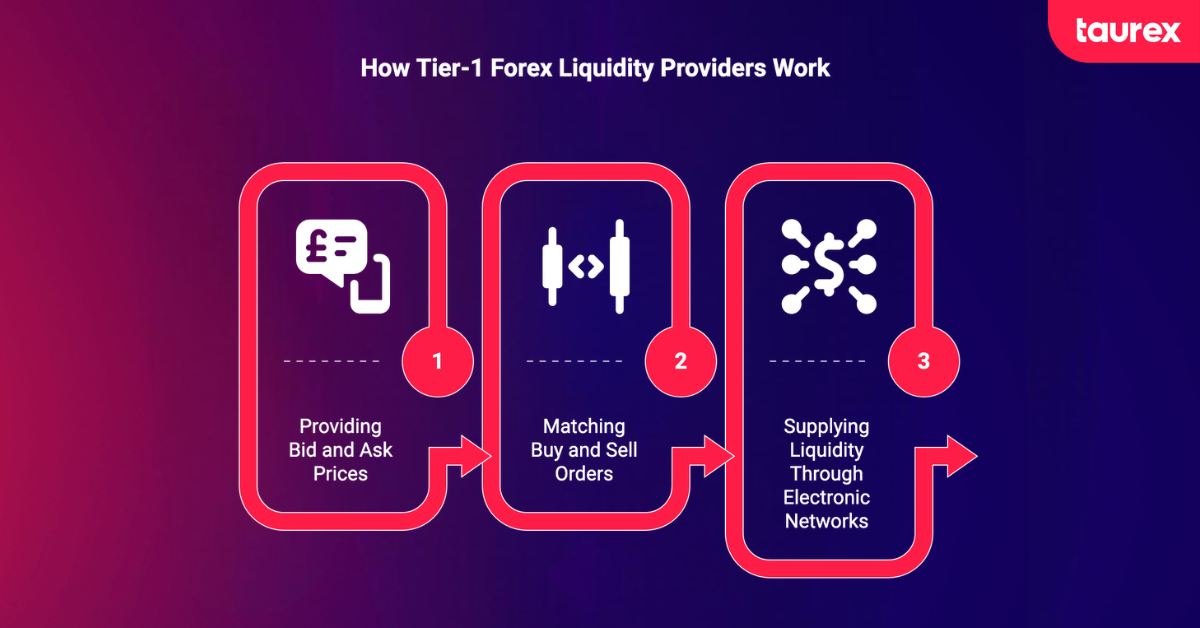
Providing Bid and Ask Prices
The bid is the price at which a buyer is willing to buy a currency pair. The ask is the price at which a seller is willing to sell. The gap between the two is the spread, which is one of the main costs of trading. Learning to read Forex quotes makes these numbers much easier to follow.
A Tier 1 provider streams both prices at once, with a set amount of volume available at each price. That volume is called depth. According to Track360, brokers stream these two-sided prices to their clients and execute orders against them. The depth behind a quote can matter as much as the price itself.
Matching Buy and Sell Orders
Every order needs someone on the other side. That can be the provider itself, trading from its own book, or another participant on the same network. Different types of Forex orders, such as market and limit orders, reach this stage in slightly different ways.
Brokers connect to this process through different models. In an ECN (electronic communication network) model, orders are matched electronically against prices from several participants. In an STP (straight-through processing) model, the broker passes your order on to its pool of providers. These models are a big part of what separates the main broker types you will come across.
Supplying Liquidity Through Electronic Networks
Prices travel from the provider to the broker through fast electronic links. Many of these links use FIX API, a standard format that financial firms use to send prices and orders to each other. On the broker side, software called a bridge connects those feeds to the trading platform.
Track360 describes the bridge as the link that routes orders out to providers and streams prices back in. The platform might be MT4, MT5 or another system, and it shows those prices to you in real time. So when you compare forex trading platforms, you are partly comparing the final step of this chain.
How Do Forex Brokers connect to Tier-1 Liquidity?
Most brokers do not plug straight into tier 1 liquidity providers. They reach that pricing through one or more layers in between. According to Finance Magnates, direct bank relationships usually need large capital, volume and infrastructure. That puts them out of reach for many small and mid-sized brokers.
Direct Relationships With Banks and Financial Institutions
A large broker can build a direct relationship with a bank. This usually means passing the bank’s credit checks, committing to high trading volumes and running the technology to handle a direct feed.
For brokers that meet those terms, a direct line may give access to deep pricing on major pairs. The trade-off is cost and long-term commitment. This is one of two main routes to Tier 1 pricing, with the other being an indirect route through prime brokerage and aggregation.
Using Prime Brokers and Prime-of-Prime Providers
A prime broker is a large institution that sits in the middle of trades to handle credit and settlement. Settlement is the final exchange of money once a trade is done. With a prime broker in place, a client can trade with several liquidity providers without a separate credit line for each one.
A prime-of-prime (PoP) provider goes one step further. According to LiquidityFinder, a PoP sets up its own prime brokerage line with a Tier 1 bank. It then repackages that access for brokers, funds and professional traders who could not meet bank requirements alone. Prime brokerage activity rose about 64% to roughly $2.16 trillion per day in the 2025 BIS survey, which shows how much of the market runs through these arrangements.
Connecting Multiple Liquidity Providers Through Aggregators
A liquidity aggregator is technology that combines price feeds from several providers into one stream. It then routes each order to a chosen provider, often the one showing the best available price at that moment, based on the broker’s settings.
Using several providers can bring benefits such as price competition, a backup if one feed fails and more combined depth. It adds cost and technical work for the broker, and the results depend on how well the setup is run. Track360 notes that a common setup for a growing broker is one or two non-bank providers plus a PoP, blended through an aggregator and a bridge.
What Is the Difference Between Tier-1 and Tier-2 Forex Liquidity Providers?
The main difference is size, market access and position in the liquidity network. It is not a simple measure of service quality. Tier 1 liquidity providers sit at the top with the largest balance sheets. Tier 2 providers include smaller banks, non-bank market makers and specialist firms that often pass liquidity on to brokers on more accessible terms.
Some sources place the largest non-bank market makers in Tier 1, so these labels work best as rough industry shorthand. As Leverate points out, quality varies from provider to provider within both tiers. It helps brokers to check the depth behind a feed and the oversight the provider works under. The table below compares the two groups in broad terms.
| Factor | Tier-1 liquidity providers | Tier-2 liquidity providers |
| Typical institutions | Major global banks and large financial institutions | Smaller banks, non-bank market makers and specialist liquidity firms |
| Market access | Broad institutional market access | Often accessed through larger institutions or liquidity networks |
| Financial resources | Usually greater | Varies by institution |
| Trading capacity | High institutional capacity | Depends on the provider |
| Broker relationships | Often serve large institutional clients and brokers | May serve smaller brokers and financial firms |
| Market role | Major sources of institutional liquidity | Extend liquidity access through additional market participants |
Many brokers blend both types, so the tier label on its own says little about the execution quality you might see. How a broker builds and runs its mix of providers tends to matter more.
How Do Tier-1 Liquidity Providers Affect Forex Trading Conditions?
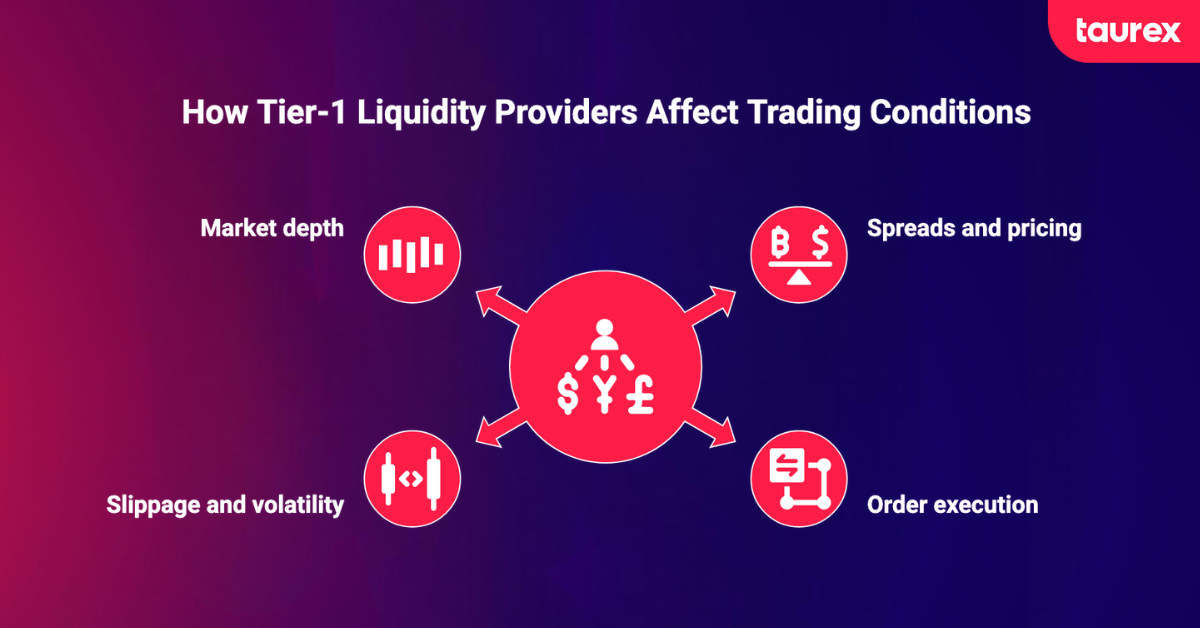
Tier 1 liquidity providers can influence spreads, fills and slippage, but they are only one part of the picture. Your broker’s setup, your account type and live market conditions all play a role. According to Finance Magnates, the provider a broker works with affects how tight and stable spreads are and how often clients see slippage or requotes.
Spreads and Pricing
Competitive quotes from several providers can support tighter raw spreads, especially on busy pairs such as EUR/USD and GBP/USD. This tends to show most during active market hours, when the main financial centres overlap.
The spread you pay is not the raw spread alone. According to B2Prime, brokers reference top-tier prices and then add markups or adjustments, and some accounts charge a commission instead. So a Tier 1 source on its own does not promise a tight spread.
Execution and Slippage
Slippage is the difference between the expected price and the fill price, and it can be positive or negative. Around major news, providers widen quotes and depth thins, so prices can move between the click and the fill, and a stop-loss may fill beyond its level.
Even Tier-1 banks pull back under stress. Euromoney reported that during the April 2025 tariff turmoil, some providers stepped back while UBS kept quoting tight spreads. A broker with several providers has somewhere else to route orders when one widens or rejects them.
Market Depth and Larger Orders
Market depth is the amount of volume available at different prices. Tier 1 liquidity providers can absorb larger orders with less price impact, as more volume sits ready at each level.
Depth varies a lot by pair. Major pairs like USD/JPY usually have far more than exotic pairs such as USD/ZAR or USD/MXN, where spreads can widen and fills can be less predictable. Track360 suggests that brokers check depth on each instrument they offer, not just EUR/USD.
How Does Taurex Access Forex Liquidity for Its Clients?
Taurex offers more than 1,500 CFD instruments, including a wide range of Forex pairs, on MT4, MT5 and the Taurex app. Its pricing page lists the Forex execution model as ECN, with orders executed automatically and without dealer intervention. What traders pay depends on the account type:
- Standard Zero and Pro Zero: commission-free, with costs built into the spread.
- Raw: raw spreads plus a commission per lot.
Algorithmic traders can also connect their own systems through Taurex’s FIX API.
Liquidity is a business for the wider group too. Taurex Prime, launched in June 2025 as the institutional arm of the Taurex Group, provides liquidity and prime brokerage across more than 1,500 assets through FIX and MT5 API connections. It is the trading name of Taurex Limited, authorised by the UK Financial Conduct Authority (FRN 816055), and serves institutional and professional clients only.
If you would like to see how Taurex pricing looks in practice, you can explore our account conditions or start with a demo account using virtual funds. The steps to open an account are set out clearly if you later decide to go further.
Risk warning: CFDs are complex instruments and come with a high risk of losing money quickly as a result of leverage. Trading leveraged products may not suit everyone, and you can lose money.
FAQ
What is a Tier-1 liquidity provider in Forex?
A Tier 1 liquidity provider is one of the largest global banks or, in some definitions, one of the largest non-bank market makers. These firms quote deep two-way prices at the top of the institutional Forex market. Their prices act as a reference that smaller providers, brokers and platforms build on.
Which banks are considered Tier-1 Forex liquidity providers?
Banks often named include JPMorgan Chase, UBS, Citigroup, Barclays and Goldman Sachs, along with other major global banks such as Deutsche Bank and HSBC. This list is illustrative only. It is not an official ranking, and it does not show that any broker connects to these banks directly.
Do all Forex brokers use Tier-1 liquidity providers?
No. Many brokers reach Tier 1 pricing indirectly through prime-of-prime providers or aggregators, and some rely mainly on non-bank market makers or other providers. How a broker sets up and runs its providers can matter as much as the names at the top of the chain.
What is the difference between a liquidity provider and a liquidity aggregator?
A liquidity provider quotes buy and sell prices and trades against incoming orders. A liquidity aggregator is technology and does not take the other side of trades. It combines quotes from several providers into one stream and routes each order to a chosen source.
Do Tier-1 liquidity providers guarantee tighter Forex spreads?
No. Tier 1 pricing can support tighter raw spreads, but the spread you pay depends on other things too. These include the broker’s markup or commission, your account type, the currency pair and live market conditions. Spreads can widen sharply during news events or quiet trading hours.
Can retail traders access Tier-1 liquidity providers directly?
In most cases, no. Tier 1 liquidity providers deal with large institutions that meet strict credit and volume terms. Retail traders reach the market through a broker, which may connect to Tier 1 pricing through prime-of-prime providers, aggregators or a mix of sources.
How many liquidity providers should a Forex broker have?
There is no fixed number. Several providers can add price competition, a backup if one feed fails and more combined depth. A single strong provider may be enough for a smaller broker. The right mix depends on the broker’s trading volumes, the products it offers and how it manages risk.