
Forex liquidity affects how easily you can buy or sell a currency pair and how much your trade costs. When liquidity is high, orders can usually be filled quickly with smaller price differences. When it is low, spreads may widen, and orders can be filled at less favourable prices.
According to the Bank of England’s April 2026 FX turnover survey, average daily Forex turnover in the UK reached a record $4.61 trillion, up 14% from April 2025. Despite this high trading activity, liquidity varies between currency pairs, trading sessions and market conditions, affecting spreads and execution quality.
In this article, we explain what affects Forex liquidity, how it influences spreads and order execution, and how traders can account for changing market conditions.
What Is Liquidity in Forex?
Liquidity in Forex is the ability to trade a currency pair quickly, in size, at a price close to the last quote. A liquid market shows three signs:
- Tight spreads: a small gap between the bid (the price a trader can sell at) and the ask (the price a trader can buy at).
- Market depth: plenty of volume waiting at and near the current price.
- Fast, stable fills: orders execute quickly without large jumps in price.
Liquidity is not the same as volatility. A market can be busy and fast-moving at the same time, as April 2025 showed. Much FX liquidity is also invisible on screen: the BIS found that dealers match more than 80% of customer trades within their own internal liquidity pools.
How Does Forex Liquidity Affect Bid-Ask Spreads?
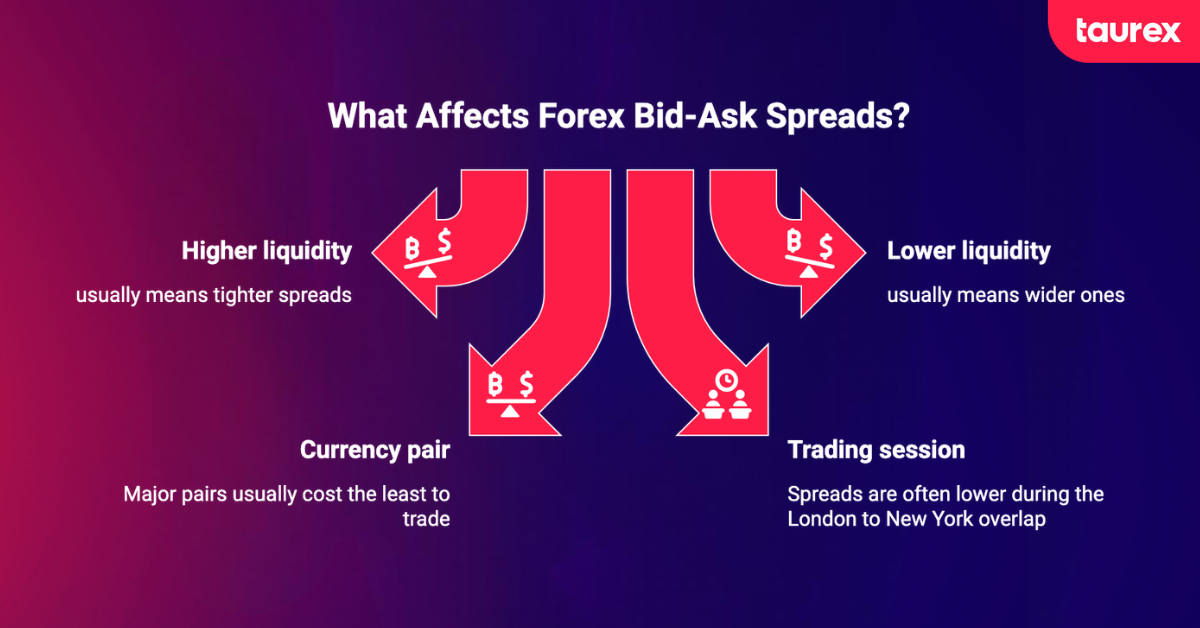
Higher liquidity usually means tighter spreads, and lower liquidity usually means wider ones. The bid-ask spread is the gap between the price you can sell at (the bid) and the price you can buy at (the ask). You see both prices side by side whenever you read Forex quotes on a platform.
The spread is one of the main costs of trading. A small difference on one trade may not seem like much, but it adds up across many trades.
Why Do High-Liquidity Currency Pairs Usually Have Tighter Spreads?
When many banks, traders and liquidity providers quote the same pair, they compete on price. A liquidity provider is a large firm, often a bank, that stands ready to buy and sell. That competition tends to squeeze the gap between bid and ask.
According to CompareForexBrokers, which draws on BIS data, EUR/USD made up 21.2% of global turnover in April 2025, with USD/JPY at 14.3%. Pairs this busy often carry some of the lowest spreads. The exact figure still depends on your broker, your account type and the time of day.
The ranking is not fixed either. USD/CNY and USD/HKD have been gaining share, and GBP/USD has slipped. So a ‘major’ pair reflects current activity, not a permanent status.
Why Do Spreads Widen When Liquidity Falls?
Liquidity providers take on risk every time they quote a price. When fewer people are trading, or prices could jump, they protect themselves by widening their quotes or pulling them for a short time.
This tends to happen at two moments in particular. The first is the daily rollover, around 5 pm New York time, when many providers reset positions and quoting thins out. The second is the short window around major data releases, as FXStreet explains in its look at rollover and news trading. In both cases, spreads can widen sharply before settling again.
How Do Currency Pairs and Trading Sessions Affect Spread Costs?
Major pairs usually cost the least to trade. Minor pairs, which leave out the US dollar, such as EUR/GBP, often cost a little more. Exotic pairs combine a major currency with one from a smaller or emerging economy, such as USD/ZAR or USD/MXN, and tend to carry the widest spreads.
Timing matters too. Spreads are often lower during the London to New York overlap, when two of the biggest centres are open together. The Asian session can be quieter for some pairs. Session hours move with daylight saving, so it helps to check your broker’s server time and the Forex market hours before planning a trade.
| Session (GMT, northern winter) | Typical liquidity | What traders tend to see |
| Asian (Tokyo), about 00:00–09:00 | Moderate | Tighter on JPY, AUD and NZD pairs than on European crosses |
| London, about 08:00–17:00 | High | Busiest single session for EUR and GBP pairs |
| London and New York overlap, about 13:00–17:00 | Highest | Tightest spreads on most majors |
| Daily rollover, about 22:00 | Lowest | Brief spread widening across most pairs |
How Does Forex Liquidity Affect Trade Execution?
Liquidity affects how a trade fills, not just what it costs. Trade execution is the process of turning your click into an open position at a real price. In a deep market, that process tends to be quick and close to the price you saw.
In a thin market, the gap between what you expected and what you got can grow. The sections below cover the main ways this shows up.
How Do Available Liquidity and Execution Speed Connect?
Every order needs someone on the other side. In a liquid market, plenty of buy and sell orders sit near the current price, so your order can be matched quickly. In a thin market, finding that match can take longer, and the price may move in the meantime. Platform speed and your internet connection play a part as well.
Why Does Slippage Increase During Low-Liquidity Conditions?
Slippage is when your order fills at a different price from the one you expected. It can work in your favour (positive slippage) or against you (negative slippage). With fewer orders waiting at each price, a fast move can skip past your level before the order is matched.
Slippage is not limited to quiet markets. It can still happen on a highly liquid pair like EUR/USD when news hits and prices move quickly.
How Does Market Depth Affect Large Order Execution?
Market depth is the amount of volume waiting to be traded at each price level. When depth is thin, a large order can use up everything at the best price and then fill the rest at the next levels, each one a little worse. This is called price impact.
Some traders split a large order into smaller pieces. Each piece then needs less liquidity to fill, which may reduce the price impact.
What Causes Requotes, Rejections and Execution Delays?
A requote happens when the price changes between your click and the moment the order is processed, so you are offered a new price to accept or decline. Slippage is different, since the order still fills, only at another price.
Liquidity providers check prices and latency (the delay as data travels) to manage their own risk. Recent academic research on FX market making describes these checks as part of normal risk control, and an order may be rejected if the price has moved too far. Order handling can differ between types of Forex brokers. Platforms that use market execution usually fill orders without requotes, but the fill can show positive or negative slippage.
What Causes Forex Liquidity to Change?
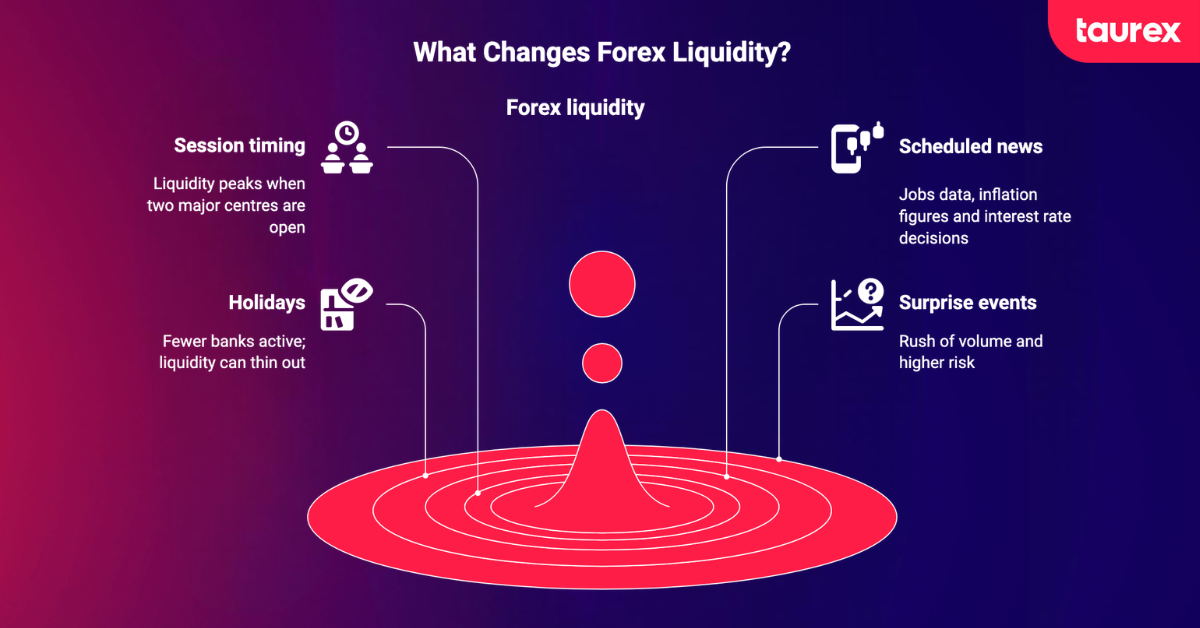
Forex market liquidity rises and falls through the day and across the year. Most changes come from four sources: session timing, scheduled news, holidays and surprise events.
Knowing which one is in play can help you make sense of a spread that suddenly looks different.
How Do Overlapping Forex Trading Sessions Change Liquidity?
Liquidity tends to peak when two major centres are open at the same time. The London to New York overlap, roughly 13:00 to 17:00 GMT, is widely seen as the busiest window of the day. Asia carries real weight too, with Singapore’s share of global turnover rising to 11.8% in 2025, up from 9.5% in 2022.
How Do Major Economic News and Central Bank Announcements Affect Liquidity?
Big releases such as jobs data, inflation figures and interest rate decisions can thin out the market for a short time. Providers often pull or widen quotes just before the number comes out and return once prices settle. During that gap, volatility and the chance of slippage may both rise. An economic calendar shows when these events are due, but unexpected headlines are harder to plan for.
How Do Public Holidays and Market Closures Affect Liquidity?
The Forex market can stay open when a major financial centre is closed. With fewer banks active, liquidity can thin out and spreads may widen. Late December is a well-known example, with Khaleej Times describing the period as fragile, with thinner trading and more sensitivity to headlines. Many brokers publish holiday trading notices, so checking them before holding positions over a break can help.
How Do Geopolitical Events and Unexpected Developments Affect Liquidity?
Surprise events can bring both a rush of volume and higher risk. The US tariff announcements in April 2025 are a clear case. The BIS links about $1.5 trillion of that month’s daily turnover to the tariff shock and the dollar’s sharp fall.
Even so, the BIS found no clear signs that liquidity broke down, and spreads for dealer-to-customer trades stayed fairly resilient. Shocks can raise the risk of wider spreads and slippage, but the outcome can vary a lot by market and by how dealers respond. News that breaks over a weekend can make prices gap when trading reopens.
High Liquidity vs Low Liquidity in Forex Trading
The table below compares how trading conditions tend to look when liquidity is high and when it is low.
| Factor | High liquidity | Low liquidity |
| Market participation | More active buyers and sellers | Fewer active participants |
| Bid-ask spreads | Usually tighter | More likely to widen |
| Available market depth | Usually greater | May be limited |
| Order execution | More opportunities to match orders | Execution may be more difficult |
| Slippage | Can still occur, especially during volatility | May be more pronounced |
| Large orders | Often easier to execute | May have greater price impact |
| Market conditions | Often seen during active trading sessions | More common during quiet periods or market disruptions |
Real markets sit somewhere on a sliding scale between these two columns. A single pair can move from one side to the other within the same day, so checking conditions before you trade can make your costs easier to predict.
How Can Traders Manage Spreads and Execution Risks?
You cannot control FX liquidity, but you can choose when, what and how you trade. The options below are ones some traders use, and they may not suit everyone.
They tend to work best as part of your own trading rules, set before you open a position.
How to Trade Major Currency Pairs When Liquidity Is Stronger
Some traders focus on major pairs such as EUR/USD, USD/JPY and AUD/USD during the busiest session hours. Spreads are often tighter at those times, and orders may fill closer to the quote. Liquid pairs still carry risk, and prices can move against you at any hour.
How to Check Spreads Before Opening a Position
A pip is the smallest standard price move in a currency pair. A spread of ‘0.0 pips’ is a minimum, not a promise, so look at the live spread before you trade. MT4 and MT5, both available at Taurex, show this in real time. How stable the spread stays can matter as much as its lowest level.
How to Be Careful Around Major Economic Announcements
Around high-impact releases, some traders wait for prices to settle, trade a smaller size or give their stop-loss more room for wider spreads. A stop-loss is an order that closes your trade at a set price to limit losses. In a fast market, it can still fill at a worse price.
How to Choose Order Types Based on Your Trading Needs
A market order fills at the next available price, so it favours speed but is more exposed to slippage. A limit order fills only at your price or better, giving price control, but it may not fill at all. Stop orders can slip. Some brokers offer stop-losses with a fixed exit price, usually for a fee if triggered. The main Forex order types each trade off price against speed differently.
How to Consider Position Size and Available Market Depth
Larger positions need more liquidity to fill at one price. If the market looks thin, splitting an entry into smaller orders is one option. MT5 includes a depth of market view, which shows how much volume is waiting at nearby prices.
How Does Taurex Support Forex Trading and Order Execution?
At Taurex, we offer three live account types: Standard Zero, Pro Zero and Raw. Standard Zero and Pro Zero are commission-free, with costs built into the spread. The Raw account has spreads from 0.0 pips plus a commission of $4 per round lot. Account terms can change, so check the current figures before opening an account. Comparing these pricing structures can show how changing liquidity may affect your total cost on each one.
You can trade more than 1,500 instruments, including Forex pairs, indices, commodities, metals, shares and crypto, on MT4, MT5 and the Taurex Trading App. Spreads and fills on every account still vary with market liquidity, and no account removes slippage or spread widening.
Before opening an account, you can review our global regulations and safety of funds information for the entity you would trade with.
FAQ
What Is Liquidity in Forex?
Forex liquidity refers to how easily a currency pair can be bought or sold without significantly affecting its market price. High liquidity means more active buyers and sellers, typically resulting in tighter spreads and faster trade execution.
Low liquidity can lead to wider spreads, increased slippage, and less favourable execution prices.
Does higher Forex liquidity mean lower spreads?
Usually, yes, since more buyers, sellers and liquidity providers compete on price. It is not a promise, though, as broker pricing, account type and sudden volatility can all push spreads wider.
Why do Forex spreads widen during low liquidity?
With fewer quotes in the market, liquidity providers face more risk and widen their prices to cover it. This often happens around the daily rollover, on public holidays and near major news.
Does low liquidity cause slippage in Forex?
It can increase slippage, since fewer orders sit at each price level. Slippage can still happen in highly liquid markets when prices move quickly, for example during major news releases.
Which Forex trading session has the highest liquidity?
The London to New York overlap, roughly 13:00 to 17:00 GMT, is usually the most liquid window. Daylight saving shifts these hours, so check your broker’s server time.
How does liquidity affect large Forex orders?
When market depth is thin, a large order may fill across several price levels instead of one. That can move the average fill price further from the quote and increase price impact.
Can a Forex market have high liquidity and high volatility at the same time?
Yes. High liquidity and high volatility can occur simultaneously. Even during sharp price movements, the Forex market can maintain sufficient liquidity, although spreads may temporarily widen before returning to normal levels.
Why does liquidity matter when choosing a currency pair?
Liquidity affects the typical spread you pay, how likely slippage is and how easily you can open or close a position. Thinly traded pairs may cost more and react more sharply to news.