
Forex Margin Requirements: Complete Guide for Traders
Forex margin requirements decide how much of your account is set aside each time you open a leveraged trade. Margin is the deposit that lets you control a position larger than your balance. If you do not keep an eye on it, margin can tie up more of your money than you expect.
The Forex market continues to grow. According to the Bank of England’s August 2026 report, average daily UK Forex turnover reached a record $4.61 trillion in April 2026, a 14% increase compared with April 2025.
If terms like ‘used margin’ and ‘margin level’ feel confusing, that is completely normal. In this guide, we explain what margin is, how to work it out, how leverage changes the numbers and what happens when margin runs low.
What Are Margin Requirements in Forex Trading?
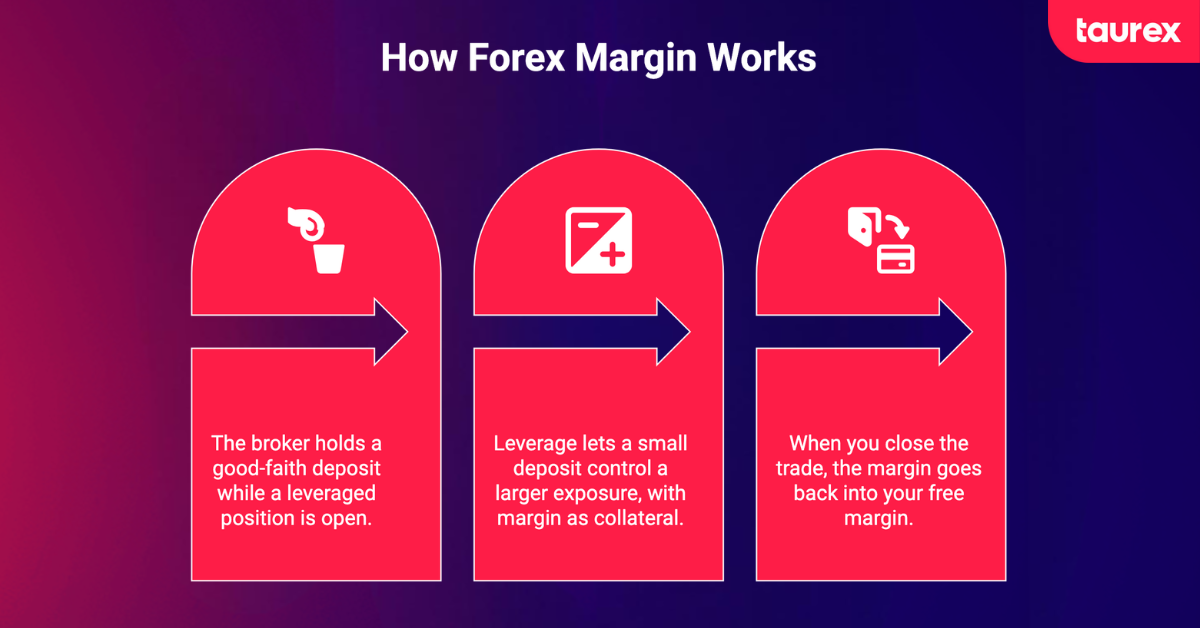
Margin is a good-faith deposit a broker holds while a leveraged position is open. It is not a fee, a trading cost or a loss. When the trade closes, the margin is released back into free margin, the money available for new trades.
The margin requirement is the share of a position’s notional value, the full size of the trade in money terms, that a trader must put up. Margin requirements for Forex trading are usually quoted as a percentage, such as 3.33%, 2%, 1% or 0.2%.
A common misconception is that margin is the most a trader can lose. It is not: losses depend on position size and price movement, so they can exceed the margin a trade uses.
How Do Forex Margin Requirements Work?
Every trading platform tracks a few linked numbers, once you understand how they connect, the margin screen will become easier to read.
| Term | What it means | How it is calculated |
| Balance | Account cash, excluding open trades | Deposits − withdrawals ± closed profit/loss |
| Equity | Account value including open trades | Balance ± floating profit/loss |
| Required margin | Margin locked to open one position | Notional value ÷ leverage |
| Used margin | Total margin locked across all open positions | Sum of required margin |
| Free margin | Funds available for new trades or to absorb losses | Equity − used margin |
| Margin level | Equity as a percentage of used margin | Equity ÷ used margin × 100 |
What Does Margin Level Mean in Forex?
Margin level is the main health gauge of a leveraged account. A reading of 400% means equity is four times the margin in use, such as $4,000 of equity against $1,000 of used margin. The higher the figure, the more room before a margin call.
How Do You Calculate Forex Margin Requirements?
You can use this formula:
Required margin = (position size × price, in your account currency) ÷ leverage
You can also write it as notional value × margin percentage. Both versions give the same answer.
Here is a worked example, for illustration only. Say you have a $5,000 account in US dollars and you buy 0.5 lots of EUR/USD at 1.1000 with 1:100 leverage.
- Notional value: 50,000 × 1.10 = $55,000
- Required margin: $55,000 ÷ 100 = $550
- If the trade moves $200 against you, equity drops to $4,800
- Free margin becomes $4,800 minus $550, which is $4,250
- Margin level: $4,800 ÷ $550 × 100 = about 872.7%
Used margin stayed at $550 the whole time. Only the floating loss moved your equity and free margin. With a 100% margin call level, equity would need to fall to $550 before you received a warning.
How to Calculate Margin in Different Account Currencies
Start by working out the margin in the base currency of the pair, then convert it into your account currency. The base currency is the first currency in a pair. Learning how to read Forex quotes helps you identify the base currency and understand how the exchange rate is expressed.
For 1 standard lot at 1:100, for illustration:
- EUR account, EUR/USD: EUR 1,000
- USD account, EUR/USD at 1.1000: $1,100
- GBP account, EUR/USD, with EUR/GBP at 0.8500: GBP 850
Your platform handles this conversion for you, so the margin figure may shift slightly as exchange rates move.
How Do Forex Margin Requirements Change With Leverage?
The same position needs less margin as leverage rises. The table below shows 1 standard lot of EUR/USD at 1.1000 (a notional value of $110,000), for illustration.
| Leverage | Margin % | Approx. margin required |
| 1:30 | 3.33% | $3,666.67 |
| 1:50 | 2.00% | $2,200 |
| 1:100 | 1.00% | $1,100 |
| 1:500 | 0.20% | $220 |
These figures are approximate. Real Forex trading margins depend on the broker, the instrument and the regulator. As examples, EU rules cap retail leverage on major pairs at 1:30. US rules set a minimum deposit of 2% on major pairs and 5% on all others, which works out to 1:50 and 1:20. Some brokers, including Taurex for eligible clients, offer up to 1:2000. At that level, the same position would need about $55 of margin.
Lower margin does not mean lower risk. The position is still worth $110,000, so every price move affects your account by the same amount, whatever leverage you choose.
What Determines Forex Margin Requirements?
Several things feed into the margin figure you see on screen.
- Leverage and position size. Bigger lots need more margin. Lower leverage raises the margin needed for each lot.
- Currency pair and market volatility. Major pairs such as USD/JPY often carry lower requirements than exotic pairs such as USD/ZAR. Brokers may raise requirements for volatile instruments or around big news releases.
- Broker policies and account type. Each broker sets its own margin call and stop-out levels, which may also vary by account type and client classification. Check your broker’s terms to understand when you may receive a margin call and when positions could be closed automatically.
- Regulatory limits and your location. EU retail leverage tiers run from 1:30 on major pairs to 1:20 for non-major pairs, gold and major indices, and down to 1:2 for crypto. Where you live can decide which rules apply to your account. Checking a broker’s regulation can also help you spot Forex scams.
What Is the Difference Between Margin Requirements and Leverage?
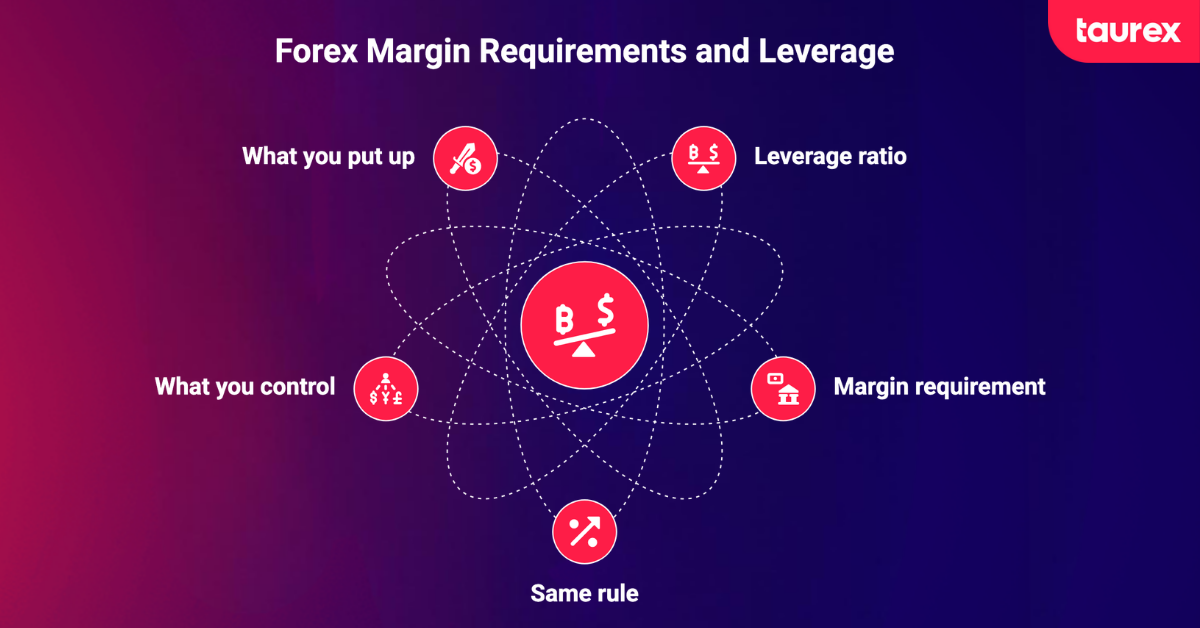
Leverage is the ratio of your exposure to your capital, such as 1:100. The margin requirement is the percentage of the position you put up, such as 1%. They are two views of the same rule, since the margin percentage equals 1 ÷ leverage.
Leverage is not an extra loan stacked on top of margin. It simply follows from the margin rule. In short, leverage describes how much you can control, and margin describes how much you need to put up.
What Happens When You Do Not Have Enough Margin?
When your equity falls too far compared with your used margin, your broker steps in. It sends a warning first, and then it starts closing trades if the situation gets worse.
- Margin calls and low margin levels. A margin call warns you that your margin level has dropped to the broker’s threshold. At that point, you can add funds or close positions to free up margin. Many platforms block new trades once you reach this level.
- Stop-out levels and automatic position closures. If equity keeps falling, the broker starts closing positions, often beginning with the trade that has the largest loss. Under ESMA rules, EU providers must start closing retail positions once equity reaches 50% of the initial margin. If 1 lot at 1:30 needs $3,666.67 of margin, closures would start at about $1,833 of equity.
- How unrealised losses affect available margin. Floating losses cut equity and free margin immediately, before anything is closed. Used margin stays the same, so the margin level can drop sharply without a single new trade.
How Can You Manage Forex Margin Requirements?
Margin is easier to handle when you plan for it before a trade, not after the price moves against you. A 2026 analysis by The Investors Centre found an average disclosed loss rate of 69.9% across 14 UK-regulated CFD brokers. Figures like these highlight the importance of understanding your margin requirements and managing risk before opening a position.
How to Choose Position Sizes Carefully
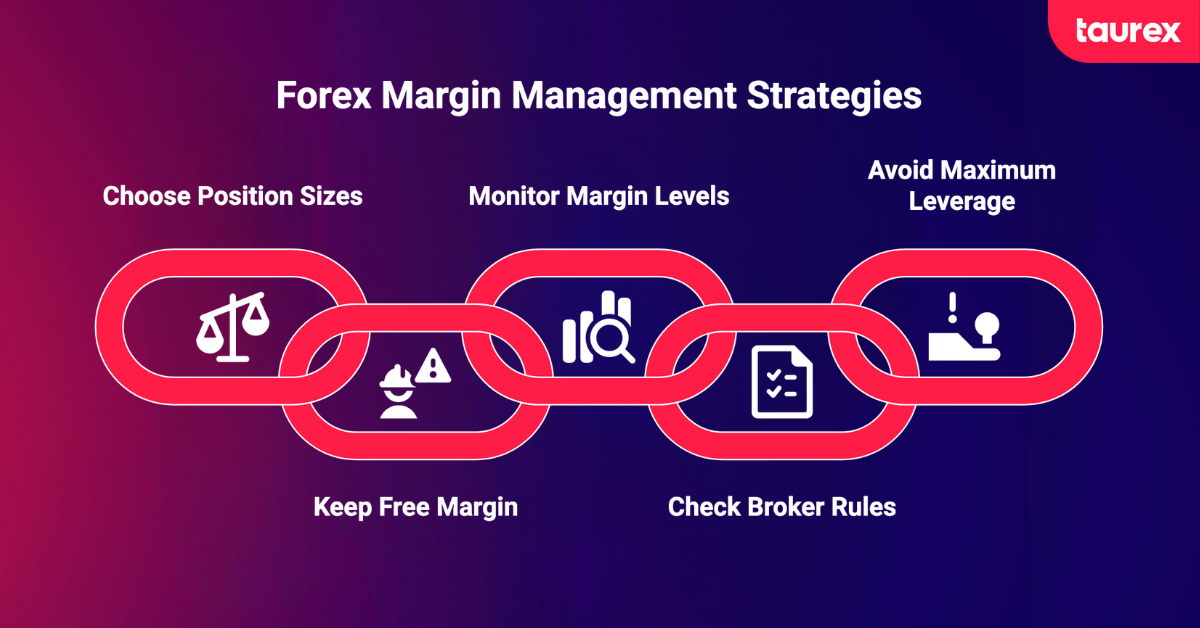
Some traders size each trade so that a normal move against them does not push their margin level close to the call threshold. Smaller positions lock less margin and leave more room for price swings.
How to Keep Enough Free Margin in Your Account
A buffer of free margin can stop a widening spread or a new trade from tipping you into a margin call. The spread is the gap between the buy and sell price, and it can widen during quiet hours or around news.
How to Monitor Margin Levels as Prices Change
Your balance does not show floating losses, but your margin level does. Checking it during busy Forex market hours and before big data releases can give you time to react.
How to Check Your Broker’s Margin and Stop-Out Rules
Read the account terms for the margin call level, the stop-out level and any changes that apply during news events. These rules differ from one broker to the next, and they can change over time.
How to Avoid Using Maximum Leverage by Default
Higher leverage lowers the margin for each trade, but it does not lower the risk. It may help to decide your position size and stop-loss order first, then choose leverage that fits. A stop-loss is an order that closes your trade at a set price to limit the loss.
How Do Forex Margin Requirements Work at Taurex?
At Taurex, we list leverage of up to 1:2000 on Forex across our Standard Zero, Pro Zero and Raw accounts (as of 2026). The margin call level is 100% and the stop-out level is 20% on all three accounts.
We use a dynamic margin model. The margin rate depends on your position size and on whether your positions are hedged, and the rules apply across all your open positions. For example, a trader with $2,500 of equity can get up to 1:2000.
After a $1,000 deposit takes equity to $3,500, a new trade gets 1:1000, and the earlier trade keeps its original 1:2000. Hedged positions need 50% of the margin required for the same unhedged positions.
Higher margin applies to new trades during high-impact events. These include central bank rate decisions, Non-Farm Payroll, CPI and GDP releases, the daily rollover period and the weekend market close. At those times, maximum leverage drops to 1:200 for Forex, metals, BTC and ETH, and to 1:50 for indices and energies.
Taurex Global Limited is regulated by the FSA of Seychelles (licence SD092). You can read more on our global regulations and safety of funds pages. Our services are not available to residents of some countries, including the UK and the US.
Open a Taurex demo account to practise trading, explore platform features, and learn how margin calls and stop-out levels work without risking real money.
CFDs are complex instruments and come with a high risk of losing money quickly as a result of leverage. You can lose money. Past performance is not a reliable guide to future results.
FAQs
What is the minimum margin required to trade Forex?
There is no single figure. It depends on your lot size, leverage and currency pair. For illustration, 0.01 lots of EUR/USD at 1.1000 with 1:100 leverage needs about $11 of margin.
How much margin is needed for a 1-lot Forex trade?
Divide the notional value by your leverage. For EUR/USD at 1.1000, that comes to about $1,100 at 1:100 or $3,666.67 at 1:30.
What does margin level mean in Forex?
Margin level shows your equity as a percentage of your used margin. A higher number means more room before a margin call. With no open trades, it reads as zero, since no margin is in use.
What is a good margin level in Forex?
There is no official ‘good’ level. Staying well above your broker’s margin call level, such as 100% at Taurex, can leave more room for price swings.
Can you lose more than your margin in Forex trading?
Yes. Margin is only a deposit, so the loss on a trade can be larger than the margin it uses. EU retail clients get negative balance protection by regulation, which stops an account from going below zero. Elsewhere, this protection depends on your broker and region, so check the account terms.
What happens if your margin level reaches 100%?
Your equity equals your used margin, so you have no free margin left. Many brokers, Taurex included, trigger a margin call at this point, and new trades are usually blocked.
Are Forex margin requirements the same for every broker?
No. Leverage, margin call levels and stop-out levels differ by broker, account type and regulator.