
Forex margin call and stop-out levels decide when a broker warns a trader and when it starts closing positions automatically. An account balance can look healthy on screen while trades are already being closed, because brokers watch the margin level, not the balance.
The stakes are real. A March 2026 report covered by Pound Sterling Live found that around 68% of retail CFD accounts lost money even at the UK brokers with the lowest loss rates in its sample. In 2022, the FCA put the figure at about 80% of customers.
This article explains what each level means, how they differ, how to calculate them, what triggers them and how they work at Taurex, with a worked example.
What Is a Margin Call in Forex Trading?
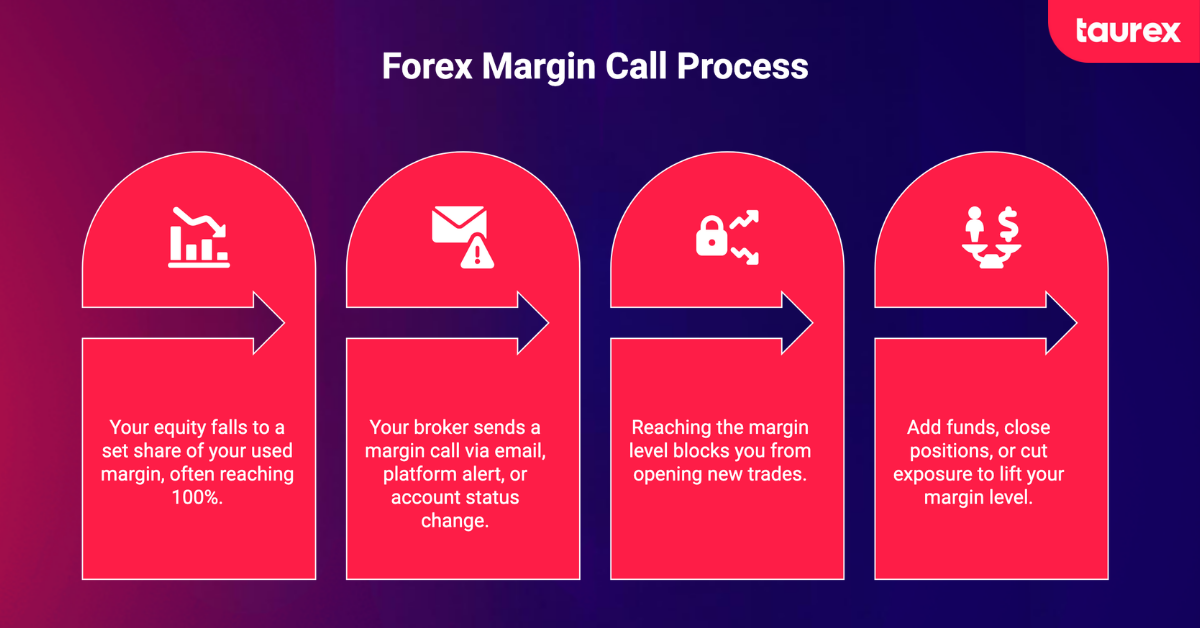
If you have ever asked what a margin call in Forex is, the short answer is that it is a warning. Your broker sends it when your equity falls to a set share of your used margin, often when your margin level reaches 100%.
Equity is your balance plus or minus the profit or loss on your open trades. Used margin is the money your broker sets aside to keep those trades open. Margin level is equity divided by used margin, shown as a percentage.
A margin call does not close any trade by itself. It may arrive as an email, a platform alert or a change in your account status. At many brokers, reaching this level blocks you from opening new trades. You can then add funds, close some positions or cut your exposure to lift your margin level again.
What Is a Stop-Out Level in Forex?
A stop-out level is the lower margin level at which your broker’s system automatically closes your positions, with no approval needed. Its job is to stop losses from growing further and to protect both your account and the broker. Some brokers call it a margin close-out or liquidation level.
The common stop-out levels Forex trading brokers set usually sit between 20% and 50%, according to Tradebrains.
A stop-out is not the same as a stop-loss. A stop-loss order is one you set yourself to close a trade at a chosen price, and a stop-out is enforced by the broker when your margin runs too thin.
What Is the Difference Between a Margin Call and a Stop-Out?
The margin call vs stop out question comes down to warning versus action. The margin call sits at a higher margin level and gives you time to respond, and the stop-out sits lower and acts on its own.
| Margin call | Stop-out | |
| Meaning | Warning that equity is running low compared with used margin | Automatic closing of positions at a critical margin level |
| Typical trigger | Margin level falls to the broker’s call level, often 100% | Margin level falls to the broker’s stop-out level, often 20% to 50% |
| What happens to open positions | Positions normally stay open. New trades may be restricted. | The platform closes positions, commonly starting with the largest loser, until margin level recovers |
| Does the trader need to act? | Yes. Add funds or reduce exposure to restore margin level. | No approval is needed. The broker acts automatically, so your chance to act has passed. |
| How broker policies affect it | Level and alert method vary. Some brokers only have one combined level. | Percentage, closing order and account-type rules vary by broker and entity |
Read your own broker’s terms, as some brokers use one combined level that closes trades with no separate warning.
How Do You Calculate Margin Call and Stop-Out Levels?
Working out your Forex trading margin call and stop-out levels takes a few simple formulas. Once you know them, you can find the equity figure and the loss that would trigger each stage before you place a trade.
How to calculate your margin level
Equity = Balance + Floating profit or loss
Free margin = Equity – Used margin
Margin level (%) = (Equity ÷ Used margin) x 100
Used margin is the position value divided by your leverage. Leverage lets you open a larger position with less money, which increases both profits and losses. With 1:100 leverage, you put up 1% of the position value as margin.
How to calculate the equity threshold for a margin call
Equity at margin call = Used margin x Margin call %
Loss that triggers it = Balance – Equity at margin call
How to calculate the equity threshold for a stop-out
Equity at stop-out = Used margin x Stop-out %
Loss that triggers it = Balance – Equity at stop-out
Here is an example with made-up numbers that match Taurex’s 100% margin call and 20% stop-out. Say you have a $2,000 balance, use 1:100 leverage and buy 1 standard lot of EUR/USD at 1.1000. That position is worth about $110,000, so your used margin is $1,100 and your free margin starts at $900.
| Scenario | Balance | Floating P/L | Equity | Used margin | Margin level | Status |
| Trade opened | $2,000 | $0 | $2,000 | $1,100 | 181.8% | Healthy |
| Price moves against you | $2,000 | -$500 | $1,500 | $1,100 | 136.4% | Above margin call |
| Margin call reached | $2,000 | -$900 | $1,100 | $1,100 | 100% | Margin call |
| Stop-out reached | $2,000 | -$1,780 | $220 | $1,100 | 20% | Stop-out |
A pip is the smallest standard price move in a currency pair, worth roughly $10 on 1 standard lot of EUR/USD. So the margin call arrives after about 90 pips, and the stop-out after about 178 pips. With a 50% stop-out, the same account would close at $550 equity, after a $1,450 loss of about 145 pips.
Your used margin sets the thresholds, floating losses reduce your equity and the broker’s percentages decide when each stage begins. A lower stop-out gives a trade more room, but more of your account is gone by the time the broker acts. Real accounts include swaps and commissions too, and the pip values here are approximate.
What Causes a Margin Call or Stop-Out?
A margin call or stop-out usually builds from one or more of these situations.
- Large or prolonged unrealised losses. A losing trade cuts your equity as soon as price moves against you, even before you close it. The longer a big loss stays open, the closer your margin level drifts to each threshold.
- Using high leverage and oversized positions. Bigger positions use more margin, so you start with a lower margin level and less room. We offer leverage up to 1:2000, and higher leverage can shrink that buffer quickly.
- Trading during volatile market conditions. News and rollover can move prices fast. Higher margin may apply around central bank decisions, Non-Farm Payroll, CPI and GDP releases, daily rollover and the weekend close.
- Holding multiple positions at the same time. Margin is counted across your whole account, so several open trades can drain your free margin together.
What Happens to Your Trades During a Stop-Out?
When the margin level touches the stop-out level, the platform closes positions at the market price without asking first. Many brokers close the position with the largest loss first and continue until the margin level recovers; some close everything at once.
What remains is a realised loss and a smaller balance. In fast markets or after a weekend gap, closing prices can be worse than the trigger level, so the final loss can exceed the estimate. The client agreement sets out how any negative balance is handled.
How Can You Avoid Margin Calls and Stop-Outs?
None of these habits removes risk, but each one can give your account more room.
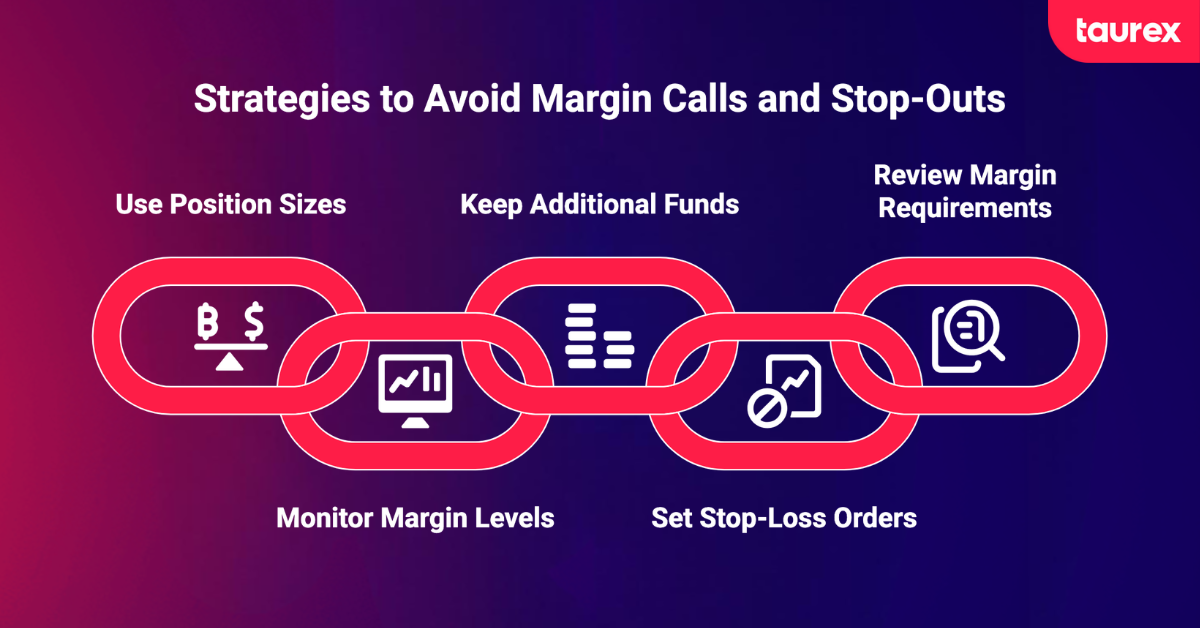
Use Position Sizes That Fit Your Account Equity
Smaller positions use less margin, which means a higher margin level from the start. Some traders choose their size from the amount they are willing to lose on one trade, not from the largest size the account allows.
Monitor Free Margin and Margin Level
Your balance does not show floating losses, but your margin level does. You can watch it in MT4, MT5 or the Taurex Trading App. Some traders pick a personal warning level well above the broker’s margin call level.
Keep Additional Funds Available When Appropriate
Adding funds raises your equity and margin level straight away. It is a tool for a planned trade, not a way to keep a losing position open forever, as topping up can lead to larger total losses.
Set Stop-Loss Orders Based on Your Trading Plan
A stop-loss can close a trade before your margin reaches either threshold. Gaps can skip stop-loss levels, so a stop-loss is not a replacement for sensible sizing.
Review Margin Requirements Before Opening a Position
Margin differs by instrument and can rise during big news events. With our Dynamic Margin, leverage on new trades in these windows is capped at 1:200 for Forex, Metals, BTC and ETH, and 1:50 for Indices and Energies.
How Do Margin Call and Stop-Out Rules Differ Between Brokers?
There is no single industry standard. If you line up the Forex margin call and stop out typical levels across brokers, a 100% call with a 50% stop-out is a common pairing, and stop-outs range from about 20% to 50%. Rules can change with account type, regulatory entity, platform and instrument, and with the type of broker.
Brokers differ in how they issue margin calls and decide which positions to close first. Before funding an account, review the margin policy, client agreement, and account specifications. Comparing these details is an important part of choosing a Forex broker.
How Do Margin Calls and Stop-Out Levels Work at Taurex?
At Taurex, our account types page lists a 100% margin call and a 20% stop-out for Standard Zero, Pro Zero and Raw accounts as of 2026, with Forex leverage up to 1:2000. In the example above, a used margin of $1,100 means the margin call begins at $1,100 equity and the stop-out at $220 equity.
During certain high-impact events, Dynamic Margin applies higher margin requirements to new trades, with the caps listed earlier. You can track your margin level on best forex trading platforms like MT4, MT5 and the Taurex Trading App.
Thresholds can vary by entity and may change. Taurex Global Limited is regulated by the Seychelles FSA (SD092), and Taurex Limited is authorised by the UK FCA (FRN 816055). See our global regulations and safety of funds pages, and check your client portal and agreement for the figures that apply to you. If you would like to watch margin level move without real money, you can open a demo account and practise first.
CFDs are complex instruments and carry a high risk of rapid losses caused by leverage. Make sure you understand the risks before trading.
FAQ
What is the difference between a margin call and a stop-out?
A margin call is a warning that your equity is low compared with your used margin. A stop-out is your broker automatically closing positions at a lower margin level.
At what margin level does a margin call happen?
It depends on the broker. A level of 100% is common, and Taurex lists 100% on its account types page as of 2026. Check your own account terms.
At what margin level does a broker close trades?
Stop-out levels commonly range from 20% to 50%. We list 20% for our three live account types. Your broker’s terms show the level for your account.
Can a broker close trades without warning?
Yes. A stop-out is automatic and needs no approval from you. Some brokers use one combined level, so trades can close with no separate margin call first.
Does a stop-loss prevent a margin call?
Not always. A stop-loss can close a trade earlier, but price gaps can skip it, and large or multiple positions can still pull your margin level down.
Can you lose more than your account balance after a stop-out?
It is possible in fast markets or gaps, where closing prices can be worse than the trigger level. How a negative balance is treated depends on your broker’s terms, so read your client agreement.
CFDs are complex instruments and carry a high risk of rapid losses caused by leverage. Trading leveraged products may result in the loss of all invested capital.