
The global Forex market trades more than $7.5 trillion each day. This shows how large the currency market is and why many traders are interested in it. At the same time, reports from ESMA show that about 74% to 89% of retail investor accounts lose money.
One factor that may separate traders who stay in the market from those who stop trading is risk management. This means managing how much money you could lose before thinking about possible profits.
In this guide, we explain the main types of risk in Forex trading, the key principles of managing risk, simple calculation examples, and tools that may help you apply these ideas in your own trades.
What Is Risk Management In Forex Trading?
Forex trading risk management is the set of rules traders use to protect their capital. In simple terms, it means deciding how much you could lose before opening a trade and using tools to reduce risks from price changes, economic events, or unexpected news.
Many new traders focus first on potential profit. More experienced traders often start with a different question: how much could I lose, and can I accept that loss without affecting my next trade?
Risk cannot be removed from trading, but it can be controlled. The goal is to keep losses small enough that you can continue trading over time. Research from Gitnux suggests the average retail Forex account lasts about four months, which shows why a clear risk strategy may matter.
What Are The 5 Types Of Risk In Forex Trading?
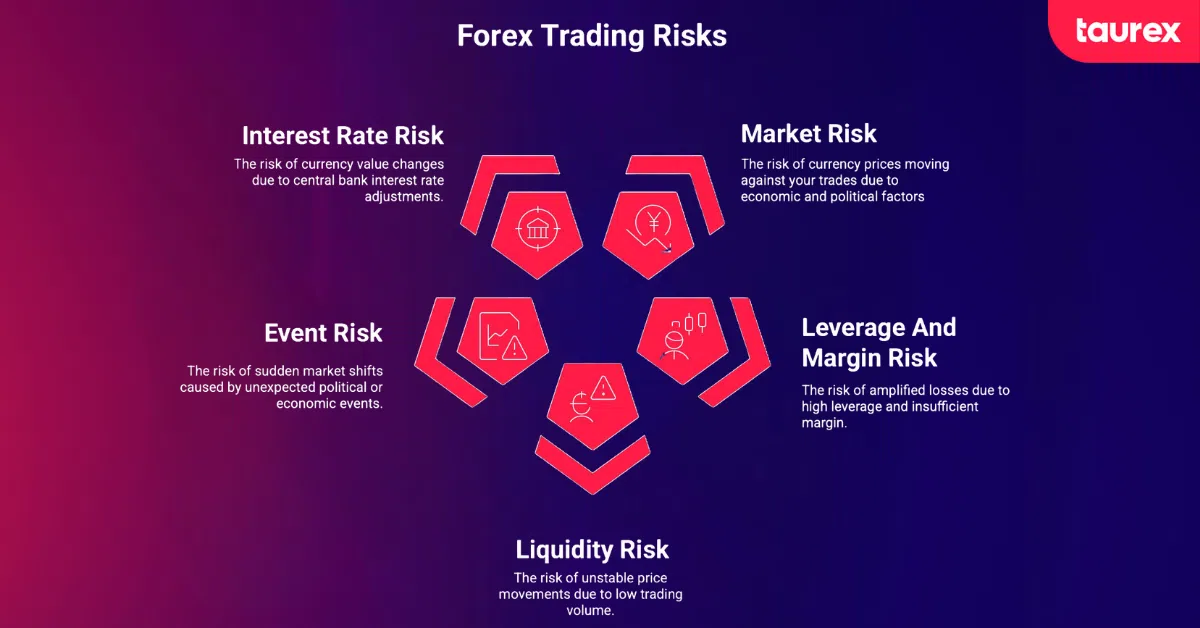
Forex risk does not come from only one source. Many traders focus only on price moving against their trade, but other factors can also affect results. Understanding the main types of risk can help you manage them more effectively.
Market Risk
Market risk is the risk that a currency pair moves against your position. Prices change because of economic data, political events, and changes in market sentiment. Reports such as inflation data, GDP figures, or employment numbers can move pairs like EUR/USD or GBP/USD very quickly.
Also, about 60% of stop-loss orders are triggered by short-term market volatility rather than a real trend change. This shows how normal price movement alone can close trades.
Leverage And Margin Risk
Leverage allows traders to control a larger position with a smaller amount of capital. For example, with 100:1 leverage, a trader with 500 dollars can open a position worth 50,000 dollars.
This increases potential profits, but it also increases losses. A small price move against your position can quickly reduce your account balance. Gitnux also reports that traders with small accounts are more likely to use maximum leverage.
It is also important to understand the difference between margin and risk. Margin is the money required to open a trade. Risk is the amount of money you choose to lose if the trade fails.
Liquidity Risk
Liquidity refers to how easily a currency can be bought or sold in the market. When liquidity is low, price movements can become more unstable.
Low liquidity often appears during the Sunday market open, holidays, or major global events. During these periods, prices may jump from one level to another without trading in between. If this happens, a stop loss order may execute at a worse price than expected.
Event Risk
Event risk comes from unexpected situations that can move the market suddenly. These can include political decisions, natural disasters, elections, or surprise central bank actions.
Scheduled events can also cause strong market reactions. Interest rate decisions or employment reports are common examples of this. Many trading platforms include an economic calendar so traders can track these events and decide whether to trade during those periods.
Interest Rate Risk
Interest rates play an important role in currency markets. When central banks change interest rates, it can affect the value of a currency.
Interest rates also influence swap rates, which are the fees or payments traders receive when holding positions overnight. Because of this, rate differences between currencies, such as USD/JPY or AUD/USD, can affect longer-term trades.
What Are The Core Principles Of Forex Risk Management for Traders?
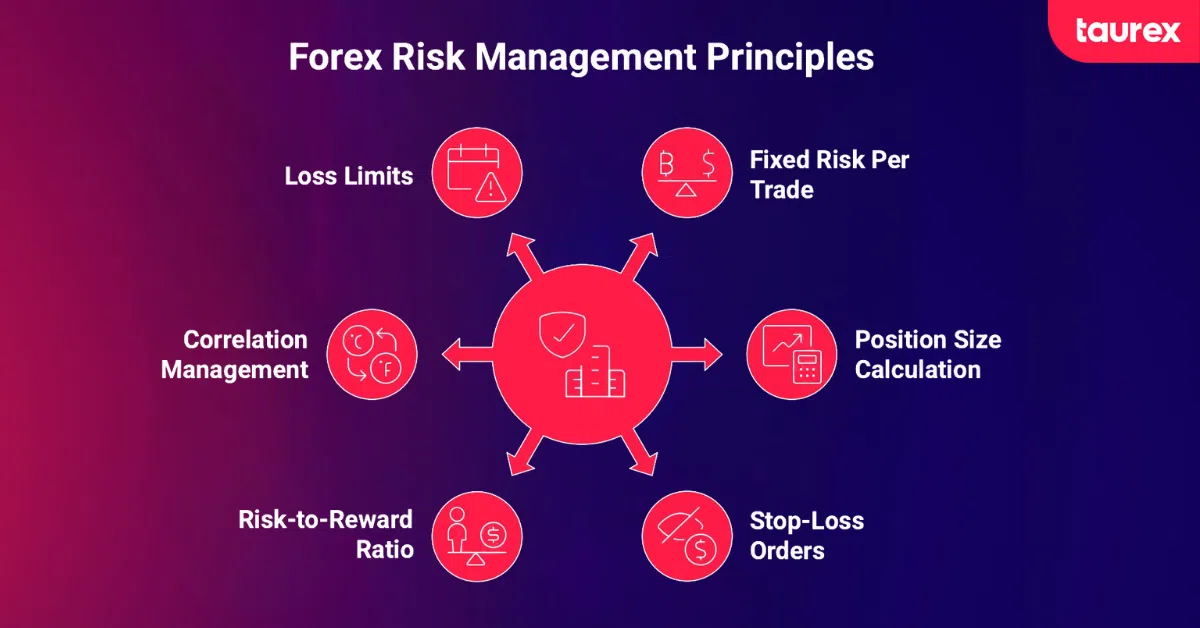
Forex trading and risk management are not just one rule or tool. It is a system where several principles work together to protect your capital. Using one rule alone, like the 1-2% risk guideline, is not enough if you do not also calculate position size or watch for exposure across multiple trades.
Key Forex risk management strategies include setting a fixed risk per trade, calculating position size, using stop-loss orders, maintaining a favorable risk-to-reward ratio, limiting exposure across correlated trades, and defining maximum daily or weekly losses. Applying these strategies consistently is far more effective than trying to perfect any single rule.
1. Set A Fixed Percentage Risk Per Trade
This is the foundation of risk management. It means risking the same part of your account on every trade, usually 1 to 2%. Higher risk per trade can wipe out an account much faster, while lower risk protects your capital through losing streaks.
Using a fixed percentage also adjusts automatically as your account grows or shrinks. For example, 1% of a $10,000 account is $100, and if your account rises to $20,000, the risk becomes $200. Keeping risk consistent helps you survive drawdowns and trade more steadily.
2. Calculate Position Size Correctly
Position size links your risk percentage to the actual trade. It is a calculation, not a guess, using this formula:
Position Size = (Account Equity × Risk %) ÷ (Stop Loss in Pips × Pip Value)
For example, if you have a $10,000 account and want to risk 1% ($100) on a trade, and your GBP/USD stop-loss is 50 pips, with each pip worth $1 in mini lots, the calculation is:
$100 ÷ (50 × $1) = 2 mini lots
This means if the stop is hit, your loss will be $100. MT4 and MT5 built-in calculators can do this automatically.
Some traders may adjust stops based on market volatility using the Average True Range (ATR). This makes the stop wider in volatile markets and tighter in calm markets. On a $100,000 account, total exposure across all open trades is usually suggested to stay under 2–3% of equity.
3. Use Stop-Loss Orders Strategically
A stop-loss order automatically closes a trade when the price reaches a set loss level. Where you place it matters because putting it at random distances can make it trigger too early from normal market moves.
Stops work best at technical levels such as support and resistance, swing points, or order blocks that other traders notice.
Three common types of stop-loss orders to be aware of:
- Fixed stops are a set number of pips from the entry. They are simple and good for beginners.
- Trailing stops move with the price to lock in gains. For example, if you buy EUR/USD at 1.10 with a 100-pip trailing stop and the price rises to 1.11, the stop moves from 1.09 to 1.10 to protect your breakeven.
- ATR-based stops adjust based on current volatility. They are tighter in calm markets and wider in fast-moving markets.
A key rule is to never move your stop to avoid a loss. Small losses stay small, but moving stops can turn them into big, unmanageable losses.
With a regulated broker like Taurex, you can track stop-loss levels and manage trades efficiently.
4. Maintain A Favourable Risk-To-Reward Ratio
The risk-to-reward ratio compares how much you could make to how much you could lose. For example, risking $100 to make $200 is 1 to 2, and risking $100 to make $300 is 1 to 3. A higher ratio means you can win fewer trades and still be profitable.
DuvalHouse shows that a trader with a 40% win rate and a 1 to 2 ratio risking 2% per trade can earn over 25% annually. Using at least a 1 to 2 target helps most strategies work better and keeps losses manageable.
5. Limit Exposure Across Correlated Currency Pairs
Currency correlation shows how closely two pairs move together. For example, EUR/USD and GBP/USD have a positive correlation of about +0.95, so going long on both is like doubling your bet on USD weakness. AUD/USD and NZD/USD behave similarly.
Negative correlations, like EUR/USD and USD/CHF at -0.97, can hedge, but holding both long cancels your trade. A practical rule is to treat pairs above 70% correlation as a single position for risk, and use correlation tables or Forex broker tools to check quickly.
6. Establish Maximum Daily And Weekly Loss Limits
You can set a ceiling for how much you are willing to lose in a day or week before stopping trading. This is an important part of how to manage risk in Forex, because it helps prevent emotional decisions like revenge trading, which can quickly damage an account. For example, on a $25,000 account, a daily loss limit might be $500, or 2% of the balance.
One common practice is to stop trading for 24 hours after hitting a daily limit. Considering Forex market hours can help you plan these breaks effectively. You can take a full week off if the weekly limit is reached, and review your strategy if a monthly loss limit is breached, using the market’s schedule to identify the best times to pause and reset.
A Real-World Example Of How To Manage Risk In Forex Trading
A trader has AU$10,000 and wants to trade AUD/USD. Using 100:1 leverage, AU$500 of margin opens a 50,000-unit position. They follow the 2% risk rule, so the maximum loss on this trade is AU$200.
Converted to USD at 0.7250, AU$200 is about US$145. On a 50,000-unit position, each pip is worth US$5. The stop-loss is set 29 pips from entry (US$145 ÷ US$5).
The take-profit is set at 87 pips, three times the stop distance, creating a 1:3 risk-to-reward ratio. If the stop-loss hits, the loss is AU$200. If the take-profit hits, the gain is three times the risk.
This example shows how proper position sizing, stop-loss placement, and risk-to-reward planning protect capital.
| Parameter | Value |
| Account Balance | AU$10,000 |
| Margin Used | AU$500 |
| Risk % | 2% |
| Max Loss | AU$200 (US$145) |
| Pip Value | US$5 |
| Stop-Loss Distance | 29 pips |
| Take-Profit Target | 87 pips |
| Risk-to-Reward Ratio | 1:3 |
This is how position size, margin, risk percentage, and stop placement connect mathematically. Each variable depends on the others, and changing one changes everything downstream.
What Tools Can Be Used For Managing Risk In Forex Trading?
Knowing the principles of risk management is only part of the process. Using the right tools may help you apply them consistently and reduce calculation errors.
- MetaTrader 4 and 5 (MT4/MT5) can be used by many retail traders. These platforms may allow automated stop-loss and take-profit orders, position sizing calculations, trade history tracking, and integration with economic calendars. Taurex may support both MT4 and MT5, along with its own mobile app.
- Position size calculators can help you work out the correct lot size based on your account balance, risk percentage, and stop-loss distance. This may prevent accidental over-risking that could happen when calculating manually.
- Economic calendars from sources like Forex Factory, Investing.com, or DailyFX can show upcoming events such as interest rate decisions, employment reports, or GDP data. Checking these may help avoid trades during high-volatility times.
- Risk-reward ratio indicators for MT4 or MT5 can show stop-loss and take-profit levels on your Forex chart and calculate the ratio automatically. Some may adjust based on market volatility using the Average True Range (ATR).
- Volatility meters and ATR can show how much a pair is moving on average. ATR-based stops may sit tighter in calm markets and widen during volatile sessions, keeping your stop levels more proportional to actual market movement.
- AI-powered risk platforms may offer real-time drawdown monitoring and can automatically pause trading if thresholds are reached. According to some reports, algorithmic traders using such tools may achieve slightly higher profitability than fully manual retail traders.
Common Forex Risk Management Mistakes
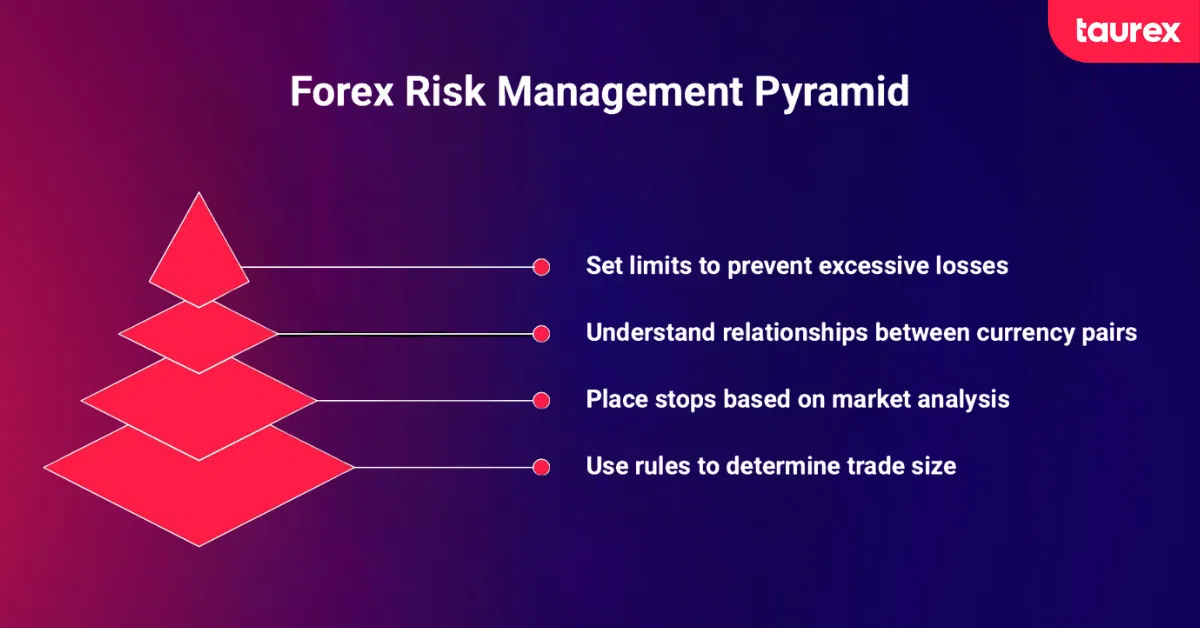
Knowing what to do is only part of trading. Being aware of common mistakes may help prevent losses, especially because many feel intuitive at the moment.
- Risking too much per trade can quickly deplete an account. Some traders may risk 5 to 10% on a single trade. At 10% risk, 10 consecutive losing trades could wipe out the account. Using consistent position sizing rules may help avoid this problem.
- Moving stop-losses based on emotion can turn a small, manageable loss into a large one. Stops may be moved to “give the trade more room,” but this can increase risk. Stop placement that follows market structure rather than personal comfort may be more effective.
- Ignoring the correlation between pairs can create hidden exposure. Opening positions in EUR/USD, GBP/USD, and AUD/USD at the same time may feel diversified but could all move together if the USD strengthens. Checking correlations may help prevent over-concentration.
- Trading without a maximum loss rule can lead to larger losses over time. Without daily or weekly limits, losing trades may trigger revenge trading and bigger positions. Setting firm loss limits may help manage stress and protect your account.
Conclusion
Forex risk management is not just one tool or number. It is a framework that includes setting a fixed risk percentage per trade, calculating position size, placing stop-losses strategically, maintaining a favourable risk-to-reward ratio, monitoring correlations between positions, and setting daily or weekly loss limits. Together, these elements help protect a trading account when the market moves against you.
Traders who last in Forex may not always have the best entries or strongest technical skills. They may be the ones who manage losses carefully and keep their discipline intact. Applying the 1 to 2 percent risk rule, placing stops before targets, and checking correlations may help reduce risk over time.
For those looking to practise these principles in a low-stakes environment, opening a demo account can be a useful first step toward building the habits that make Forex risk management second nature.
FAQ
What are the biggest risks in Forex trading?
The main risks may include market risk from price moves, leverage risk that can amplify losses, liquidity risk if positions cannot be closed at expected prices, event risk from unexpected macro or political shocks, and interest rate risk affecting currencies and swaps. Leverage and event risks may be the most underestimated by retail traders.
What is a safe percentage to risk per trade in Forex?
Many traders may risk 1 to 2% of their account per trade. At 1% risk, it could take about 100 consecutive losing trades to deplete the account, while 5% risk might wipe it out in just 20 losses. Beginners may prefer starting at 1% until they have more experience and data.
What is the difference between margin and risk?
Margin is the collateral required to open a leveraged position and is not the same as the money you stand to lose. Risk is the amount you may actually lose, usually calculated as account balance times risk percentage. For example, on a $10,000 account with 100:1 leverage, you might use $500 of margin but limit risk to $100 through a stop-loss.
How much should I risk per trade?
Some people may think starting at 1% risk per trade. The goal is to keep losses small, so the account can survive through losing streaks. At 1% risk, the account may survive around 100 consecutive losses, whereas at 5%, it may survive only about 20 losses.
What is the best risk management strategy for Forex?
There may not be a single best strategy, but combining several elements can help: a fixed 1 to 2% risk per trade, calculated position size, stop-loss placement at technical levels, a minimum 1:2 risk-to-reward ratio, and pre-set daily loss limits. Consistent application of all elements may work better than focusing on one alone.
What is the ideal risk-to-reward ratio?
A minimum of 1:2 is often recommended, meaning potential profit is twice the amount risked. Some traders aim for 1:3, so winning only one in three trades may be enough to break even. Pairing a disciplined risk-to-reward approach with careful risk management may make trading more resilient over time.