What Is FOMO in Forex Trading? 6 Ways to Avoid It
A sudden move in EUR/USD after a Non-Farm Payrolls release can create pressure to enter a Forex trade before checking the setup, entry price or risk. High-impact events can cause sharp currency moves within minutes, which is why having a clear Forex news trading strategy matters when volatility increases.
This reaction is known as FOMO in trading, or Fear of Missing Out. In Forex, it often happens when traders see a currency pair moving quickly and enter because they are afraid the opportunity will disappear. This can lead to chasing price, ignoring a trading plan or taking more risk than intended.
Leveraged trading also carries significant risk. Previous ESMA data cited loss rates of 74% to 89% among retail CFD accounts, highlighting the importance of discipline and risk control when trading leveraged markets.
In this guide, we explain what FOMO means in Forex trading, what causes it, how to recognise it and six practical ways traders can avoid making decisions based on fear of missing a market move.
What Is FOMO in Forex Trading and Why Does It Happen?
FOMO, or Fear of Missing Out, in trading refers to the anxiety you feel when others appear to benefit from a market move, and you are not part of it. The term was introduced by Patrick McGinnis in 2004 and later defined as a persistent concern that others may be experiencing rewarding opportunities while you are excluded.
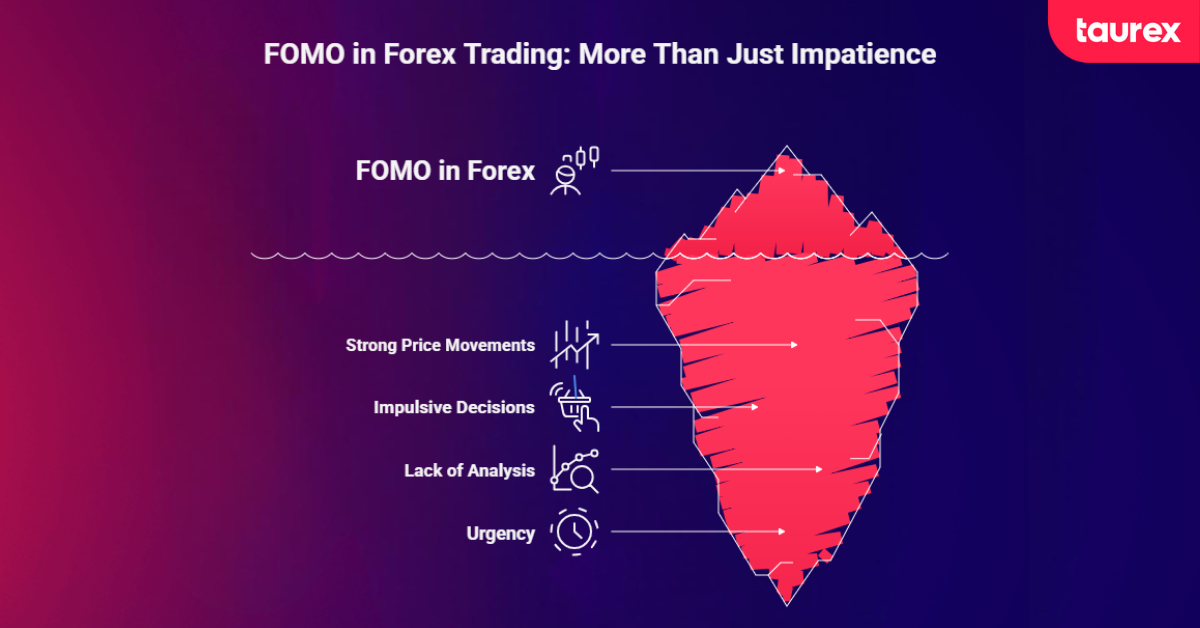
In Forex trading, FOMO often appears during strong price movements. When a currency pair rises or falls quickly, you may feel pressure to enter the market without a planned setup or defined conditions.
This response is not only impatience. It can make impulsive decisions feel justified, even when they are not supported by analysis.
The key difference is clear. A structured trade is based on predefined rules and analysis. A FOMO-driven trade is driven by urgency and the fear of being left behind.
If you are still developing a consistent approach, understanding this behavior early can help you reduce avoidable mistakes and make more controlled decisions.
What Causes FOMO in Forex Trading?
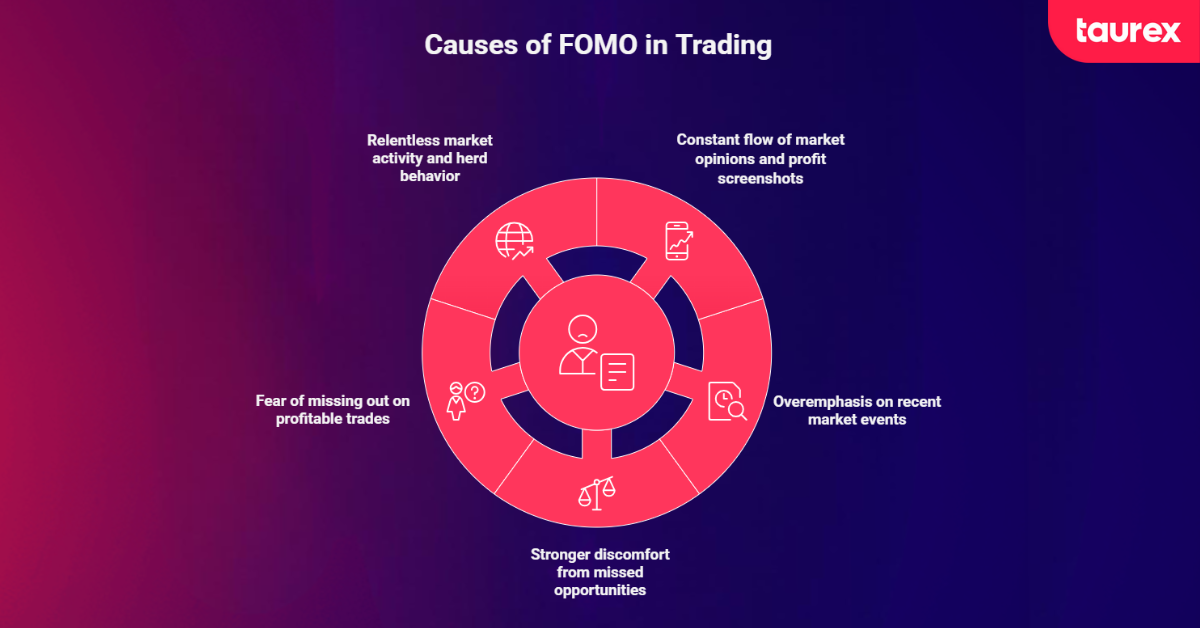
FOMO in Forex trading doesn’t appear randomly. It is driven by specific and repeatable triggers. When you understand these triggers, you are better able to recognize and manage your reaction.
Social Media and Trading Signals
Platforms such as X, Reddit, Discord and Telegram expose traders to a constant stream of market opinions, signals and profit screenshots. Because successful trades are often shared more than losing ones, this can create the impression that other traders are consistently finding opportunities you are missing.
Seeing several people discuss the same currency pair can increase the pressure to enter without completing your own analysis.
Recency Bias
Recency bias occurs when you give too much importance to recent market events. If a specific setup worked well in the past, you may expect it to work again under different conditions.
This can lead you to see opportunities where none exist. A recent strong move may create the impression that the market will continue in the same direction, even when the underlying conditions have changed.
Loss Aversion Asymmetry
Research by Daniel Kahneman and Amos Tversky shows that losses tend to feel stronger than gains. In trading, this can influence how you react to missed opportunities.
You may feel more discomfort from missing a profitable trade than from avoiding a risky one. This can push you to enter trades without proper validation, simply to avoid the feeling of missing out.
Opportunity Cost Anxiety
Opportunity cost anxiety appears when you focus on what you might miss. You may think that if you don’t enter a trade now, the price will continue moving without you. Behavioural economists call this regret avoidance bias.
This creates pressure to act quickly. Instead of following a structured approach, decisions are influenced by the fear of future regret.
Market Structure And Momentum
The Forex market operates 24 hours a day, five days a week. There is always a session open, always a pair moving, always a candle forming somewhere. That relentlessness can create the impression that you should always be active.
When you add herd behaviour to the mix, the market itself starts to look like an invitation you cannot refuse. Volatile news events like central bank rate decisions or CPI releases only intensify this. The 60-pip spike on USD/JPY after a surprise rate hold might look like an opportunity, but for a trader without a pre-planned setup, it is more often a trap.
How Can You Recognise FOMO Before Entering a Trade?
FOMO often appears before the trade is placed. The main warning sign is when urgency starts to replace your usual decision-making process.
Common signs include:
- You feel you need to enter immediately. The main reason for the trade is that price may move without you.
- The setup was not part of your plan. You notice the opportunity only after the move has already started.
- You skip your normal checks. Entry criteria, stop-loss levels or risk are decided after the trade rather than before.
- Other traders influence the decision. A signal group, social post or profit screenshot makes the opportunity feel more urgent.
- You focus on the profit you might miss. The potential gain becomes more important than whether the setup is still valid.
A useful question to ask before entering is: Would I still take this trade if the price were not moving quickly right now? If the answer is no, the decision may be driven more by FOMO than by the setup.
| Planned Trade | FOMO-Driven Trade |
| Entry follows predefined conditions | Entry happens because price is moving away |
| Risk is set before entry | Risk is decided after entry |
| The setup determines the decision | Urgency determines the decision |
| A missed entry is accepted | Price is chased after the entry is missed |
What Does FOMO Look Like in Forex Trading?
FOMO in Forex trading often appears when a trader abandons a planned approach because price is moving quickly or other traders seem to be acting first. Common examples include:
Chasing a Breakout
A currency pair breaks above a resistance level and starts moving quickly. Instead of waiting for confirmation or a retest, the trader enters immediately near the top of the move. Price then pulls back toward the breakout level, leaving the position exposed.
Waiting for a pullback trading strategy setup can help traders assess whether the breakout still holds before they enter.
The NFP Spike Entry
Following a stronger-than-expected Non-Farm Payrolls release, USD/JPY reacts with a sharp upward move within minutes. The candle’s speed creates pressure to participate immediately.
You enter a buy position while the price is already extended near the top of the spike. In the next few minutes, the initial momentum fades, and the market begins to retrace as liquidity normalizes. Your position moves into a drawdown as the price returns closer to its pre-news range.
Following a Trading Signal Too Late
A Telegram or Discord group posts a signal on GBP/USD. The trader enters without checking when the original setup appeared or whether it still fits their own strategy.
If much of the move has already happened, the late entry may offer less room for potential reward and more exposure to a reversal.
Pair-Switching Syndrome
Instead of waiting for a clean setup on the pair you specialise in, you open eight charts and chase whichever one “starts moving.” You end the session with six small losing trades across different pairs, with no coherent strategy applied to any of them.
None of these scenarios involves a lack of market knowledge. They all involve a lack of emotional discipline, and each one is driven by FOMO.
Why Is FOMO Dangerous in Forex Trading?
FOMO can affect both trade selection and risk management. A trader may enter after a move has already started, ignore normal entry rules or take more risk simply because the opportunity feels urgent.
How FOMO Affects Your Trading Performance
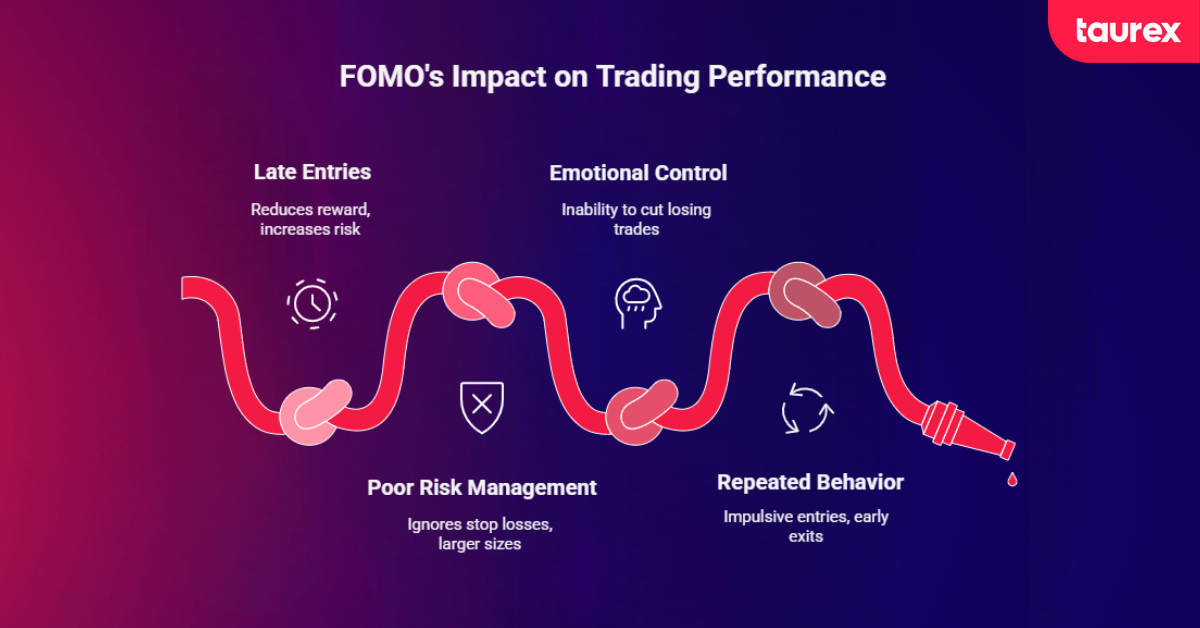
One common problem is a late entry. When traders chase a move after price has already travelled far, there may be less potential reward while the risk of a pullback increases.
FOMO can also weaken Forex risk management. Traders may increase position size, move a stop-loss further away or enter before they have defined where the trade should be closed.
The behaviour can then become repetitive: a trader enters impulsively, reacts emotionally to the result and looks for another trade to make up for the previous decision. This makes it harder to follow a consistent plan.
Clear Forex trading rules can help reduce this behaviour by setting predefined conditions for entries, exits and risk before a trade is placed.
How Can Forex Traders Spot an Overextended Move?
Before entering after a sharp move, traders can read the Forex chart to assess market structure and use indicators in Forex such as RSI or Bollinger Bands to see whether momentum is already stretched.
An extreme RSI reading or price extending beyond an outer Bollinger Band does not guarantee a reversal, but it can be a reason to pause and reassess the setup instead of chasing the move because of FOMO.
How Can Traders Avoid FOMO in Forex Trading?
You need practical methods that help you understand how to avoid FOMO in trading and control impulsive decisions when they happen in real time. The approaches below are designed to support more structured and consistent trading behavior.
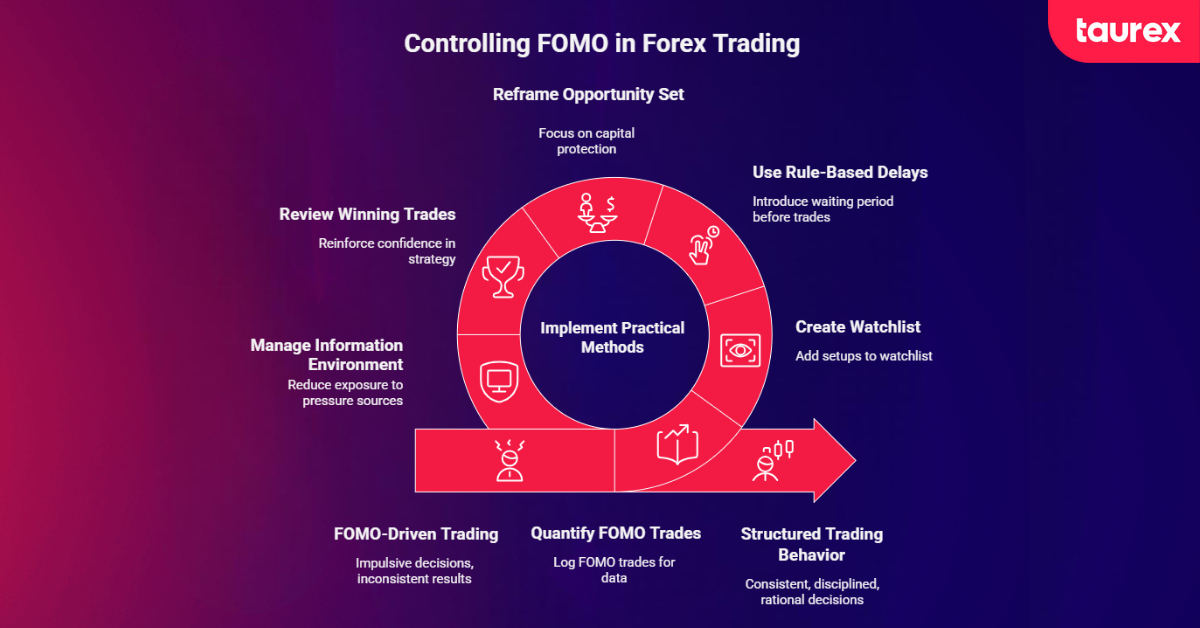
Quantify Your FOMO
Start a dedicated “FOMO trade log.” This is a separate section in your trading journal, reserved exclusively for trades you entered without a pre-planned setup. For each entry, record the reason (be completely honest), the outcome, how far the trade went in your favour versus against you, and what your planned trade for the session would have been instead.
After 20 to 30 logged FOMO trades, you will have personal data. If your FOMO entries lose 65% or 70% of the time, that number becomes your anchor the next time the urge hits. Data overrides emotion, but only if you collect it first.
Create A “Watch But Don’t Trade” List
When a market is moving without a planned setup, add it to a watchlist instead of entering. Set alerts at levels where your strategy would normally allow an entry.
This allows you to stay engaged with the market without taking trades that do not meet your rules. It shifts focus from reacting to price movement to waiting for defined conditions.
Use Rule-Based Delays
Introduce a waiting period before entering any trade that was not planned. This can be 15 to 30 minutes or another fixed interval. During that window, use limit or pending orders at key price levels rather than chasing with market orders.
This delay helps reduce emotional reactions and gives time for more rational evaluation. It also encourages the use of pending orders instead of immediate market entries.
Reframe The Opportunity Set
The Forex market offers many setups across different pairs and timeframes. Missing one move does not limit future opportunities.
Focusing on capital protection and consistency is more important than trying to catch every price movement. This helps reduce the pressure to act immediately.
Review Your Winning Trades
Review trades where you followed your plan and achieved positive results. Focus on what conditions were met and how you executed the setup correctly.
This helps reinforce confidence in your strategy and reduces the influence of emotional decision-making. It also provides a reminder that discipline produces consistent outcomes over time.
Control Your Information Sources
Signal groups, social media and constant market commentary can increase the urge to trade. Reduce sources that encourage reactive decisions and focus instead on your own analysis, scheduled market events and an economic calendar.
The goal is not to ignore market information, but to avoid letting outside noise replace your trading plan.
Final Thoughts
FOMO is one of the most common emotional challenges in Forex trading. It often leads to rushed decisions, weak risk control, and inconsistent performance. While it cannot be removed completely, it can be managed through structure, discipline, and a clear trading process.
Developing awareness of your behavior is an important first step. Applying rules, waiting for valid setups, and focusing on long-term consistency can significantly reduce impulsive trading over time.
If you want to apply a more disciplined approach in live market conditions, you can open a demo account with Taurex to practice trading under real market conditions without using real capital. It allows you to test your strategy, build discipline, and work on emotional control before moving to live trading.
FAQ
What does FOMO mean in trading?
FOMO means Fear of Missing Out. In trading, it describes the urge to enter a trade because price is moving and you are worried the opportunity will disappear before you take part.
Is FOMO the same as revenge trading?
No. FOMO usually comes from fear of missing a potential opportunity, while revenge trading in Forex happens when a trader tries to recover a previous loss quickly. Both can lead to impulsive decisions, but the emotional trigger is different.
Can FOMO happen in both rising and falling markets?
Yes. FOMO can appear when traders chase a fast upward move because they expect further gains, or enter a sharp decline because they are afraid of missing a potential short opportunity.
What should you do if you have already missed a Forex move?
Missing a move does not mean you need to enter late. Traders can wait for a pullback, consolidation or another setup that meets their usual rules. If those conditions never appear, skipping the trade may be the better decision.
What is the difference between FOMO and momentum trading?
A planned momentum trading strategy uses predefined conditions to assess the strength of a price move before entry. FOMO trading is driven mainly by urgency and the fear that the move will continue without you.
Does FOMO affect experienced traders too?
Yes. FOMO is not limited to beginners. Fast markets, unexpected news or seeing other traders profit can influence experienced traders as well. The difference is often how consistently a trader follows predefined rules when that pressure appears.
Can FOMO in trading be eliminated?
Probably not. Emotional reactions are part of decision-making, but traders can reduce their influence by recognising common triggers, using predefined entry and risk rules and reviewing impulsive trades afterward.