The Bank of Japan decided to keep interest rates unchanged at 0.75%, as widely expected, amid rising energy prices and increasing economic uncertainty. However, the notable development was the division in the voting, with 6 votes in favor of maintaining the rate and 3 votes supporting a rate hike. This marks the largest voting split since Kazuo Ueda assumed the governorship of the Bank of Japan.
Meanwhile, the Nikkei 225 index continues its upward trajectory, reaching 60,904 points on Monday, the highest level in its history. The index has risen by about 20% from the low recorded on March 31, 2026, at 50,559 points to Monday’s peak. It has also gained around 19% since the beginning of the year, outperforming US, European, and Chinese equity indices. However, it still lags behind South Korea’s Kospi index, which has surged by about 58% since the start of the year.
This notable rally in Japanese equities can be attributed to several factors, most notably growing optimism that geopolitical tensions in the Middle East may ease, particularly since Japan is one of the world’s largest importers of crude oil. Any optimism, ceasefire between the conflicting parties, or progress regarding the Strait of Hormuz tends to have a positive impact on Japan, especially with the recent decline in crude oil prices.
Japanese markets have also witnessed strong foreign investment inflows into equities during this month. In addition, the weakness of the Japanese yen has supported the markets, as it recently traded near 160 yen per US dollar, its weakest level since July 2024, encouraging foreign investors to inject more capital into Japanese equities.
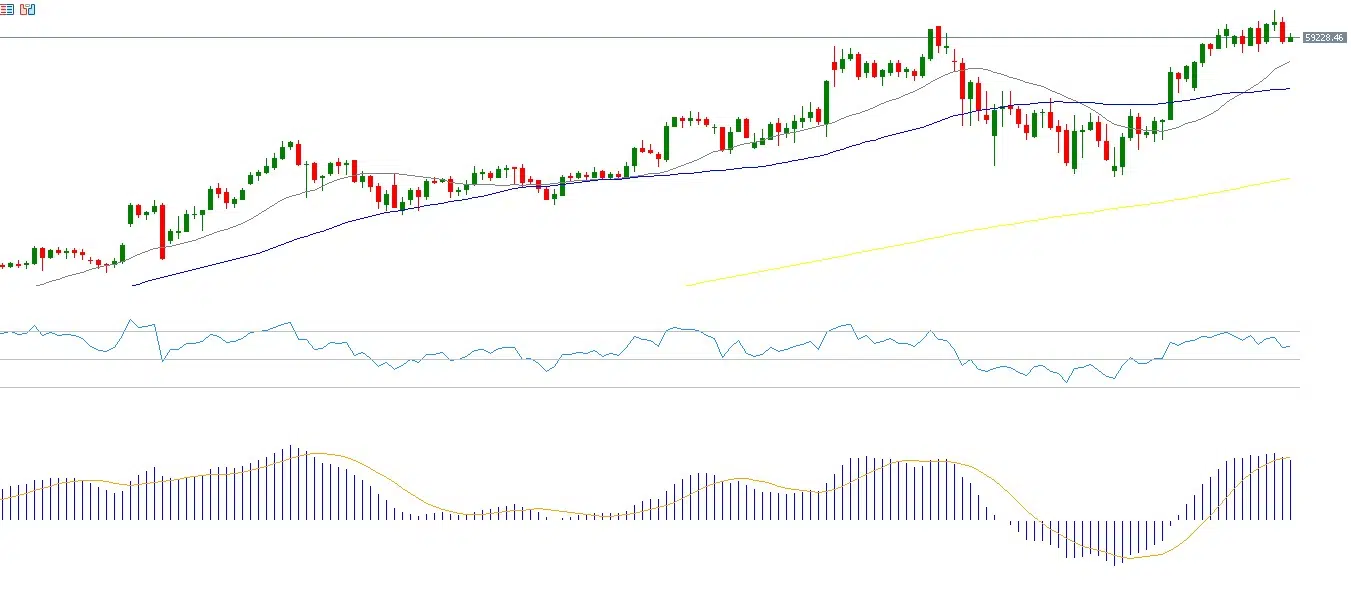
From a technical perspective, indicators suggest the possibility of continued gains in the Nikkei 225 for the following reasons:
A bullish (golden) crossover has occurred between the 20-day moving average and the 50-day moving average, which may signal the continuation of the upward trend in the coming period.
The Relative Strength Index (RSI) currently stands at 63, indicating bullish momentum in the index.
The MACD indicator also shows a bullish crossover between the MACD line and the signal line, reinforcing the positive momentum in the Nikkei 225 index.
Please note that this analysis is provided for informational purposes only and should not be considered as investment advice. All trading involves risk.