
About every six weeks, a small group in Washington, D.C., makes decisions that can quickly move USD currency pairs by hundreds of points. If you have ever seen your EUR/USD or USD/JPY trade jump or drop sharply on a Wednesday afternoon, the reason is often Federal Open Market Committee meetings.
But what exactly is the FOMC, and why does it have such a big impact on the Forex market?
In this article, we will explain what the committee does, why traders all over the world watch it closely, and how you can get ready for the market changes it can bring.
What Are FOMC Meetings and What Does the Federal Open Market Committee Do?
The FOMC, or Federal Open Market Committee, is a part of the U.S. Federal Reserve that sets monetary policy. You can think of it as the group that decides how expensive or cheap it is to borrow money in the United States.
According to the Federal Reserve, the committee has 12 voting members. This includes seven members of the Federal Reserve Board of Governors, the president of the Federal Reserve Bank of New York, who always has a vote, and four of the remaining eleven regional Reserve Bank presidents, who rotate each year.
All 12 regional presidents join the meetings and take part in discussions, but only the voting members make the final decisions. The current Chair is Jerome H. Powell, and the Vice Chair is John C. Williams from the New York Fed.
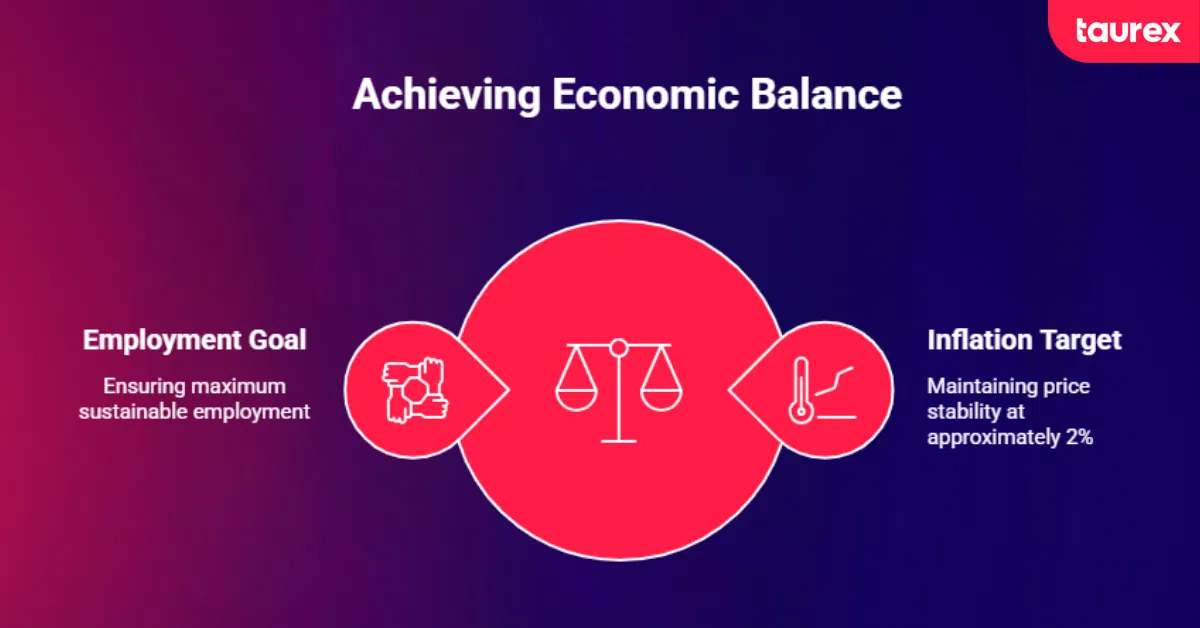
At its core, the FOMC operates under what is called a dual mandate. Its goal is to keep unemployment low and prices stable, aiming for around 2% inflation. The main tool it uses is the federal funds rate, which is the interest rate banks charge each other overnight. By changing this rate, the FOMC influences borrowing costs across the economy. As of the March 18, 2026, meeting, the federal funds rate was set between 3.50% and 3.75%.
The committee can also buy or sell U.S. Treasury securities to add or remove money from the economy. It publishes guidance about where it expects rates to go in the future. Four times a year, the FOMC releases the Summary of Economic Projections, or the “dot plot,” showing each member’s forecast for interest rates. These quarterly Federal Open Market Committee meetings often move the markets the most.
About three weeks after each meeting, the FOMC releases detailed minutes. Traders read these carefully because the discussion can give clues about what the committee might do next, often causing another wave of market reactions.
When is the FOMC Meeting?
Federal Open Market Committee meetings are held about every 6 weeks, usually on Tuesdays and Wednesdays. The exact dates are published well in advance on the Federal Reserve’s official calendar, allowing traders to mark them on their economic calendars and plan ahead for high-impact events.
While most meetings last two days, the market-moving announcements occur on the second day, when the FOMC releases its statement and any interest rate decisions. Four meetings each year also include the Summary of Economic Projections and the “dot plot,” which often lead to the largest reactions in USD currency pairs.
Traders should also keep an eye on the FOMC minutes, released about three weeks after each meeting, as they provide detailed insights into the committee’s discussions and can trigger additional market movements.
Why Are FOMC Meetings So Important For Forex Traders?
The U.S. dollar plays a central role in global finance. About 58% of official global reserves are held in dollars, according to the IMF’s 2024 data. This means nearly every major Forex pair either includes the dollar directly or is influenced by it. When the FOMC changes interest rates or hints at future moves, it sends ripples across the entire currency market.
Traders pay close attention to the FOMC’s tone. A “hawkish” stance means the committee is likely to raise rates or keep them high to fight inflation. A “dovish” stance means they may cut rates or keep them low to support jobs and growth.
FOMC Stances and Their Typical Market Effects
| Stance | Goal | Impact on USD | Impact on Gold |
| Hawkish | Fight Inflation (Higher Rates) | Usually Stronger | Usually Weaker |
| Dovish | Support Growth (Lower Rates) | Usually Weaker | Usually Stronger |
The market reacts not just to the decision itself, but also to the words in the statement. Even small changes, like swapping the word “patient” for “vigilant,” can move prices significantly.
The biggest market moves happen when the decision surprises expectations. Traders use tools like the CME FedWatch Tool to see the chances of rate changes before each meeting. If the FOMC acts differently than expected, the reaction can be fast and strong.
How big is the effect? Research from the Federal Reserve Bank of New York shows that the euro-dollar exchange rate is about 8 times more volatile on FOMC statement days. Even the Japanese yen, which is usually less affected, shows 4 times its normal movement. This kind of volatility brings both opportunities and risks, which is why preparation is so important for Forex traders.
How Do FOMC Meetings Impact USD Pairs?
When the FOMC raises interest rates, this is considered a hawkish move. Higher rates make dollar investments more attractive, so foreign investors buy dollars, increasing demand and strengthening the currency. When the FOMC cuts rates, a dovish move, dollar assets become less appealing. Money flows out, and the USD weakens.
The impact varies across different Forex currency pairs.
EUR/USD
This is the most traded currency pair in the world. It is very sensitive to the interest rate gap between the U.S. and the Eurozone. If the Fed is hawkish while the European Central Bank holds rates steady or cuts, EUR/USD tends to fall. For example, in late 2024, the Fed kept rates above 4% while the ECB paused its tightening. The widening gap helped push EUR/USD from 1.14 down to 1.05.
USD/JPY
The yen has had near-zero interest rates for years, making it a common funding currency for carry trades. When the Fed raises rates, the difference between dollar and yen yields grows, and USD/JPY usually climbs.
GBP/USD, AUD/USD, and USD/CAD
GBP/USD moves based on the difference between U.S. and UK rate expectations and overall market sentiment. AUD/USD is influenced by commodity prices and risk appetite, while USD/CAD follows both oil prices and the U.S.-Canada rate gap.
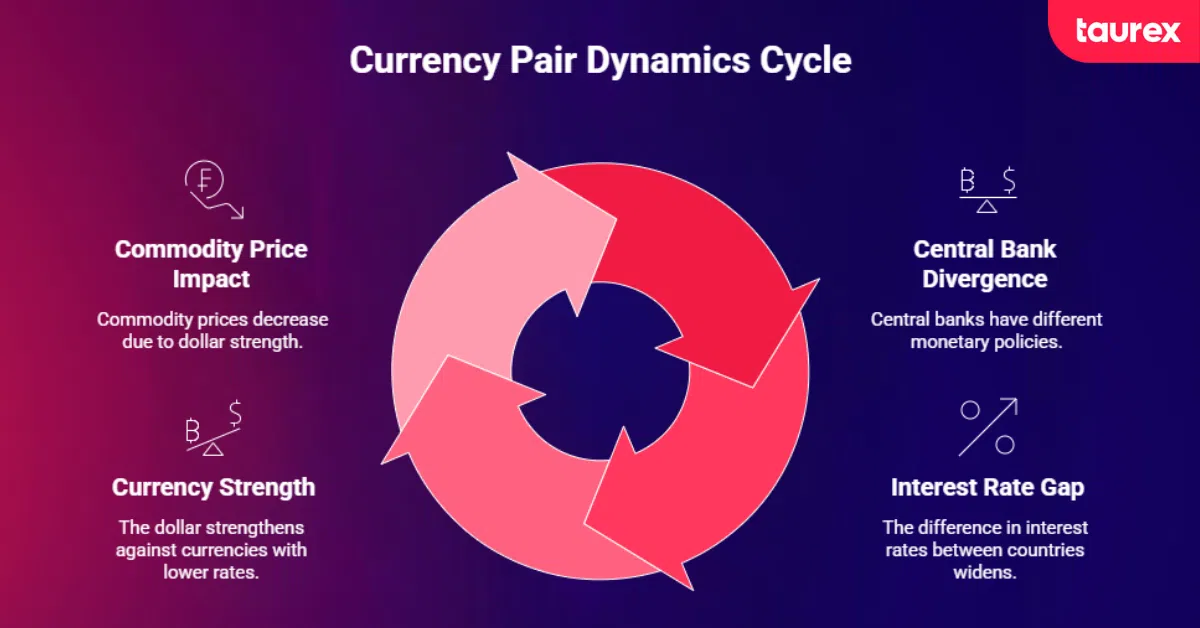
A key concept to remember is central bank divergence. It’s not just about what the Fed does, but how it acts compared to other central banks. If the Fed is raising rates while the Bank of Japan or the ECB is holding or cutting, the dollar tends to strengthen more against those currencies.
Beyond Currencies
FOMC decisions also affect commodities like gold and oil, which are priced in dollars. When the dollar strengthens, these commodities become more expensive for buyers using other currencies. This can reduce demand and push prices lower.
How to Prepare for FOMC Meetings: Risk Management and Trading Strategy
Preparation is what separates smart trading from reacting on impulse. Before any FOMC announcement, focus on 3 key areas.
Interest Rate Changes And Expectations
The CME FedWatch Tool is a popular resource for seeing what the market expects. It uses futures prices to estimate the chances of rate changes at upcoming meetings. For example, if the market expects rates to stay the same but the FOMC cuts them instead, that surprise can move USD pairs sharply.
At the four meetings that include the dot plot, pay attention to changes in the projected rate path. Even if rates stay steady, a shift in where members expect rates in six or twelve months can move the market just as much as an actual rate change. Between meetings, listen to Fed officials’ speeches, often called “Fedspeak,” for clues about their thinking.
Economic Indicators And Their Influence
The FOMC bases its decisions on a variety of economic indicators. Traders who follow the same data get a better sense of possible outcomes.
Important releases include inflation numbers like CPI and PCE (the Fed’s preferred gauge), jobs data such as Non-Farm Payrolls and the unemployment rate, and GDP growth. Strong inflation often points to a hawkish move, while weak jobs data may suggest a dovish approach.
It’s helpful to use an economic calendar to track data over the two to four weeks before a meeting. Remember, the Fed looks at trends, not single reports, so focus on the bigger picture.
Risk Management Around FOMC Events
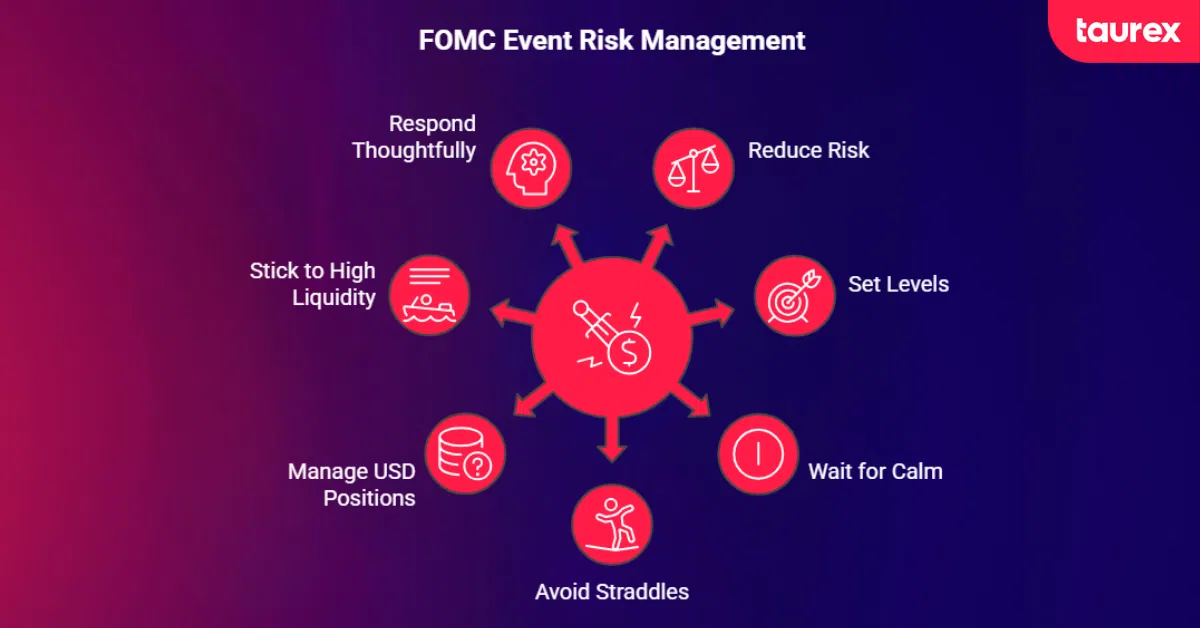
FOMC announcements can move prices 50 to 150 pips or more in just minutes. Spreads often widen, making trades riskier. If you usually risk 1% of your account per trade, consider lowering it to 0.5% or even 0.25% around these events.
Set your stop-loss and take-profit levels in advance. The first reaction at 2:00 PM Eastern Time, when the statement is released, is often fast and unpredictable.
Then comes an important second moment. At 2:30 PM Eastern Time, the Fed Chair begins the press conference. This is where a second wave of volatility often appears. Markets may reverse their initial move as the chair answers unscripted questions and gives more details about the decision.
Because of this, many traders choose to wait and let both reactions play out before entering a trade. Waiting 15 to 30 minutes after the press conference begins can help you avoid the most chaotic price action.
Be cautious with strategies like the “straddle,” where you place buy-stop and sell-stop orders on both sides of the current price. Early spikes can trigger both Forex orders and cause losses, so only attempt this if you are very experienced.
If you already hold USD positions, weigh the risk of the announcement against potential gains. Stick to high-liquidity pairs like EUR/USD or GBP/USD, which tend to handle volatility better. And remember, you don’t need to chase the initial move. Post-FOMC trends can develop over hours or even days, giving you time to respond thoughtfully.
If you’re ready to practice trading around FOMC events without risking real money, open a demo account at Taurex today and start building your strategy with live market conditions.
FAQ
What does FOMC stand for?
FOMC stands for Federal Open Market Committee. It is the branch of the U.S. Federal Reserve responsible for setting key interest rates and guiding U.S. monetary policy. Its decisions directly influence the U.S. dollar and global financial markets.
How often does the FOMC meet?
The FOMC holds eight scheduled meetings each year, usually every six weeks. Each meeting lasts two days, from Tuesday to Wednesday.
On Wednesday at 2:00 PM Eastern Time, the FOMC releases its interest rate decision and official statement. At 2:30 PM Eastern Time, the Fed Chair follows with a press conference, which often brings a second wave of market movement as new details and answers are shared. In times of major economic stress, the FOMC can also hold emergency meetings outside its regular schedule.
Why does the FOMC affect the US Dollar?
The FOMC sets the federal funds rate, which is the benchmark interest rate for the U.S. economy. When rates rise, the dollar becomes more attractive to global investors seeking higher yields, increasing demand and strengthening the currency. When rates fall, the opposite occurs.
How do FOMC meetings impact other currencies besides the USD?
FOMC decisions ripple across every major and emerging market currency. When the Fed hikes rates, it tends to pull capital away from other economies, and currencies like the EUR, GBP, JPY, and AUD often weaken against the dollar. Emerging market currencies can be especially vulnerable because much of their external debt is denominated in USD. Rising U.S. rates increase the cost of servicing that debt, which can trigger capital outflows and currency depreciation.
What is the best strategy for trading the FOMC?
There is no single “best” strategy, and what works depends on your experience level and risk tolerance. Some traders avoid entering new positions in the 15 to 30 minutes immediately after the announcement due to erratic price action. Others wait for the initial spike to settle before entering in the direction of the developing move.
Reducing position sizes, setting stop-loss orders in advance, and focusing on high-liquidity pairs like EUR/USD or USD/JPY for tighter spreads are all common approaches. Knowing market expectations beforehand, through tools like the CME FedWatch and by tracking how to read charts and technical analysis, is often the most valuable preparation you can do.
How much does the market typically move after an FOMC announcement?
It varies widely depending on whether the decision surprises the market. On a typical hold or expected decision, major USD pairs may move 20 to 50 pips. When there is an actual rate change or a significant shift in the Fed’s tone or dot plot, movements of 100 to 200+ pips within hours are not uncommon. EUR/USD volatility is at least eight times higher on FOMC statement days compared to non-event days, which gives a sense of just how concentrated the price action can be around these announcements.