Key Points
- Since fighting between the US and Iran resumed on 31 August, WTI has surged more than fifteen percent from its 79.80 dollar low while USD/JPY has broken decisively back above the psychological 160.00 level. Both moves have unfolded inside the same forty eight hour window, and on the overlay chart below the two lines are climbing almost in lockstep, which is not something we see nearly as often as you might expect.
- Japan imports well over ninety percent of its energy needs, so a sustained oil rally does not just move USD/JPY through the usual rate differential channel, it hits Japan’s trade balance directly and adds a second layer of yen weakness on top of an already dovish Bank of Japan. With the Fed and the BoJ both meeting later this month, this is a feedback loop VIP members should be watching closely.
Why Oil and the Yen Are Connected
Most traders think of USD/JPY purely through the lens of the interest rate differential between the Fed and the Bank of Japan, and most of the time that is the right lens to use. But there is a second, quieter driver that gets far less attention. Japan has almost no domestic oil or gas production and imports over ninety percent of its energy needs. When crude prices rise, Japan’s import bill rises with it, widening its trade deficit and adding structural pressure on the yen that has nothing to do with what the Fed or the BoJ say at their next meeting.
This dynamic usually stays in the background, because oil and USD/JPY do not typically move together on a day to day basis. Look at the earlier part of this year’s chart, from March through June, and the two lines are largely doing their own thing, oil grinding higher in fits and starts while USD/JPY chops in a wide range with no clear relationship between the two. That is the normal state of affairs. What has happened over the past fortnight is not normal.
The Overlay
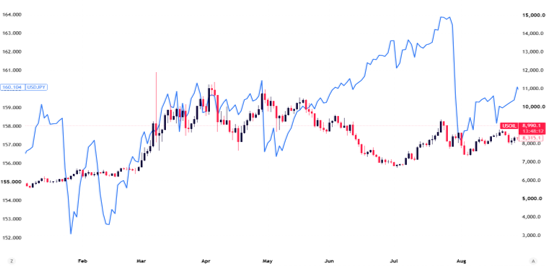
Chart: USD/JPY (blue line) vs WTI Crude Oil (candlesticks), Daily timeframe
Two Shocks, One Direction
The pause in US Iran hostilities that had held since the start of August broke down on 31 August, when US forces struck Iranian rocket launchers in the Strait of Hormuz and Iran retaliated against US bases in Jordan. Oil reacted immediately, rallying from a strong low of 79.80 dollars to a weak high near 92.00 dollars within days, before settling back to around 89.90 dollars as the initial spike is digested.
USD/JPY told almost exactly the same story over almost exactly the same window. The pair built a strong low at 158.00 on 20 August, then rallied in a clean sequence of breaks of structure through 158.80, 159.00, 159.20 and 159.40 before tagging a weak high of 160.20 on 29 and 30 August, the same days the Hormuz escalation was building. The pair is now consolidating just below that level at 160.10, holding the 160.00 breakout rather than reversing it.
What makes this worth your attention is not simply that both went up, it is that they went up for genuinely connected reasons at the same time. The Fed side of the USD/JPY move is well understood: Chair Warsh’s hawkish Jackson Hole comments have markets pricing a September hike and the dollar is broadly firm as a result. But the oil side of the equation is compounding that dollar strength specifically against the yen, because Tokyo is now paying more for every barrel it imports at the exact moment its own central bank remains anchored near zero. Two separate stories pushing through the same pressure point.
What This Means for Your Trading
As long as the Hormuz situation stays unresolved, oil carries a geopolitical risk premium that will keep leaking into USD/JPY through Japan’s terms of trade, layered on top of the standard rate differential trade. Retail sentiment data has shown USD/JPY positioning skewed short for most of the past month, which suggests this move has been squeezing a crowded short book as much as it has been driven by fresh longs, a dynamic that tends to extend moves further than the fundamentals alone would justify.
The level to watch on oil is a clean break and hold above 92.00, the current weak high. That would confirm the geopolitical premium is building rather than fading, and a continuation in oil through that level has historically coincided with further USD/JPY strength toward 160.20 and beyond. On the flip side, a break back below the 85.50 demand zone on oil would be the first sign the risk premium is unwinding, and I would expect USD/JPY to lose momentum in sympathy, particularly with the Fed’s September decision and the BoJ’s own meeting both landing before the month is out.
This is not a signal to trade oil off USD/JPY levels or vice versa. It is a reminder that the yen’s weakness right now is being reinforced by more than interest rate expectations, and traders who are only watching the Fed calendar are missing half of the picture.
Risk Warning: Trading financial instruments, particularly those involving leverage, involves a substantial degree of risk and is not appropriate for all investors. The value of your investments can rise or fall sharply, and it is possible to lose the entirety of your invested capital. Do not trade with funds you cannot afford to lose. Nothing in this site should be read or construed as constituting advice on the part of Taurex or any of its affiliates, directors, officers or employees.